Graph Paper Use Cases: Applications Across Industries
Graph paper is used wherever something has to stay in proportion or in line: plotting functions and measuring area in math class, drawing a room, a garden bed or a circuit to scale, charting cross stitch and knitting one square per stitch, mapping a dungeon, and keeping a habit tracker honest. In every one of those jobs the grid does the measuring for you, so you count squares instead of reaching for a ruler. This page walks through the uses one field at a time and tells you which grid, square size and paper to print for each.
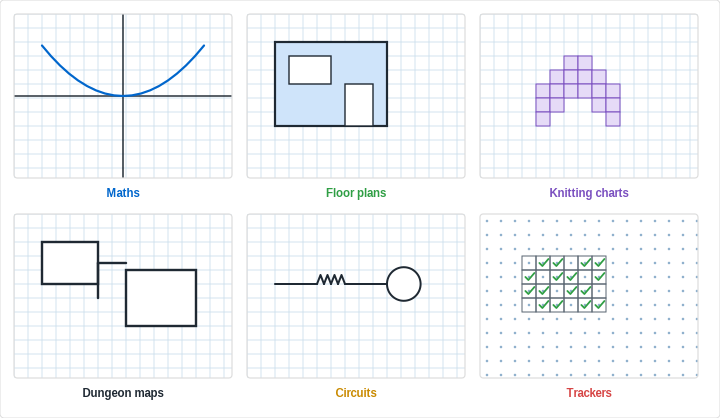
How Do You Use Graph Paper in Math and Science?
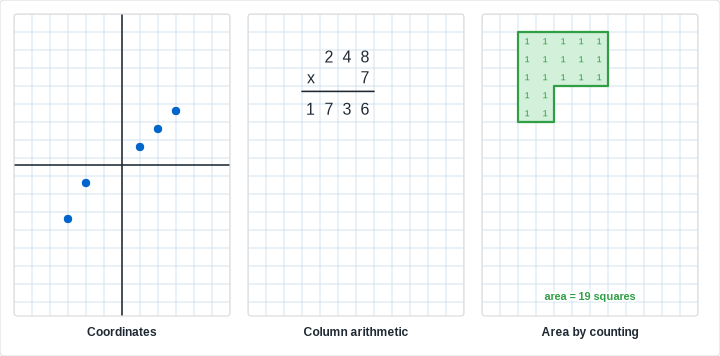
Mathematics Education
Elementary School Mathematics
- Number Concepts: Counting squares to understand quantity and develop number sense
- Basic Operations: Visual representations of addition, subtraction, multiplication, and division
- Skip Counting: Highlighting patterns in multiples using the grid structure
- Fractions: Dividing squares to understand parts of a whole
- Geometric Shapes: Drawing and counting sides of basic shapes
- Measurement: Introduction to length, area, and perimeter using grid squares as units
Recommended Grid: 1/4" or 5-6mm for clear visibility and easy counting
Middle School Mathematics
- Coordinate Plane: Plotting points, understanding quadrants, and graphing ordered pairs into a mystery picture
- Linear Equations: Graphing lines using slope-intercept form
- Functions: Visualizing relationships between variables
- Geometry: Drawing and analyzing shapes, calculating area and perimeter
- Transformations: Demonstrating translations, rotations, and reflections
- Data Analysis: Creating bar graphs, histograms, and scatter plots
- Proportional Relationships: Graphing proportions and understanding ratios visually
Recommended Grid: 1/5" or 5mm for balanced detail and clarity
High School Mathematics
- Advanced Algebra: Graphing polynomial, exponential, and logarithmic functions
- Trigonometry: Plotting sine, cosine, and tangent functions
- Precalculus: Analyzing complex functions and their transformations
- Calculus: Sketching derivatives, integrals, and limits
- Statistics: Creating normal distributions, box plots, and regression lines
- Vectors: Representing magnitude and direction on coordinate planes
Recommended Grid: 1/8" or 2-3mm for detailed plotting
College and University Mathematics
- Multivariable Calculus: Sketching 3D surfaces and contour plots
- Differential Equations: Phase portraits and solution curves
- Linear Algebra: Matrix visualizations and vector spaces
- Complex Analysis: Mapping complex functions
- Numerical Analysis: Plotting approximations and errors
Recommended Grid: 1/10" or 2mm for precision work
Science Education
- Physics: Plotting motion graphs (position, velocity, acceleration vs. time), force diagrams, and experimental data
- Chemistry: Titration curves, reaction rates, concentration graphs, and molecular structures
- Biology: Population growth curves, ecological data, enzyme kinetics, and cellular diagrams
- Earth Science: Weather patterns, geological profiles, and topographical representations
- Laboratory Work: Recording experimental observations and creating data visualizations
Recommended Grid: 1/8" to 1/10" (2-3mm) depending on data density
Other Educational Applications
- Geography: Map making, understanding scale, and plotting coordinates
- Economics: Supply and demand curves, economic models, and market analysis
- Psychology: Behavioral data plotting and experimental results
- Computer Science: Algorithm visualization, flowcharts, and grid-based game design
- Music: Rhythm notation, composition planning, and sound wave visualization
How Do Engineers and Architects Use Graph Paper?
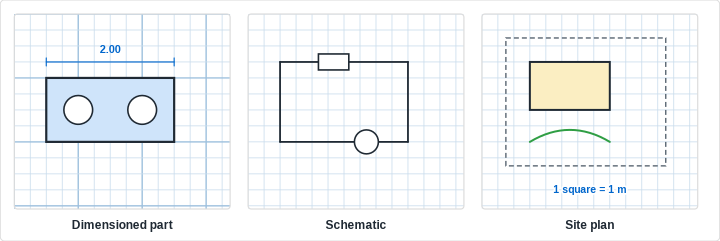
Engineering
Mechanical Engineering
- Part Design: Sketching machine components and assemblies
- Technical Drawings: Creating dimensioned drawings of parts and systems
- Mechanism Planning: Laying out linkages, gears, and moving parts
- Prototype Development: Quick sketches before CAD modeling
- Assembly Instructions: Step-by-step visual guides
- Tolerance Analysis: Visualizing dimensional relationships
Recommended Grid: 1/10" or 2mm for precision
Electrical and Electronics Engineering
- Circuit Design: Laying out component placement on breadboards and PCBs
- Schematic Diagrams: Planning before using CAD software
- Signal Flow: Visualizing data paths and connections
- Control Systems: Block diagrams and system architecture
- Wiring Diagrams: Planning cable routing and connections
- PCB Layout: Initial placement planning before electronic design automation
Recommended Grid: 1/10" or 2mm; sometimes 1mm for dense circuits
Civil Engineering
- Site Plans: Preliminary layout of buildings, roads, and infrastructure
- Surveying: Recording field measurements and creating site maps
- Drainage Design: Planning water flow and retention systems
- Roadway Design: Sketching intersections, curves, and alignments
- Structural Sketches: Quick beam and column layouts
Recommended Grid: Varies by scale; 1/4" for large-scale site plans, 1/10" for detailed drawings
Software Engineering
- System Architecture: Diagramming components and their relationships
- Database Design: Entity-relationship diagrams and schema planning
- User Interface Design: Grid-based wireframing and layout planning
- Algorithm Visualization: Flowcharts and decision trees
- Game Development: Level design, tile mapping, and sprite planning
- Network Topology: Planning server and network configurations
Recommended Grid: 1/8" to 1/5" (3-5mm) for flexibility
Architecture and Design
Architectural Design
- Floor Plans: Initial layout of rooms and spaces
- Elevations: Facade designs and vertical views
- Section Drawings: Visualizing interior vertical relationships
- Site Planning: Building placement and landscape design
- Concept Sketches: Quick ideas before detailed drafting
- Scale Drawings: Maintaining proportions using grid as reference
- Furniture Layout: Space planning and interior arrangement
Recommended Grid: 1/8" for concepts, 1/10" or 2mm for detailed plans
Interior Design
- Space Planning: Furniture arrangement and traffic flow
- Material Layouts: Tile patterns, flooring, and finishes
- Lighting Plans: Fixture placement and coverage
- Elevation Views: Wall treatments and built-in furniture
- Color Schemes: Grid-based color relationship planning
Recommended Grid: 1/8" to 1/4" depending on scale
Landscape Architecture
- Garden Design: Plant placement and bed layouts
- Hardscape Planning: Patios, walkways, and retaining walls
- Irrigation Systems: Sprinkler coverage and water management
- Topography: Grading plans and elevation changes
- Outdoor Spaces: Seating areas, fire pits, and recreational zones
Recommended Grid: 1/4" for large sites, 1/8" for detailed areas
Urban Planning and Geography
- City Planning: Zoning, transportation networks, and development patterns
- Map Making: Custom maps with accurate scale and detail
- Land Use Planning: Visualizing different zones and their relationships
- Transportation Planning: Transit routes, bike lanes, and pedestrian networks
- Demographic Analysis: Mapping population density and distribution
Can You Use Graph Paper for Drawing and Design?
Yes, and in several distinct ways: a square grid holds proportions while you enlarge a reference image or block out a comic page, an isometric grid draws an object in three dimensions without any perspective construction, and a dot grid gives you guides that vanish in a photograph of the finished piece. The step by step version is in the design sketching tutorial and the enlargement method is in the grid method article.
Drawing and Illustration
- Proportion Studies: Maintaining correct proportions in figure drawing
- Perspective Drawing: Using grid to establish vanishing points and perspective
- Character Design: Consistent character proportions across different poses
- Comic Panels: Laying out comic book pages and panel arrangements
- Storyboarding: Planning animation and film sequences
- Technical Illustration: Detailed product drawings and exploded views
- Pattern Design: Creating repeating patterns and tessellations
Recommended Grid: 1/4" for rough layouts, 1/8" for detailed work
Digital Art and Design
- Pixel Art: Grid represents individual pixels for retro-style artwork
- Sprite Design: Creating game characters and assets
- Icon Design: Grid-based icon systems for consistency
- UI/UX Design: Wireframing and layout grids for interfaces
- Grid Systems: Establishing design systems for digital products
- Typography: Letter form construction and font design
Recommended Grid: 1/8" to 1/10" (2-3mm) for pixel-level work
Fine Arts
- Grid Transfer Method: Accurately enlarging or reducing reference images
- Composition Planning: Rule of thirds and golden ratio applications
- Abstract Art: Geometric patterns and systematic art
- Collage Planning: Arranging elements before final assembly
- Mural Design: Scaling up designs for large wall paintings
- Printmaking: Planning multi-layer prints and registration
Graphic Design
- Logo Design: Geometric construction and proportion systems
- Layout Design: Magazine spreads, posters, and marketing materials
- Grid Systems: Establishing modular design frameworks
- Typography: Baseline grids and vertical rhythm
- Packaging Design: Dieline planning and label layouts
- Branding Systems: Consistent spacing and alignment rules
How Do Crafters Use Graph Paper?
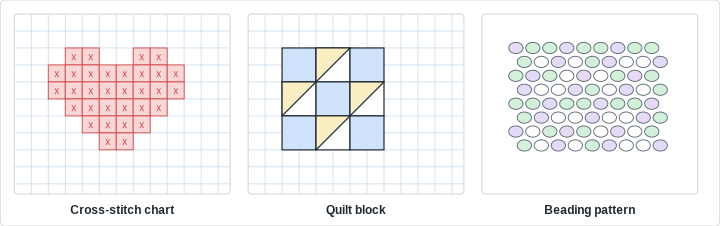
Needlework and Textile Arts
Cross-Stitch and Embroidery
- Pattern Design: Each square represents one cross-stitch
- Color Planning: Mapping out color changes and gradients
- Counting: Accurate stitch placement and spacing
- Custom Patterns: Creating personalized designs and text
- Sampling: Testing patterns before stitching
Recommended Grid: Match fabric count (typically 1/8" or 1/10")
Quilting
- Block Design: Planning quilt block patterns and layouts
- Fabric Calculation: Determining material requirements
- Quilt Layout: Arranging blocks before assembly
- Template Creation: Designing custom piecing templates
- Color Distribution: Planning color flow across the quilt
Recommended Grid: 1/4" or 1/8" depending on block size
Knitting and Crochet
- Colorwork Charts: Fair Isle and intarsia pattern planning
- Stitch Patterns: Designing cable and lace patterns
- Garment Shaping: Planning increases and decreases
- Size Adjustments: Scaling patterns for different sizes
Model Building
- Scale Modeling: Planning builds with accurate scale reference
- Scratch Building: Creating custom parts and structures
- Diorama Planning: Laying out scenes and landscapes
- Railroad Layouts: Track planning and scenery placement
- Architecture Models: Planning building components before construction
- Vehicle Modifications: Custom part design and modification planning
Recommended Grid: 1/10" or 2mm to match common model scales
Paper Crafts
- Card Making: Layout planning and element placement
- Scrapbooking: Page layouts and photo arrangements
- Origami Design: Crease pattern planning
- Paper Engineering: Pop-up card mechanisms
- Bookbinding: Signature planning and spine calculations
Jewelry and Beading
- Bead Patterns: Planning bead loom and peyote stitch designs
- Wire Work: Planning wire-wrapped jewelry components
- Layout Design: Arranging beads and components before stringing
- Symmetry: Ensuring balanced designs
Gaming and Recreation
- Board Game Design: Creating custom game boards and pieces
- Tabletop RPG Maps: Dungeon layouts and battle maps
- Chess Problems: Recording and sharing chess positions
- Puzzle Creation: Crosswords, Sudoku, and logic puzzles
- Strategy Planning: Tactical analysis and move planning
How Do You Use Graph Paper for Planning and Journaling?
Graph paper is at the center of a broader analog revival, as more people turn to screen-free, tactile tools for planning and creative work.
Bullet Journaling
- Layouts: Weekly and monthly spreads with clean lines
- Habit Trackers: Grid-based tracking systems
- Mood Trackers: Visual representations of emotions
- Collections: Organized lists and information pages
- Doodles and Art: Grid provides structure for creativity
- Goal Setting: Visual progress tracking
Recommended Grid: 5mm dot grid (standard bullet journal spacing)
Note-Taking
- Cornell Notes: Organized sections with clear divisions
- Mind Mapping: Structured brainstorming with spatial reference
- Lecture Notes: Organized information with diagrams
- Meeting Notes: Action items and organized thoughts
- Study Guides: Visual organization of information
Project Planning
- Gantt Charts: Timeline visualization for project management
- Flowcharts: Process mapping and decision trees
- Organizational Charts: Team structures and hierarchies
- Budget Planning: Financial tracking grids
- Meal Planning: Weekly menu grids
- Garden Planning: Bed layouts and crop rotation
Where Else Is Graph Paper Used?
Music and Audio
- Rhythm Notation: Beat patterns and drum programming
- Song Structure: Mapping out verse, chorus, and bridge arrangements
- Setlist Planning: Performance timing and flow
- MIDI Programming: Piano roll-style note arrangement
- Stage Plots: Band equipment layout and positioning
Photography and Videography
- Composition Grids: Rule of thirds and golden ratio overlays
- Storyboarding: Shot planning for video projects
- Lighting Diagrams: Planning light placement for shoots
- Set Design: Planning scene layouts and props
- Contact Sheets: Organizing and reviewing images
Agriculture and Horticulture
- Garden Layouts: Square foot gardening and bed planning — see our complete garden planning guide
- Crop Rotation: Planning seasonal plantings
- Orchard Planning: Tree spacing and layout
- Greenhouse Design: Bench and growing area layout
- Irrigation Planning: Water line and sprinkler placement
Fitness and Health
- Workout Planning: Exercise schedules and rep tracking
- Progress Tracking: Weight, measurements, and performance graphs
- Meal Prep: Nutrition planning and portion sizing
- Sleep Tracking: Pattern analysis and quality monitoring
- Rehabilitation: Physical therapy progress tracking
Business and Finance
- Financial Graphs: Revenue, expenses, and profit tracking
- Inventory Management: Stock level visualization
- Sales Forecasting: Trend analysis and projections
- Process Mapping: Business workflow optimization
- Market Analysis: Competitive positioning and trends
Which Grid Should You Print for Each Use?
Each use below has a grid that suits it. The links open the generator with that setting already chosen, so you can print the sheet and come back.
| Use | Grid | Print it |
|---|---|---|
| Math and coursework | Square lines, 0.25 in or 5 mm, Letter or A4 | Print a quarter inch grid |
| Engineering and drafting | Engineering grid, heavy line every tenth square | Print engineering paper |
| Room layouts and floor plans | Square lines, 0.25 in, one square per foot | Print a scale plan grid |
| Product and design sketching | Isometric for three dimensional views | Print isometric paper |
| Cross stitch and knitting charts | Square lines, fine, on the largest sheet you can print | Print a 3 mm chart grid |
| Bullet journals and planners | Dot grid, 5 mm, A5 or Half Letter | Print a dot grid page |
| Dungeon and battle maps | Square lines at 0.25 in, or hexagons for overland | Print hex paper |
| Lab data and rate plots | Semi-log or log-log, cycles to match the data | Print log paper |
General Best Practices
- Match Grid to Purpose: Fine grids for detail, large grids for quick work
- Test First: Print a sample before committing to large quantities
- Layer When Needed: Use different grid sizes for different project phases
- Go Digital When Appropriate: Scan completed work for digital archives
- Archive Originals: Keep paper copies of important work
The Bottom Line
Every use on this page comes down to the same trade: the grid keeps your work square, aligned and to scale, and in return you work in whole squares instead of measured distances. Decide what one square is going to mean before you draw anything, whether that is a foot, a stitch, a bead, half an hour or one unit on an axis, and the rest of the sheet follows from it.
For most of these jobs a quarter inch or 5 mm square grid on Letter or A4 is the right starting point. Switch style only when the subject asks for it: isometric for three dimensional views, dot grid for journaling, hexagons for overland maps, log scales for rate data. If you are unsure which square size to pick, the grid size guide settles it in a couple of paragraphs.
Print the Grid for Your Project
Start from a quarter inch square grid on Letter, then change the style, square size or paper to suit the job. Print it or download a PNG or SVG, with no sign-up.
Open the generatorRelated Resources
- Designing Board Games on Graph Paper
- Sketching Circuits on Graph Paper -- schematics and perfboard layout
- How to Make a Seating Chart -- classroom and event layouts to scale
- How to Choose the Right Grid Size
- What is Graph Paper? Complete Guide
- Professional Printing Tips
- Frequently Asked Questions
- All graph paper guides