Drawing Dungeon Maps on Graph Paper: A Guide for Tabletop RPG Players
Graph paper and tabletop RPGs go back to the very beginning. When Gary Gygax and Dave Arneson published the original Dungeons & Dragons rules in 1974, they assumed you had graph paper on the table. Fifty years later, with an estimated 50 million active tabletop RPG players worldwide, graph paper remains the fastest way to sketch a dungeon, run a combat encounter, or map an entire fantasy world. No software to learn, no subscription to pay, no screen between you and your players. Just pencil, paper, and imagination.
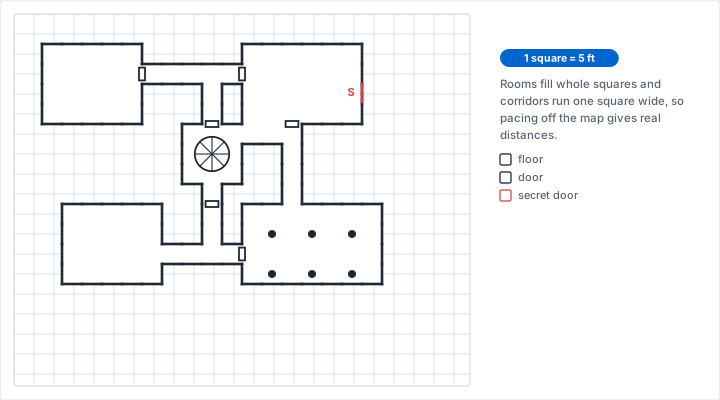
Why Graph Paper for RPG Maps
The single most important convention in tabletop RPG mapping is this: 1 square = 5 feet. That ratio, baked into D&D since its earliest editions and adopted by Pathfinder and many other systems, turns every sheet of graph paper into a ready-made dungeon canvas. You don't need to calculate scale or set up a coordinate system. The grid does it for you.
- Instant scale: A 20x30-foot room is 4 squares by 6 squares. A 10-foot-wide corridor is 2 squares. No math beyond counting.
- Movement tracking: Most characters move 30 feet per turn, which is exactly 6 squares. Count them off during combat and you always know who can reach what.
- No software required: You can draft a complete dungeon in the time it takes a VTT to load. There is no learning curve.
- Physicality during play: Passing a hand-drawn map across the table creates a moment that a screen share cannot replicate. Players lean in. They point. They argue about which corridor to take.
- Speed at the table: When a player asks "how wide is this hallway?" you glance at the grid and answer. No zooming, no panning, no layer toggles.
- Works anywhere: Game store, kitchen table, campsite. Graph paper needs no power outlet, no Wi-Fi, and no compatibility updates.
Digital vs. Paper: Not Either/Or
Virtual tabletops like Roll20 and Foundry are powerful tools, especially for remote play. But for in-person sessions, a hand-drawn map on graph paper often runs faster and keeps attention focused on the table rather than on screens. Many DMs use digital tools for prep and graph paper at the table.
Choosing Your Grid
Different grid types serve different mapping purposes. The right choice depends on what you're mapping and who will use it.
Standard Square Grid (1/4 inch) -- Dungeon Maps and Battle Maps
This is the workhorse of RPG mapping. At 1/4-inch spacing on US Letter paper, you get a grid roughly 32 squares wide by 40 squares tall. At 5 feet per square, that covers a dungeon area of 160 by 200 feet -- more than enough for most dungeon levels. Use this for:
- DM dungeon maps: Your behind-the-screen reference with room numbers, trap locations, and secret doors
- Player handout maps: Simplified versions you reveal as the party explores
- Quick encounter sketches: Rough battle layouts drawn during play
Larger Grid (1/2 inch) -- Miniature-Scale Battle Maps
If your group uses miniatures or tokens, you need a larger grid where each square can physically hold a figure. A 1/2-inch grid works for small tokens. A 1-inch grid is the standard for miniature play, matching the base size of most 25-28mm figures. Print these maps larger or tape multiple sheets together to cover the encounter area.
Hex Grid -- Overworld and Wilderness Maps
Hexagonal graph paper is the traditional choice for regional and wilderness maps. Hexes handle diagonal movement more naturally than squares and feel right for open terrain. The classic convention is 1 hex = 6 miles for regional maps or 1 hex = 24 miles for continental-scale maps. Use hex paper when mapping:
- Regional wilderness: The area around a town or between two cities
- Overland travel routes: Tracking the party's journey day by day
- Kingdom-scale maps: Political boundaries, terrain regions, trade routes
Engineering Grid -- Multi-Level Dungeon Complexes
Engineering graph paper features heavier lines at regular intervals (typically every 5 or 10 squares), creating a built-in "super grid." This is excellent for large, complex dungeon maps where you need to track sections, floors, or zones. The bold lines help you maintain orientation across a sprawling megadungeon and quickly reference specific areas.
Grid Size Quick Reference for RPG Mapping
- 1/4-inch squares: DM reference maps, dungeon drafting, session prep
- 1/2-inch squares: Small-token battle maps, player handouts
- 1-inch squares: Full miniature battle maps (standard for minis)
- Hex grid: Wilderness, overworld, and regional maps
Use the grid size guide for detailed sizing recommendations.
Drawing Your First Dungeon Map
A dungeon map is a floor plan. You are drawing rooms, corridors, and the connections between them. Start simple. You can always add detail later.
Step 1: Establish Your Scale and Entrance
Write "1 square = 5 feet" in the top margin. Then mark the dungeon entrance near one edge of the paper. The entrance anchors the entire map and gives you a starting reference point. Draw a short corridor (2 squares wide, or 10 feet -- the standard corridor width in most RPGs) leading from the entrance into the first room.
Step 2: Draw Rooms
Rooms are rectangles, but they don't have to be perfect. Vary the sizes. A guard room might be 4x4 squares (20x20 feet). A great hall could be 10x6 squares (50x30 feet). An intimate shrine might be 3x3 squares (15x15 feet). Draw the walls by tracing the grid lines with a heavier line or a different color than the grid itself.
- Small rooms: 3x3 to 4x4 squares (15x15 to 20x20 feet) -- closets, cells, guard posts
- Medium rooms: 4x6 to 6x8 squares (20x30 to 30x40 feet) -- barracks, dining halls, workshops
- Large rooms: 8x10 squares and up (40x50+ feet) -- throne rooms, caverns, temples
Step 3: Connect with Corridors
Standard dungeon corridors are 10 feet wide (2 squares). This allows two characters to walk abreast and is wide enough for most combat formations. For variety, include some 5-foot-wide passages (1 square) that force single-file movement, or wider 15-foot halls (3 squares) in grander sections of the dungeon.
Step 4: Add Doors
Doors control access and create tactical choices during play. Mark them with standard symbols (covered in detail below):
- Regular door: A short line across the doorway, perpendicular to the wall
- Open door: A quarter-circle arc showing the swing direction
- Secret door: An "S" on the wall where the door is hidden
- Locked door: A small dot or circle on the door line
Step 5: Add Features
Now populate the rooms. Mark stairs, traps, pillars, furniture, water features, and anything else the players might interact with. Keep symbols simple and consistent. You are drawing a functional reference, not an illustration.
Step 6: Number Each Room
Place a circled number inside each room. Start with 1 at the entrance and number sequentially as you move deeper into the dungeon. This numbering system links your map to a room key -- a separate list (in the margin or on another sheet) where you describe what is in each room: monsters, treasure, traps, lore, and environmental details.
Step 7: Create the Room Key
The room key is where most of your prep lives. For each numbered room, write:
- Room name or description: "Guard Room," "Flooded Chamber," "Alchemist's Lab"
- Inhabitants: What creatures are here and what they are doing
- Features: Notable objects, furniture, environmental hazards
- Treasure: What the players can find if they search
- Connections: Where each exit leads (by room number)
Pencil First
Always draft in pencil. You will change room sizes, reroute corridors, and rethink layouts as the dungeon takes shape. Once you are satisfied with the design, go over the final lines in ink or fine-tip marker. The pencil grid lines underneath will still show through and serve as your scale reference.
Map Symbols and Conventions
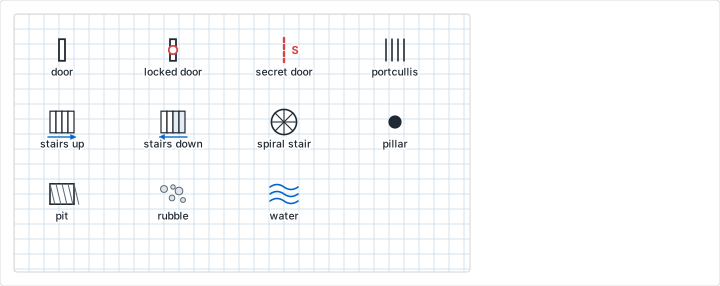
Consistent symbols make your map readable at a glance, both for you during the session and for anyone else who picks it up. These conventions have been standard in RPG mapping since the 1970s.
Doors
- Single door: A short perpendicular line across the opening in the wall
- Double door: Two short parallel lines across the opening
- Secret door: The letter "S" centered on the wall section that conceals the door
- Locked door: A door line with a filled circle (dot) on it
- Portcullis: A series of short vertical lines across the passage (resembling the gate's bars)
- One-way door: A door line with an arrow pointing in the direction it opens
Stairs and Elevation
- Stairs up: Parallel lines across the stairway with an arrow pointing up (or the letter "U")
- Stairs down: Parallel lines across the stairway with an arrow pointing down (or the letter "D")
- Ladder: Two vertical lines with rungs (horizontal dashes between them)
- Pit: An "X" inside the square, or cross-hatching across the pit area
- Elevated platform: A raised area outlined with a double line on the higher edge
Hazards and Traps
- Trap: The letter "T" in the affected square (only on the DM's map, not the player's copy)
- Pit trap: A dashed-line square with an "X" inside
- Pressure plate: A small square within the grid square
- Poison gas: A small cloud symbol or the letter "G"
Water and Terrain
- Water (shallow): Wavy horizontal lines filling the water area
- Water (deep): Dense wavy lines or solid fill with wavy border
- Rough/rubble terrain: Small dots or pebble shapes scattered in the area
- Chasm or cliff edge: A thick line with short perpendicular hatch marks on the drop side
Furniture and Objects
- Table: A simple rectangle (1x2 squares for a long table)
- Chest: A small square with a line across the top (the lid)
- Altar: A rectangle with a cross or symbol on top
- Throne: A rectangle against a wall with a semicircle back
- Pillar/column: A filled circle (solid dot) in the square
- Statue: A circle with a letter or symbol inside
- Fireplace/hearth: A rectangle against a wall with flame-like marks
Make Your Own Symbol Key
There is no single official standard for dungeon map symbols. What matters is consistency. Pick symbols that make sense to you, draw a legend in the corner of your map, and use the same symbols across all your dungeon levels. Your future self will thank you when you pick up the map six months later.
Battle Maps vs. Dungeon Maps
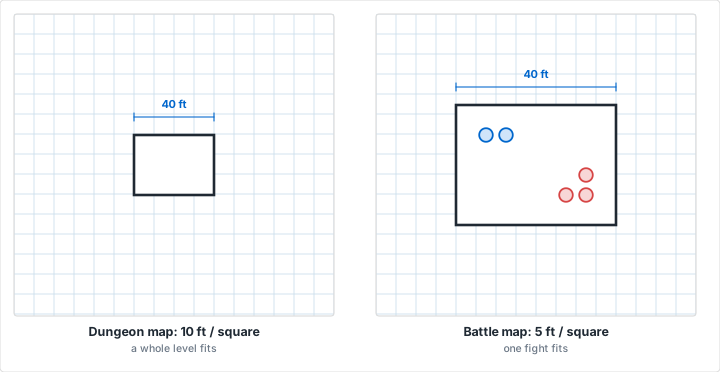
These serve different purposes and are drawn at different scales. Understanding the distinction will save you prep time and improve your sessions.
Dungeon Maps (DM Reference)
- Purpose: Your behind-the-screen reference for the entire dungeon level
- Scale: 1/4-inch squares, 1 square = 5 feet
- Detail level: Room numbers, door symbols, trap locations, secret passages, compass direction
- Audience: The DM only -- players should not see this
- Coverage: An entire dungeon level on one sheet
Battle Maps (Player-Facing)
- Purpose: A zoomed-in view of a single room or encounter area for tactical combat
- Scale: 1/2-inch to 1-inch squares, 1 square = 5 feet
- Detail level: Terrain features that affect combat (cover, difficult terrain, elevation), furniture, visible exits
- Audience: The entire table -- this is what players see and interact with
- Coverage: One room or encounter area per sheet
Making Both from the Same Base
Draft your dungeon on 1/4-inch graph paper first. When you identify rooms likely to host combat encounters, redraw just those rooms on larger-grid paper (1/2-inch or 1-inch). Add terrain details relevant to the fight: a pillar that provides half cover, a table that can be flipped for a barricade, a pit in the center of the room. Keep a stack of blank battle map sheets ready for improvised encounters.
Reusable Battle Maps
Print a stack of blank 1-inch grid sheets and keep them at the table. When combat breaks out in an unplanned location, grab a blank sheet and sketch the room in under a minute. The grid does the heavy lifting -- you just need walls and a few features. Many DMs find this faster than scrolling through a VTT map library.
Overworld and Wilderness Maps
When the party leaves the dungeon and travels across the world, you need a different kind of map. Hexagonal graph paper has been the standard for RPG overworld mapping since the original D&D Wilderness Adventures supplement in 1974.
Why Hexes for Wilderness
Hexagons solve the diagonal distance problem. On a square grid, moving diagonally covers more ground than moving orthogonally, which distorts travel distances. Every hex is equidistant from its six neighbors, so travel in any direction covers the same distance. This matters when you are tracking days of travel across a wilderness.
Scale Conventions
- 1 hex = 6 miles: The classic D&D scale. A party on foot covers about 3-4 hexes per day on roads, 2 hexes cross-country. This is the most common scale for regional maps.
- 1 hex = 1 mile: Detailed local area map. Good for the immediate surroundings of a town or adventure site.
- 1 hex = 24 miles: Continental-scale maps showing entire kingdoms and trade routes.
Terrain Types
Fill or mark each hex with a terrain type. Use simple symbols or color coding:
- Forest: Small tree symbols (inverted Y shapes) or green fill
- Mountains: Small triangle peaks or brown fill
- Plains/grassland: Leave empty or use a light dot pattern
- Desert: Dotted pattern or yellow fill
- Swamp: Wavy lines with scattered dots
- Water (ocean/lake): Wavy lines or blue fill
- Hills: Small curved humps or light brown fill
What to Place on the Map
- Settlements: A dot for villages, a circle for towns, a double circle for cities
- Roads: Solid lines connecting settlements
- Trails: Dashed lines for less-traveled paths
- Rivers: Wavy lines flowing from highlands to the sea
- Dungeon entrances: A small square or triangle marking adventure sites
- Landmarks: Named features like mountain peaks, bridges, ruins
Multi-Level Dungeons
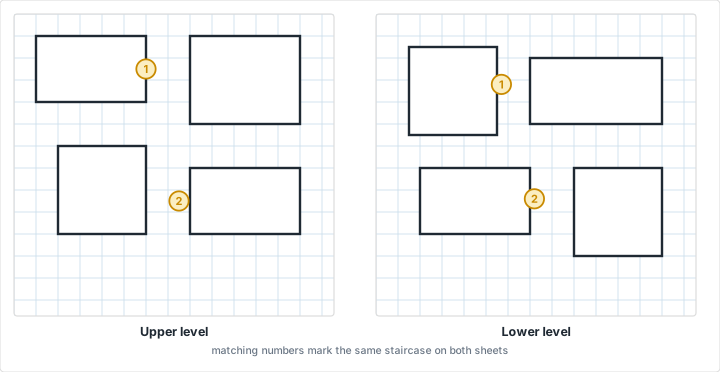
Most memorable dungeons have multiple floors. A kobold warren might have two levels. A dwarven stronghold might have ten. Managing the connections between levels is the key challenge of multi-level dungeon design.
One Sheet Per Level
Use a separate sheet of graph paper for each dungeon level. Label each sheet clearly: "Level 1 - Entry Caves," "Level 2 - Catacombs," and so on. Keep all sheets together in a folder or binder so you can flip between them during play.
Connecting the Levels
- Match stair locations: When you draw stairs going down on Level 1, mark the exact same grid position on Level 2 as stairs going up. Use the same grid coordinates (count squares from the top-left corner) to ensure alignment.
- Label connections: Next to each stairway, write where it goes: "Down to Level 2, Room 7" or "Up to Level 1, Room 3." Do this on both maps.
- Use consistent numbering: Number rooms sequentially within each level. Prefix with the level number for clarity: Room 1-1, 1-2, 1-3 on Level 1; Room 2-1, 2-2, 2-3 on Level 2.
- Mark shafts and pits: Vertical connections like elevator shafts, open pits, or chimneys should be drawn in the same grid position on every level they pass through.
Vertical Cross-Section
For complex multi-level dungeons, draw a side-view cross-section showing how the levels stack vertically. This doesn't need to be detailed -- just rectangles representing each level with lines showing stairways, shafts, and ramps connecting them. This overview helps you (and your players, if you choose to share it) understand the three-dimensional structure of the dungeon.
Alignment Trick
Print your graph paper with a grid that matches exactly across sheets. Before drawing Level 2, place it under Level 1 and hold both up to a light source. You can trace the stair locations from Level 1 directly onto Level 2 to ensure perfect alignment. This also helps you avoid accidentally placing a room on Level 2 directly under a chasm on Level 1 (unless that is intentional).
Tips for Better RPG Maps
- Draft in pencil, finalize in ink: You will change your mind about room sizes and corridor routes. Pencil lets you erase and revise. Once the layout is locked in, trace over it with a fine-tip pen or marker.
- Vary room shapes and sizes: A dungeon full of 20x20-foot square rooms feels artificial. Mix rectangles, L-shapes, irregular caverns, and rooms with alcoves. Let some walls follow the grid at angles by cutting corners diagonally.
- Avoid perfect symmetry: Real places aren't symmetrical. A lopsided guard room with a cramped storage alcove feels more believable than a perfectly mirrored layout. Symmetry also makes the map less interesting to explore because players can predict what is around the next corner.
- Think about purpose: Before drawing a room, ask what it is for. A kitchen needs a hearth and worktables. A barracks needs beds. A temple needs an altar and pews. The purpose drives the shape, size, and contents.
- Leave margins for notes: Don't fill the entire sheet with dungeon. Reserve the borders for your room key, encounter notes, wandering monster tables, and other reference material you need during play.
- Use elevation: Dungeons don't have to be flat. Add raised platforms, sunken pools, balconies overlooking lower rooms, and natural cave formations with uneven floors. Mark elevation changes clearly so you can communicate them to players during combat.
- Include empty rooms: Not every room needs a monster or treasure. Empty rooms create tension, provide resting spots, and make the dungeon feel like a real place rather than a sequence of encounters.
- Consider traffic flow: Think about how the dungeon's inhabitants move through the space. Where do guards patrol? How do they get to the kitchen? Where do they flee when attacked? This logic makes the dungeon's layout feel plausible.
Common Mistakes
Making All Rooms the Same Size
A dungeon where every room is a 20x20-foot square is boring to explore and boring to fight in. Vary your rooms from cramped 10x15-foot closets to sprawling 50x60-foot caverns. Different room sizes create different tactical situations in combat and different moods during exploration.
Forgetting That Door Swing Direction Matters
In combat, which way a door opens can determine who has advantage. A door that opens toward the party gives them cover as they push it open. A door that opens away means enemies on the other side can brace it shut. Mark the swing direction with a quarter-circle arc on your map. Players and monsters will both exploit this during play.
No Room Numbering System
Without room numbers, you end up flipping back and forth trying to remember which room has the goblin chief and which one has the trapped chest. Number every room and reference those numbers in your notes. It takes thirty seconds during prep and saves minutes of fumbling at the table.
Corridors Too Narrow for the Party
A 5-foot-wide corridor (1 square) means only one character can stand abreast. That is fine for a chokepoint, but if every corridor is 5 feet wide, combat becomes a tedious conga line where only the front character can attack. Use 10-foot corridors (2 squares) as your default and reserve narrow passages for deliberate tactical situations.
Mapping the Entire World Before Session One
You don't need a finished map to start playing. Draw the first dungeon level and the immediate area around the entrance. Expand the map as the campaign demands. Prepping only what you need for the next session keeps your workload manageable and leaves room to adapt the world to your players' choices.
Conclusion
Graph paper is the original game master's tool, and nothing has replaced it for speed, simplicity, and tactile engagement at the table. A pencil and a sheet of gridded paper let you build a dungeon in minutes, run combat with clear spatial reference, and hand your players a physical artifact of the adventure they just survived. Whether you are drawing your first five-room dungeon or your fiftieth multi-level megadungeon, the grid gives you structure and the blank squares give you freedom.
Print a stack of graph paper, sharpen a pencil, and start mapping. Your players are waiting.
Ready to Map Your Dungeon?
Generate custom graph paper in the exact grid size you need -- 1/4-inch for DM reference maps, 1/2-inch for quick battle maps, or hex grid for wilderness exploration. Print as many sheets as your campaign demands.
Create Graph Paper NowRelated Resources
- Hexagonal Graph Paper -- The standard for RPG overworld and wilderness maps
- Engineering Graph Paper -- Heavy ruling lines for complex multi-level dungeons
- How to Choose the Right Grid Size
- Graph Paper Use Cases Across Industries
- Design Sketching on Graph Paper
- Professional Printing Tips
- Designing Board Games on Graph Paper
- Designing Video Game Levels and Maps on Graph Paper
- Designing and Solving Grid Puzzles on Graph Paper