What is Graph Paper?
A comprehensive guide to graph paper, grid paper, and coordinate paper - their types, uses, and applications
Print any of the eight grid types
Each one opens the generator with that grid already selected. Set the square size and paper size, then print it or download a PNG or SVG.
- Square gridThe standard grid, any square size
- Dot gridDots at the corners, no lines
- Engineering 5x5Heavy line every 5 squares
- Engineering 10x10Heavy line every 10 squares
- Isometric30 degree triangular grid for 3D
- HexagonalTessellating hexagons, optional numbers
- PolarRings and radials for angles
- LogarithmicSemi-log and log-log, 1 to 6 cycles
Introduction to Graph Paper
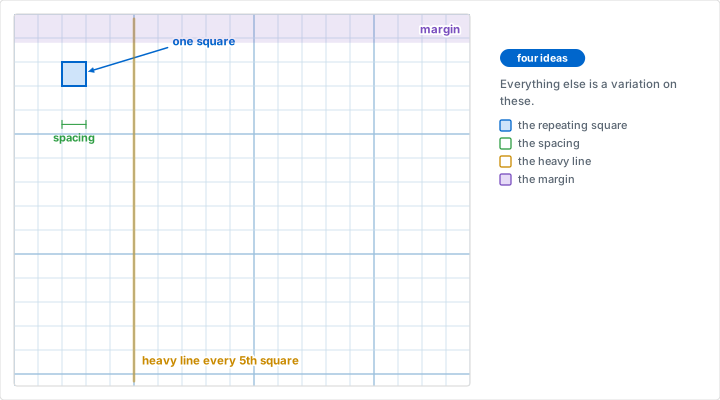
Graph paper, also known as grid paper, coordinate paper, or squared paper, is writing paper printed with fine lines arranged in a regular grid pattern. These evenly-spaced horizontal and vertical lines create squares or rectangles that serve as guides for drawing, plotting, measuring, and organizing information.
Key Characteristics
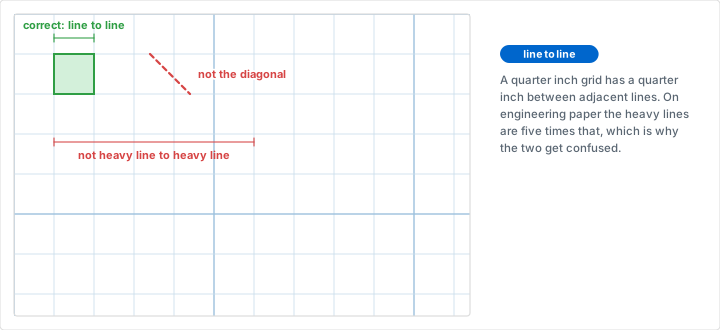
Graph paper is defined by several key characteristics:
Grid Spacing
The distance between grid lines, typically measured in:
- Imperial units: 1/4 inch (0.25"), 1/5 inch (0.2"), 1/8 inch (0.125"), 1/10 inch (0.1")
- Metric units: 5mm, 2mm, 1mm, or 0.5mm
Line Style
Graph paper can feature different line styles:
- Solid lines: Traditional continuous grid lines
- Dots: Modern style with dots at grid intersections only
- Faint lines: Lighter lines that don't overpower written content
- Bold/light combination: Heavier lines at major intervals (often every 5th line)
Paper Size
Available in standard paper sizes:
- US sizes: Letter (8.5" × 11"), Legal (8.5" × 14"), Tabloid (11" × 17")
- ISO A series: A4 (210 × 297mm), A3, A5
- Custom sizes: Any dimensions as needed
Common Types of Graph Paper
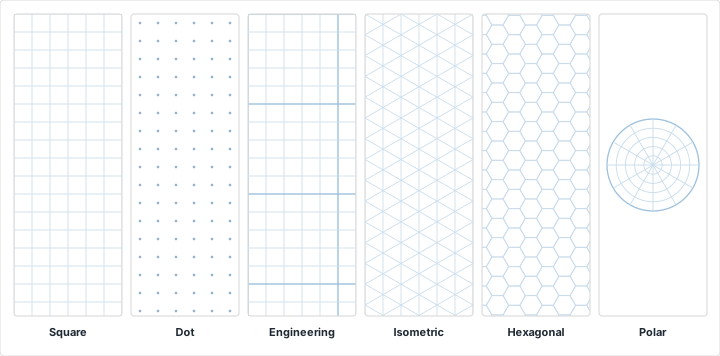
1. Standard Grid Paper (Cartesian)
The most common type, featuring evenly-spaced horizontal and vertical lines creating perfect squares. Ideal for:
- Plotting mathematical functions
- Creating charts and graphs
- Technical drawing
- Game design and mapping
2. Engineering Graph Paper
Features a green or light blue grid, often with heavier lines every 5 or 10 squares. Used for:
- Engineering drawings and schematics
- Circuit diagrams
- Mechanical design
- Technical illustrations
3. Dot Grid Paper
Modern alternative featuring dots at grid intersections instead of continuous lines. Popular for:
- Bullet journaling
- Note-taking
- Sketching and design
- Creative writing
4. Isometric Graph Paper
Features a grid of equilateral triangles at 60-degree angles. Perfect for:
- 3D technical drawings
- Isometric illustrations
- Engineering projections
- Architectural sketches
5. Polar Coordinate Paper
Circular grid with concentric circles and radial lines. Used for:
- Plotting polar equations
- Circular patterns and designs
- Antenna radiation patterns
- Mathematical analysis
6. Hexagonal Graph Paper
Uses a tessellating hexagonal grid instead of squares. Popular for:
- Tabletop gaming maps and battle grids
- Organic chemistry molecular structures
- Tessellation and geometric art
- Game design and world building
7. Logarithmic Graph Paper
Features logarithmically-scaled axes for plotting exponential data. Applications include:
- Scientific data analysis
- Engineering calculations
- Frequency response curves
- Statistical analysis
Primary Uses and Applications
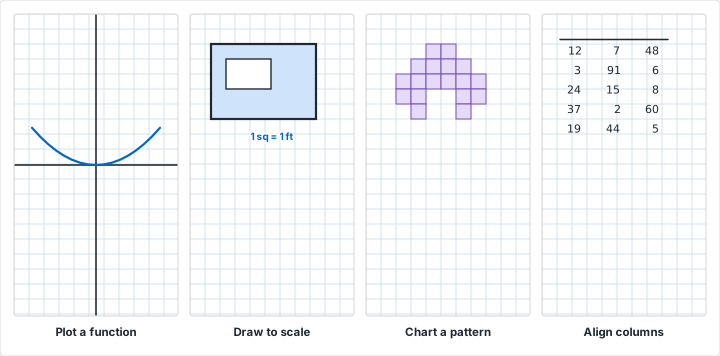
Mathematics Education
Graph paper is fundamental in mathematics education:
- Function plotting: Visualizing linear, quadratic, and other mathematical functions
- Coordinate geometry: Working with Cartesian coordinates and transformations
- Graphing practice: Teaching students to plot points and interpret graphs
- Geometry: Drawing precise shapes, measuring angles, and understanding spatial relationships
- Data visualization: Creating bar charts, histograms, and scatter plots
Engineering and Technical Fields
Engineers rely on graph paper for precision work:
- Circuit design: Creating electrical schematics and circuit diagrams
- Mechanical drawings: Designing parts, assemblies, and mechanisms
- Prototyping: Sketching initial design concepts
- Scale drawings: Creating accurate representations at different scales
- Documentation: Recording measurements and specifications
Architecture and Design
Architects and designers use graph paper for:
- Floor plans: Laying out room dimensions and furniture placement
- Elevations: Drawing building facades and cross-sections
- Landscape design: Planning gardens and outdoor spaces
- Interior design: Space planning and furniture arrangement
- Concept sketches: Quickly visualizing design ideas
Art and Creative Work
Artists utilize graph paper for various purposes:
- Pixel art: Creating digital-style artwork on paper
- Cross-stitch patterns: Designing embroidery and needlework
- Pattern design: Creating repeating motifs and tessellations
- Comic layouts: Planning panel arrangements and compositions
- Typography: Designing lettering with precise proportions
Personal Organization
Modern uses in productivity and organization:
- Bullet journaling: Creating spreads, trackers, and layouts
- Note-taking: Organizing information with visual structure
- Planners: Designing custom planning pages
- Habit tracking: Creating visual progress charts
- Mind mapping: Structuring ideas and concepts
Gaming
Graph paper has long been used in tabletop gaming:
- Dungeon maps: Creating layouts for role-playing games
- Battle grids: Tracking character and enemy positions
- World building: Designing game worlds and landscapes
- Puzzle design: Creating logic and spatial puzzles
Benefits of Using Graph Paper
Precision and Accuracy
The regular grid enables:
- Precise measurements and scaling
- Accurate proportions in drawings
- Consistent spacing and alignment
- Easy replication of dimensions
Visual Organization
The grid structure provides:
- Clear visual framework for organizing information
- Built-in guides for straight lines and right angles
- Consistent reference points
- Reduced need for rulers and guides
Mathematical Understanding
Using graph paper helps students:
- Visualize abstract mathematical concepts
- Understand coordinate systems intuitively
- See relationships between equations and graphs
- Develop spatial reasoning skills
Professional Communication
Graph paper facilitates:
- Clear technical communication
- Standardized documentation
- Easy interpretation by others
- Professional-looking sketches and diagrams
Choosing the Right Graph Paper
Consider Grid Size
Select grid spacing based on your needs:
- Large squares (1/2" or 10mm): Young children, simple sketches
- Medium squares (1/4" or 5mm): Most common, general purpose
- Small squares (1/8" or 2mm): Detailed work, engineering
- Tiny squares (1/10" or 1mm): Precision work, technical drawings
Consider Paper Size
Match paper size to your project (see our complete paper sizes guide):
- Letter/A4: Standard for most applications
- Legal: Extra length for longer graphs or lists
- Tabloid/A3: Large-scale drawings and presentations
- Smaller sizes: Portable notebooks and quick sketches
Consider Line Style
Choose based on use:
- Standard lines: Technical work, mathematics
- Dots: Note-taking, creative work, minimal distraction
- Faint lines: Background structure without overwhelming content
- Heavy/light lines: Easy counting and major divisions
Digital vs. Physical Graph Paper
Physical Graph Paper Advantages
- Tactile experience and muscle memory
- No battery or device required
- Easy to annotate and markup
- Better for brainstorming and quick sketches
- No learning curve or software needed
Digital Graph Paper Advantages
- Unlimited customization options
- Easy to generate exact specifications
- No waste - print only what you need
- Instant availability
- Cost-effective for occasional use
History of Graph Paper
Graph paper has a rich history dating back centuries:
- Early origins: Coordinate systems used by ancient mathematicians
- 17th century: René Descartes developed Cartesian coordinates, establishing the foundation for modern graph paper
- 19th century: Graph paper became commercially available as mathematics and engineering expanded
- 20th century: Standardization of grid sizes and paper formats
- Digital age: Online generators and printable templates made custom graph paper accessible to everyone
Modern Evolution
Graph paper continues to evolve:
- Custom generation: Online tools like Graph Paper Generator allow unlimited customization
- Specialized formats: New grid types developed for specific applications
- Digital integration: Hybrid approaches combining paper and digital workflows
- Analog revival: Growing demand for screen-free, tactile planning tools as people seek alternatives to digital overload
- Eco-friendly options: Reusable and sustainable alternatives
- Accessibility: Designs adapted for various learning needs and abilities
Get Started with Graph Paper
Ready to use graph paper for your projects? Our free graph paper generator lets you create custom graph paper instantly.
- Choose your preferred grid size and spacing
- Select from standard or custom paper sizes
- Pick between lines or dots
- Adjust margins and layout
- Print unlimited copies for free