Designing Cross-Stitch and Knitting Patterns on Graph Paper
Every cross-stitch pattern is a grid. Every knitting colorwork chart is a grid. Graph paper is the original pattern design tool for fiber arts, and it remains the most accessible way to create custom designs without specialized software. The global fiber arts market exceeded $10 billion in 2025, with 58% of demand driven by younger crafters drawn to DIY culture and sustainability. Whether you are designing your first cross-stitch sampler or charting a Fair Isle sweater, graph paper gives you a direct, tactile method to turn an idea into stitches.
Why Graph Paper for Fiber Arts
Fiber arts pattern software exists, and some of it is excellent. But graph paper has advantages that no app can match for many crafters:
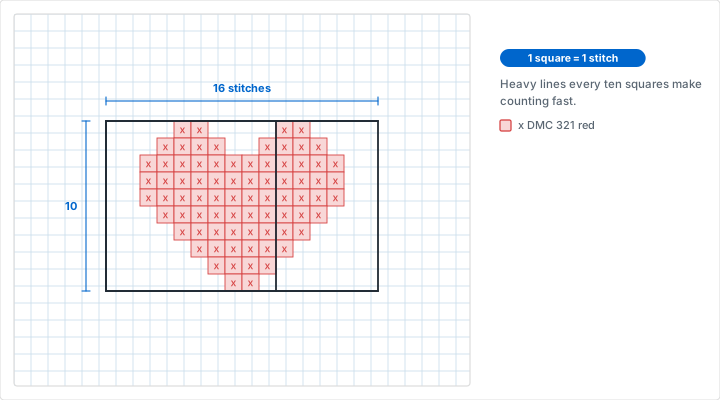
- One square, one stitch: The mapping is immediate. You fill in a square, you know exactly where that stitch goes.
- Instant visualization: You see the entire pattern at a glance without scrolling or zooming.
- Easy to modify: Erase a pencil mark, redraw. No undo history to manage.
- No software cost: Print a sheet from our generator and start designing immediately.
- Portability: A sheet of graph paper and a pencil go anywhere. No battery, no screen glare.
- Works across crafts: The same grid works for cross-stitch, knitting colorwork, tapestry crochet, bead loom work, pixel art and quilting.
Digital pattern software adds features like automatic stitch counting, color palette management, and symbol generation. Those features matter for complex projects. But for learning pattern design, experimenting with motifs, and planning small to medium projects, graph paper is faster and more forgiving. Start on paper. Move to software when the project demands it.
Cross-Stitch Pattern Design
The Grid-to-Stitch Relationship
Cross-stitch has the simplest mapping of any fiber art: one square on graph paper equals one X-shaped stitch on fabric. The grid lines represent the holes in the fabric weave. This one-to-one correspondence is why cross-stitch was one of the first crafts to adopt graph paper for pattern creation.
Choosing Grid Size Based on Fabric Count
Cross-stitch fabric is measured by "count" -- the number of holes per inch. Common counts include:
- 11-count Aida: Large stitches, good for beginners and children's projects
- 14-count Aida: The most popular count. Balances detail with ease of stitching.
- 16-count Aida: Slightly finer detail without being difficult to work
- 18-count Aida: Fine detail, popular for portraits and complex designs
- 28-count evenweave (stitched over 2): Equivalent to 14-count but on finer fabric
Your graph paper grid size does not need to match the fabric count exactly. What matters is that you have enough squares to represent the full design. A 100-stitch-wide pattern needs at least 100 squares across. For most designs, a 1/4-inch or 5mm grid is comfortable for drawing and reading. Use finer grid (1/8-inch or 2mm) when you need to fit a large pattern on a single sheet.
Starting a Design
Begin with the outline. Sketch the outer boundary of your design in pencil. Count squares carefully as you go. If the design is symmetrical, draw a center line first (vertical, horizontal, or both) and build outward from that reference. This prevents the common problem of a design that drifts off-center as you draw.
Once the outline is placed, fill in the major color areas. Work from the largest regions to the smallest details. Save fine elements like backstitching lines, French knot placements, and fractional stitches for last.
Color Planning with Colored Pencils
The most intuitive method is to fill each square with a colored pencil that approximates the thread color you intend to use. This gives you an immediate sense of how the finished piece will look. Choose pencils that are close to common DMC or Anchor floss colors. You do not need an exact match -- the goal is to distinguish color areas from each other and get a sense of overall contrast.
Color Selection Tip
Work in natural light when choosing thread colors against your colored pencil chart. Artificial light shifts color perception, especially for reds and greens. If two colors look nearly identical on paper under your desk lamp, they will look even closer on fabric.
Creating a Symbol Chart
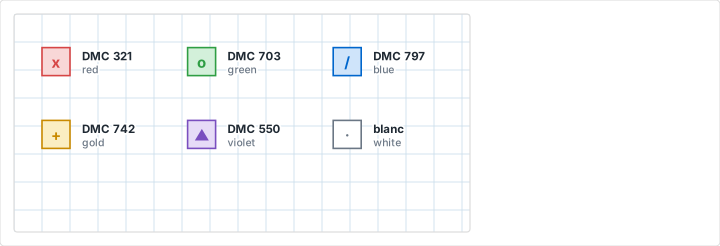
When your design uses more colors than you have pencils (or when you need a chart you can photocopy), switch to symbols. Assign a unique symbol to each thread color and fill each square with that symbol instead of color. Standard cross-stitch symbols include:
- X -- often used for the dominant or darkest color
- O -- second most common color
- / and \ -- diagonal fills for additional colors
- + -- another high-visibility symbol
- . (dot) -- subtle, useful for background or light colors
- | and - -- vertical and horizontal fills
- * -- star, good for accent colors
- # -- hash, high visibility for borders or outlines
Always create a color key in the margin of your chart. List each symbol alongside the thread brand, color number, and color name. For example: "X = DMC 310, Black" or "O = DMC 321, Red."
Calculating Finished Size
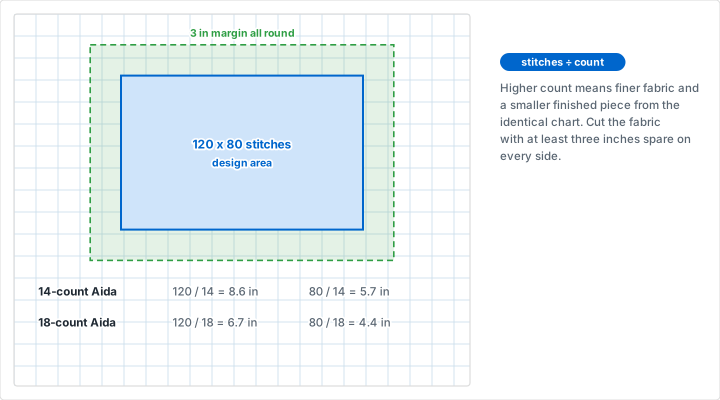
The formula is straightforward: stitch count divided by fabric count equals finished size in inches. A design that is 140 stitches wide on 14-count Aida will finish at 10 inches wide (140 / 14 = 10). On 18-count, the same 140 stitches yield about 7.8 inches (140 / 18 = 7.78).
Always add at least 3 inches of extra fabric on each side for framing or finishing. A 10-inch-wide design needs fabric cut to at least 16 inches wide.
Adding Backstitching
Backstitching adds outlines and fine detail to cross-stitch. On your graph paper chart, draw backstitching as straight lines along the edges of squares (not through the center). Use a different color pen than your symbol fills so backstitching lines are clearly distinguishable. Many designers use a bold line or a specific color (like red) for all backstitch markings.
Knitting Colorwork Charts
Knitting charts look similar to cross-stitch charts, but there is a critical difference: knitted stitches are not square. Understanding this distinction is the single most important thing about using graph paper for knitting.
The Stitch Proportion Problem
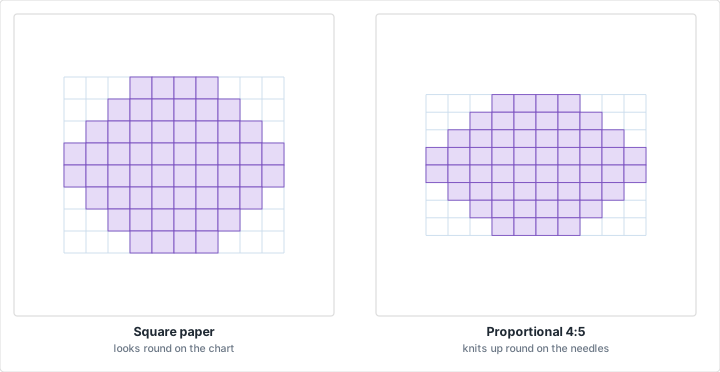
A knitted stitch is wider than it is tall. The exact ratio depends on yarn weight, needle size, and individual tension, but a common guideline for worsted-weight yarn is roughly 4 stitches and 5 rows per inch. That means each stitch is about 25% wider than it is tall. A circle charted on square graph paper will knit up as a vertically stretched oval.
Stitch ratio rule of thumb: Stockinette stitch in worsted-weight yarn typically has a ratio near 4:5 (width to height). In fingering-weight yarn, the ratio is closer to 7:9. Always knit a gauge swatch and measure your personal ratio before committing to a large colorwork project.
You have two options for handling this on graph paper:
- Use standard square grid paper and mentally adjust for the distortion. This works well for simple geometric motifs (diamonds, zigzags, stripes) that tolerate some stretching.
- Use rectangular grid paper where the cells match your stitch ratio. Print a custom grid from our generator with a cell width of 5mm and a cell height of 6.25mm (for a 4:5 ratio). The design on paper will then match the knitted result more closely.
Fair Isle and Stranded Colorwork
Fair Isle knitting uses two colors per row. The unused color is carried ("stranded") across the back of the work. On your chart, each row should contain no more than two colors. Long floats (more than 5 stitches of the same color in a row) cause puckering, so design your motifs with frequent color changes.
Traditional Fair Isle motifs are small and repeating: stars, crosses, diamonds, peeries (small seed patterns), and OXO borders. These motifs stack vertically with single-row separator bands. Chart one repeat of the motif and mark the repeat boundaries with vertical lines on your graph paper.
Intarsia
Intarsia handles larger color blocks -- picture knitting, argyle diamonds, large lettering. Unlike stranded colorwork, intarsia uses a separate ball or bobbin of yarn for each color section. There is no limit on the number of colors per row, but each color change adds a twist at the boundary.
On graph paper, chart intarsia designs the same way as cross-stitch: fill each square with the appropriate color or symbol. The stitch proportion issue still applies, so preview your design with the ratio adjustment in mind.
Reading Direction
Knitting charts read from the bottom up, because that is the direction you knit. For flat knitting (back and forth on straight needles):
- Right-side rows (odd numbers): Read from right to left
- Wrong-side rows (even numbers): Read from left to right
For circular knitting (in the round), every row reads right to left. Mark row numbers on the right edge of your chart for right-side rows and on the left edge for wrong-side rows. This simple habit prevents reading direction errors.
Marking the Repeat Section
Most colorwork patterns have a repeating section. On your graph paper, draw bold vertical lines or brackets around the repeat. Label it clearly: "Repeat these 8 stitches" or "Pattern repeat = 12 stitches." Note any edge stitches that fall outside the repeat (used to balance the pattern at the beginning and end of the row).
Crochet Charting on Graph Paper
Crochet uses a different charting system than cross-stitch or knitting. Standard crochet patterns use international crochet symbols (a circle for chain, a T-shape for single crochet, a crossed T for double crochet, and so on). These symbol charts do not map neatly to a square grid.
However, graph paper is still useful for two crochet techniques that work on a grid:
- Tapestry crochet: Single crochet worked with color changes, where each stitch corresponds to one square on the grid. The mapping is nearly identical to cross-stitch.
- Corner-to-corner (C2C) crochet: Each square represents one C2C block (typically a cluster of double crochets). Designs are worked diagonally, but the charting is done on a standard grid.
For tapestry crochet, be aware that single crochet stitches are close to square, making standard graph paper a good match. C2C blocks tend to be square as well. For both techniques, chart your design the same way you would for cross-stitch: fill squares with colors or symbols, create a color key, and count carefully.
Choosing Your Grid
The right grid size depends on the craft, the complexity of your design, and how much space you want for drawing. Here are specific recommendations:
- Standard square grid, 1/4 inch (6mm): Best for cross-stitch pattern design. Squares are large enough to fill with color or draw symbols legibly. Good for designs up to about 40 stitches wide on letter-size paper. See our grid size guide for more detail.
- Fine grid, 1/8 inch (3mm) or 2mm: Use for detailed designs, large stitch counts, or when you need to fit an entire pattern on one sheet. Harder to fill with colored pencil, but works well with fine-tip markers or the symbol method.
- Medium grid, 5mm: A versatile middle ground. Large enough for color fills, small enough for moderate stitch counts. Works well for knitting charts.
- Dot grid: Useful for freeform design sketching where you want grid reference without heavy lines. Good for initial concept work before transferring to a square grid for the final chart. See dot grid paper for options.
Print Multiple Sheets
Print several copies of the same grid size before you start designing. You will use more than you expect -- first drafts, color tests, section details, and the final clean chart. Graph paper is free to print from our generator, so do not ration your supply.
Color Planning Techniques
How you represent color on your chart affects how easy the chart is to read and reproduce. There are three main methods, and each has strengths.
Colored Pencil Method
Fill each square with a colored pencil that matches (or approximates) your thread, yarn, or floss color. This is the most visually intuitive method. You see the design as it will appear in the finished piece.
- Best for: Small to medium designs (under 8 colors), personal reference charts
- Drawback: Cannot be photocopied in black and white, limited by your pencil set
Symbol Method
Assign a unique symbol to each color (X, O, /, \, +, -, *, #). Fill each square with the appropriate symbol. Create a legend that maps symbols to thread or yarn colors.
- Best for: Designs with many colors, patterns you will share or photocopy
- Drawback: Harder to visualize the finished appearance at a glance
Numbered Method
Write the thread color code directly in each square. For DMC floss, you would write "310" for black, "321" for red, and so on. This is the most precise method but requires the largest squares.
- Best for: Complex cross-stitch patterns with many similar colors
- Drawback: Requires large grid squares (at least 5mm) to fit numbers legibly
Creating a Color Key
Regardless of which method you use, always create a color key on the same sheet as your chart (or on a clearly labeled companion sheet). A good color key includes:
- Symbol or color swatch: The visual representation used on the chart
- Brand and color number: DMC 310, Anchor 403, or equivalent
- Color name: "Black," "Christmas Red," "Medium Navy Blue"
- Stitch count: How many stitches of this color appear in the pattern (useful for estimating thread or yarn quantities)
Calculating Pattern Size
Knowing the finished dimensions before you start stitching or knitting saves material, time, and frustration. The math is simple for both crafts.
Cross-Stitch Size Calculation
Formula: stitch count / fabric count = finished size in inches.
- A pattern 70 stitches wide on 14-count Aida = 5 inches wide (70 / 14)
- The same pattern on 18-count Aida = 3.89 inches wide (70 / 18)
- The same pattern on 11-count Aida = 6.36 inches wide (70 / 11)
To change the finished size without redesigning, simply change the fabric count. This is one of the great advantages of charted needlework -- the same chart works across multiple fabric counts.
Knitting Size Calculation
Formula: stitch count / gauge (stitches per inch) = finished width in inches.
- A chart 80 stitches wide at a gauge of 5 stitches per inch = 16 inches wide
- The same chart at 4 stitches per inch = 20 inches wide
- For height: row count / rows per inch = finished height
Gauge depends on yarn weight, needle size, and your personal tension. Always knit a gauge swatch (at least 4 inches square) in the pattern stitch with the yarn you intend to use, wash and block it, then measure. Do not skip this step for garments -- a single stitch per inch difference across a sweater chest can mean 4 or more inches of sizing error.
Resizing Patterns
To make a cross-stitch pattern larger, stitch it on lower-count fabric. To make it smaller, use higher-count fabric. The chart itself does not change. For knitting, adjust your needle size to change gauge, or choose a heavier or lighter yarn weight. If you need to change the stitch count itself (adding or removing motif repeats), redraft the relevant section on a fresh sheet of graph paper.
Common Mistakes
Mistake 1: Ignoring Knitting Stitch Proportions
Problem: Charting a knitting design on square graph paper and expecting the knitted result to match. A circle on square paper becomes a tall oval in stockinette stitch because knitted stitches are wider than they are tall.
Fix: Either use rectangular grid paper matched to your gauge ratio, or deliberately widen your design on the chart. For a 4:5 stitch ratio, make circles about 20% wider than tall on the chart so they knit up round.
Mistake 2: Starting Too Complex
Problem: Attempting a 200-stitch, 15-color pattern as your first custom design. Errors compound quickly in large, complex charts, and debugging them by counting squares is tedious.
Fix: Start with simple geometric motifs: a 20x20 heart, a repeating diamond border, a basic initial or monogram. Master the process of charting, stitching, and comparing before scaling up.
Mistake 3: No Color Key
Problem: You chart a design with colored pencils today. Three weeks later, you cannot remember which shade of blue pencil corresponds to which DMC floss number.
Fix: Create the color key before you start filling squares. Write the thread or yarn details next to each color swatch in the key. Do this first, not last.
Mistake 4: Forgetting Borders and Seam Allowances
Problem: Your cross-stitch design fills the fabric edge to edge with no room for framing. Your knitting chart accounts for the motif but not the selvedge stitches or seaming.
Fix: For cross-stitch, add at least 3 inches of blank fabric on all sides. For knitting, add selvedge stitches (typically 1-2 stitches per edge) and account for seam allowances if the piece will be sewn together. Mark these margins on your chart before designing the motif.
Tips for Better Patterns
Work in Pencil First
Always draft in pencil. Ink your final chart only after you have tested the design (or at least reviewed it carefully). Pencil erases cleanly from graph paper; ink does not.
Test a Small Section
Before committing to a full cross-stitch or colorwork project, stitch a small representative section. Pick the most complex area of the chart -- the part with the most color changes or the finest detail. If it works in miniature, the full design will work.
Keep a Symbol Reference
If you design patterns regularly, standardize your symbols. Always use X for black, O for white, / for the dominant color, and so on. Consistency across projects means you can read your own charts faster and reduces errors when switching between patterns.
Use Grid Lines as Counting Aids
Every 10 squares, draw a heavier line or mark the edge of the chart with the count. This creates a built-in counting grid that makes it much easier to locate specific stitches, especially in large patterns. Our generator's engineering grid style does this automatically with bold lines at regular intervals.
Conclusion
Graph paper bridges the gap between an idea and a finished fiber arts project. It costs nothing, requires no software, and works for cross-stitch, knitting, crochet, and any other grid-based craft. The skills are straightforward: map one square to one stitch, plan your colors, count carefully, and test before committing. Start with a simple motif on a fresh sheet of graph paper, and you will have a custom pattern ready to stitch within the hour.
Ready to Design Your First Pattern?
Generate custom graph paper sized for your craft. Choose your grid spacing, paper size, and line weight, then print as many copies as you need.
Generate Custom Graph PaperRelated Resources
- How to Choose the Right Grid Size
- Dot Grid Paper -- great for freeform pattern sketching
- Engineering Graph Paper -- built-in counting grid at regular intervals
- Graph Paper and the Analog Revival
- Professional Printing Tips
- Graph Paper Use Cases Across Industries
- Bullet Journaling with Graph Paper
- Design Sketching on Graph Paper