Graph Paper Sizes: Print Any Standard Size
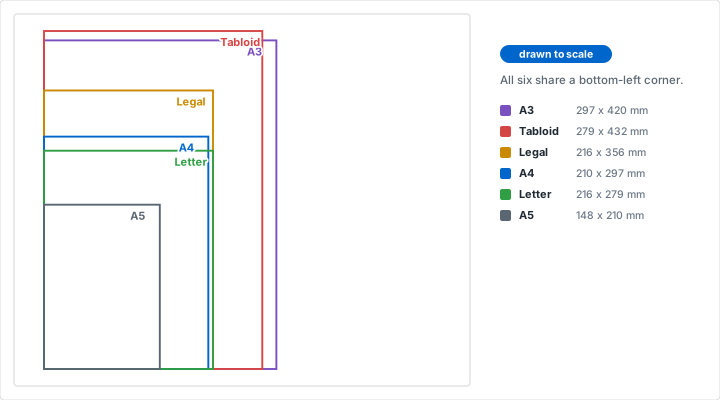
Every paper size the generator prints, with exact dimensions in millimeters and inches -- and a link that opens the generator already set to it
Print Graph Paper at Any Size
Every size below is a preset in the generator. Pick one and the grid is drawn to that sheet immediately -- square size, margins and all -- ready to print or download as a PNG or SVG. These six cover almost everything; the full list of twenty-four, including the ISO B and C series, is further down.
| Size | Millimeters | Inches | Generator |
|---|---|---|---|
| Letter | 215.9 × 279.4 mm | 8.5" × 11" | Print Letter graph paper |
| A4 | 210 × 297 mm | 8.27" × 11.69" | Print A4 graph paper |
| Legal | 215.9 × 355.6 mm | 8.5" × 14" | Print Legal graph paper |
| Tabloid | 279.4 × 431.8 mm | 11" × 17" | Print Tabloid graph paper |
| A3 | 297 × 420 mm | 11.69" × 16.54" | Print A3 graph paper |
| A5 | 148 × 210 mm | 5.83" × 8.27" | Print A5 graph paper |
If none of them is what you need, the generator also takes exact dimensions in inches or millimeters. See custom sizes below.
A4 vs Letter: Key Differences
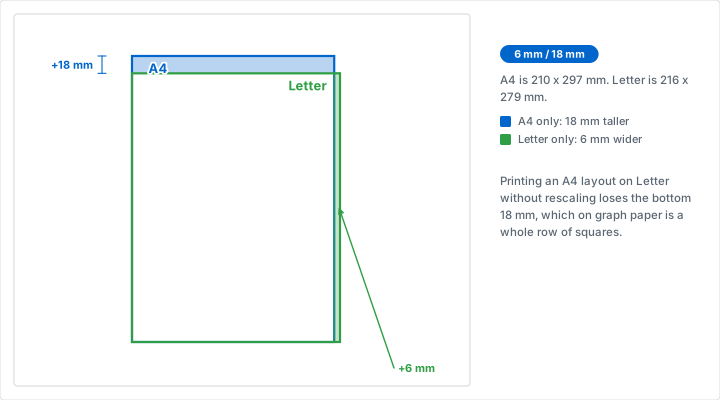
These are the two sizes almost everyone actually prints on, and they are close enough to look interchangeable without being interchangeable. Letter is about 6 mm wider; A4 is about 18 mm taller. Neither fits inside the other.
| Letter | A4 | |
|---|---|---|
| Width | 215.9 mm (8.5") | 210 mm (8.27") |
| Height | 279.4 mm (11") | 297 mm (11.69") |
| Area | 603 cm² | 624 cm² |
| Aspect ratio | 1.294:1 | 1.414:1 (√2) |
| Where it is standard | US, Canada, Philippines, Mexico, Chile | Everywhere else |
| Generator | Print Letter graph paper | Print A4 graph paper |
The practical consequence matters more for graph paper than for text. Print an A4 grid on Letter stock and the bottom 18 mm has nowhere to go: your printer either clips it, or -- far more often -- silently scales the whole page down to fit. Scaling is the damaging one, because a 5 mm square that has been reduced to 94% is 4.7 mm, and every measurement taken off that sheet is wrong by the same 6%. Nothing on the page announces it. Our printing tips cover the print-dialog settings that prevent it: scale at 100%, fit-to-page off.
So set the paper size here to match the paper actually in the tray, not the size the document was designed for.
US/Imperial Paper Sizes
The US sizes are historical rather than systematic. There is no consistent ratio between them, so halving one does not produce another, and enlarging between them always leaves an odd margin. Letter is the one that matters; the rest are specialist.
| Size | Millimeters | Inches | Typical use | Generator |
|---|---|---|---|---|
| Letter | 215.9 × 279.4 mm | 8.5" × 11" | The US default, and what almost every US printer is loaded with | Print Letter graph paper |
| Legal | 215.9 × 355.6 mm | 8.5" × 14" | Three extra inches of run for long tables and timelines | Print Legal graph paper |
| Tabloid | 279.4 × 431.8 mm | 11" × 17" | Portrait large format; needs a printer that takes 11 x 17 | Print Tabloid graph paper |
| Ledger | 431.8 × 279.4 mm | 17" × 11" | Tabloid turned landscape -- the same sheet, the other way up | Print Ledger graph paper |
| Government Letter | 203.2 × 266.7 mm | 8" × 10.5" | Slightly narrower and shorter than Letter; US federal use | Print Government Letter graph paper |
| Half Letter | 139.7 × 215.9 mm | 5.5" × 8.5" | Letter cut once. Pocket notebooks and planner inserts | Print Half Letter graph paper |
| Junior Legal | 203.2 × 127 mm | 8" × 5" | Small legal pads and note cards | Print Junior Legal graph paper |
ISO Paper Sizes (International Standard)
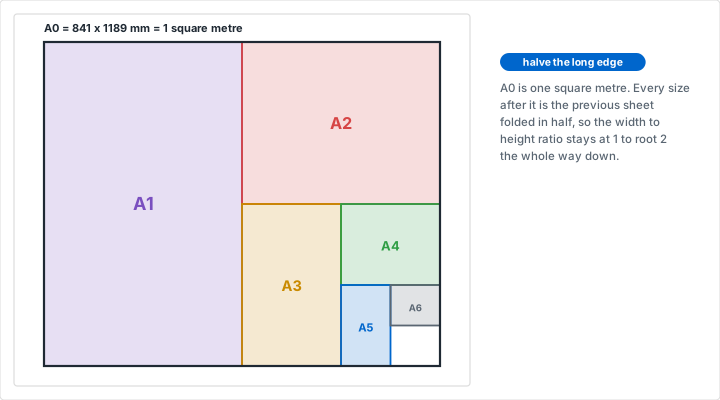
ISO 216 defines the sizes used in most of the world, and unlike the US set it is built on a single idea: every sheet has an aspect ratio of √2:1, about 1.414:1. That ratio is the only one that survives being folded in half, so cutting any ISO sheet across its long edge gives two sheets of the next size down with exactly the same proportions.
That is why the A series scales cleanly. A4 artwork enlarged to A3 fills the sheet with no leftover strip, and A3 reduced to A4 does the same. It is also why the numbering runs backwards from what people expect: A0 is the big one, with an area of one square meter, and each step up in number halves it.
ISO A Series (Most Common)
| Size | Millimeters | Inches | Typical use | Generator |
|---|---|---|---|---|
| A0 | 841 × 1189 mm | 33.11" × 46.81" | One square meter of paper. Plotters and wall drawings | Print A0 graph paper |
| A1 | 594 × 841 mm | 23.39" × 33.11" | Technical drawings and flip charts | Print A1 graph paper |
| A2 | 420 × 594 mm | 16.54" × 23.39" | Detailed drawings and presentation boards | Print A2 graph paper |
| A3 | 297 × 420 mm | 11.69" × 16.54" | Large graphs and engineering work; many office printers take it | Print A3 graph paper |
| A4 | 210 × 297 mm | 8.27" × 11.69" | The international default, and the size most of the world prints on | Print A4 graph paper |
| A5 | 148 × 210 mm | 5.83" × 8.27" | Notebooks and bullet journals | Print A5 graph paper |
| A6 | 105 × 148 mm | 4.13" × 5.83" | Postcard size. Index cards and pocket references | Print A6 graph paper |
ISO B Series
The B series sits between consecutive A sizes -- B4 falls between A3 and A4 -- which makes it useful when the A size above is too big and the one below is too small. It is common in posters and in Japanese stationery.
| Size | Millimeters | Inches | Typical use | Generator |
|---|---|---|---|---|
| B0 | 1000 × 1414 mm | 39.37" × 55.67" | Posters and large-format printing | Print B0 graph paper |
| B1 | 707 × 1000 mm | 27.83" × 39.37" | Posters, technical drawings | Print B1 graph paper |
| B2 | 500 × 707 mm | 19.69" × 27.83" | Charts and mid-size posters | Print B2 graph paper |
| B3 | 353 × 500 mm | 13.9" × 19.69" | Books, folded maps | Print B3 graph paper |
| B4 | 250 × 353 mm | 9.84" × 13.9" | Between A3 and A4; common for books and Japanese stationery | Print B4 graph paper |
| B5 | 176 × 250 mm | 6.93" × 9.84" | Notebooks, common in Japanese stationery | Print B5 graph paper |
ISO C Series (Envelopes)
The C series is sized to hold the A series: a C4 envelope takes an A4 sheet unfolded, a C5 takes it folded once. You would rarely print graph paper at these sizes, but they are here for completeness and for anyone mailing a finished sheet.
| Size | Millimeters | Inches | Holds | Generator |
|---|---|---|---|---|
| C3 | 324 × 458 mm | 12.76" × 18.03" | Holds A3 unfolded | Print C3 graph paper |
| C4 | 229 × 324 mm | 9.02" × 12.76" | Holds A4 unfolded | Print C4 graph paper |
| C5 | 162 × 229 mm | 6.38" × 9.02" | Holds A5 unfolded, or A4 folded once | Print C5 graph paper |
| C6 | 114 × 162 mm | 4.49" × 6.38" | Holds A6 unfolded, or A5 folded once | Print C6 graph paper |
Choosing the Right Paper Size for Graph Paper
Two things decide the size: how much of the subject has to fit on one sheet, and how small a square you can still work in. Going larger buys you more squares, not finer ones -- if the grid is too fine to write in on A4, it will be just as fine on A3. When the problem is square size rather than sheet size, our guide to choosing the right grid size is the one you want.
| Project | Start with | Go larger when |
|---|---|---|
| Mathematics and coursework | Letter or A4 | Plotting several functions that need to stay readable |
| Engineering and technical drawing | A3 or Tabloid | A full assembly has to sit on one sheet |
| Room layouts and floor plans | Letter or A4 per room | An open plan or a whole floor at one scale |
| Garden planning | Letter or A4 per bed | Mapping a whole property |
| Bullet journals and planners | A5 or Half Letter | Never -- portability is the point |
| Design sketching | A4 or Letter | The finished piece needs presenting |
| Cross-stitch and knitting charts | A3 or Tabloid | Almost always -- counting squares gets hard when they are small |
Two constraints override all of that. Check what your printer physically accepts before choosing anything above A3 or Tabloid, because most home printers stop at A4 or Letter. And if a plan is genuinely too big for the largest sheet you can print, tiling several sheets at one scale and taping them is more accurate than shrinking the whole thing onto one page.
Custom Paper Sizes
When no preset fits, type the dimensions in. The generator takes any width and height in inches or millimeters, which covers plotter rolls, trimmed stock, a notebook you are making inserts for, and sheets sized to a frame or a binder.
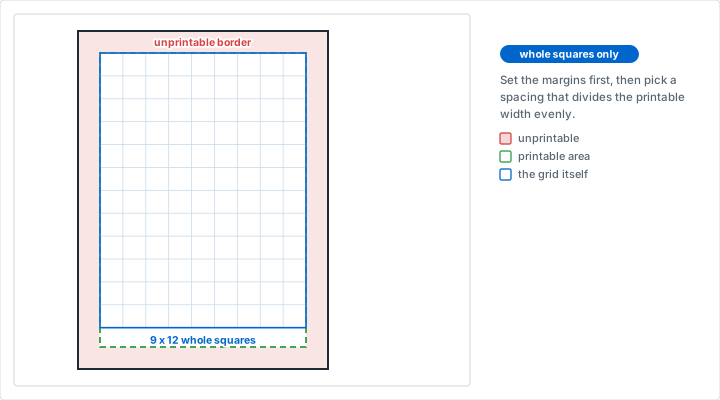
One thing to allow for: no consumer printer prints to the edge of the sheet. There is an unprintable border of a few millimeters on all four sides, so a grid built to the full paper dimensions loses its outermost row and column. If the edges matter, set margins large enough to clear the border, and size the grid so it ends on a whole square rather than a sliver.
Quick Reference Table
Every size the generator supports, with exact dimensions and the ratio of long edge to short. The ISO sizes are all 1.414:1; the US sizes are not, which is the whole difference between the two systems in one column.
| Size | Millimeters | Inches | Aspect ratio | Generator |
|---|---|---|---|---|
| Letter | 215.9 × 279.4 mm | 8.5" × 11" | 1.294:1 | Print Letter |
| Legal | 215.9 × 355.6 mm | 8.5" × 14" | 1.647:1 | Print Legal |
| Tabloid | 279.4 × 431.8 mm | 11" × 17" | 1.545:1 | Print Tabloid |
| Ledger | 431.8 × 279.4 mm | 17" × 11" | 1.545:1 | Print Ledger |
| Government Letter | 203.2 × 266.7 mm | 8" × 10.5" | 1.312:1 | Print Government Letter |
| Half Letter | 139.7 × 215.9 mm | 5.5" × 8.5" | 1.545:1 | Print Half Letter |
| Junior Legal | 203.2 × 127 mm | 8" × 5" | 1.600:1 | Print Junior Legal |
| A0 | 841 × 1189 mm | 33.11" × 46.81" | 1.414:1 | Print A0 |
| A1 | 594 × 841 mm | 23.39" × 33.11" | 1.416:1 | Print A1 |
| A2 | 420 × 594 mm | 16.54" × 23.39" | 1.414:1 | Print A2 |
| A3 | 297 × 420 mm | 11.69" × 16.54" | 1.414:1 | Print A3 |
| A4 | 210 × 297 mm | 8.27" × 11.69" | 1.414:1 | Print A4 |
| A5 | 148 × 210 mm | 5.83" × 8.27" | 1.419:1 | Print A5 |
| A6 | 105 × 148 mm | 4.13" × 5.83" | 1.410:1 | Print A6 |
| B0 | 1000 × 1414 mm | 39.37" × 55.67" | 1.414:1 | Print B0 |
| B1 | 707 × 1000 mm | 27.83" × 39.37" | 1.414:1 | Print B1 |
| B2 | 500 × 707 mm | 19.69" × 27.83" | 1.414:1 | Print B2 |
| B3 | 353 × 500 mm | 13.9" × 19.69" | 1.416:1 | Print B3 |
| B4 | 250 × 353 mm | 9.84" × 13.9" | 1.412:1 | Print B4 |
| B5 | 176 × 250 mm | 6.93" × 9.84" | 1.420:1 | Print B5 |
| C3 | 324 × 458 mm | 12.76" × 18.03" | 1.414:1 | Print C3 |
| C4 | 229 × 324 mm | 9.02" × 12.76" | 1.415:1 | Print C4 |
| C5 | 162 × 229 mm | 6.38" × 9.02" | 1.414:1 | Print C5 |
| C6 | 114 × 162 mm | 4.49" × 6.38" | 1.421:1 | Print C6 |