Graph Paper and the Analog Revival: Why Going Off-Screen Starts with a Grid
The analog movement is not a trend piece. It is a measurable shift. Searches for "analog hobbies" are up 136% over the past two years. Social media usage has declined for three consecutive years among adults under 40. Sixty-four percent of consumers still use a physical planner or notebook alongside (or instead of) digital tools. People are stepping away from screens on purpose, and they are picking up pens, paper, and hands-on projects. Graph paper turns out to be the common thread connecting many of these screen-free activities -- from bullet journaling and garden layout planning to tabletop RPG maps and hand-drawn pixel art.
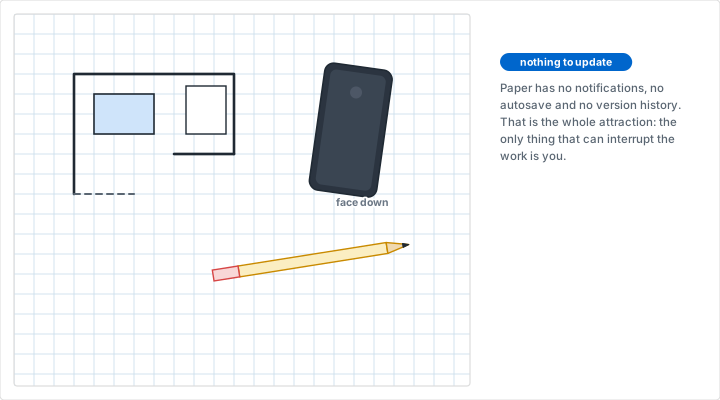
The Analog Movement in 2026
What It Is
The analog revival is a deliberate move away from digital-first workflows toward physical, tactile alternatives. It is not about rejecting technology entirely. It is about choosing when a screen adds value and when it gets in the way. People are buying more notebooks, more craft kits, more board games, and more physical planners than at any point in the past decade.
Why It Is Happening
- Digital fatigue: The average adult spends over seven hours per day on screens for work alone. Adding personal screen time on top of that has pushed many people past their threshold. Headaches, eye strain, and difficulty sleeping are driving real behavior changes.
- AI backlash: As AI-generated content floods the internet, people are placing higher value on things made by human hands. Handwritten plans, hand-drawn maps, and physical artifacts carry a weight that digital files do not.
- Mindfulness and focus: Working with your hands on a single task -- no notifications, no tabs, no algorithmic distractions -- produces a focus state that most digital tools actively undermine. A pen on paper demands your full attention.
- Retention and comprehension: Research consistently shows that people remember information better when they write it by hand versus typing it. Planning on paper is not just a preference; it produces measurably better recall.
- Subscription fatigue: The average household now pays for 12+ digital subscriptions. Free, offline tools that do not require an account or recurring payment have obvious appeal.
This Is Not Anti-Technology
The analog revival is not about throwing away your phone. It is about being deliberate. You might use a digital calendar for appointments and a paper planner for weekly priorities. You might design a garden in a landscape app and refine the planting layout on graph paper at your kitchen table. The goal is matching the tool to the task, not picking a side.
The Numbers Behind It
- Craft kit sales: Up 28% year-over-year in 2025, with continued growth into 2026
- Notebook and stationery market: Projected to reach $23 billion globally by 2027
- Board game and tabletop RPG sales: Record highs for the fourth consecutive year
- Average daily social media time: Down 12 minutes per day compared to 2023
- Physical planner usage: 64% of surveyed consumers use one, up from 56% in 2022
Why Graph Paper Fits the Moment
Structure Without Software
Blank paper is intimidating. A blank screen with a complex design tool is worse. Graph paper sits in the middle: it gives you structure -- straight lines, consistent spacing, a built-in scale -- without requiring you to learn software, create an account, or pay for a subscription. You print a sheet and start working. The grid does the heavy lifting that would otherwise require a ruler, a T-square, or a CAD program.
No Login, No Subscription, No Learning Curve
Every digital planning tool wants your email address. Most want your credit card. All of them require you to learn their interface before you can do anything useful. Graph paper requires a printer and a pencil. The barrier to entry is effectively zero, which is exactly what you want when you are trying to step away from screens, not add another one to your workflow.
Tactile Planning Works Differently
When you sketch a room layout on graph paper, you think about the space differently than when you drag rectangles in an app. Your hand moves at the speed of thought. You annotate in the margins. You draw arrows, circle problems, cross things out. The physical act of drawing engages spatial reasoning in a way that clicking and dragging does not. This is not nostalgia -- it is a practical advantage for any task that involves spatial thinking.
The Sweet Spot Between Blank and Digital
Blank paper gives you freedom but no structure. Digital tools give you structure but demand screen time and a learning curve. Graph paper gives you both freedom and structure with neither drawback. That is why it keeps showing up in every analog hobby -- it solves the same problem each time.
Works in Every Analog Hobby
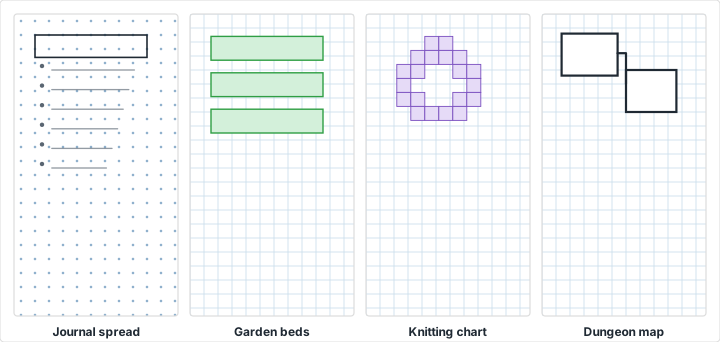
The grid is a universal tool. Bullet journalists use it for layout alignment. Gardeners use it for scale drawings. RPG players use it for dungeon maps. Knitters use it for stitch patterns. The medium adapts to the project, not the other way around. One sheet of graph paper can become a weekly planner, a floor plan, a game board, or a pixel art canvas depending on what you need that day.
Screen-Free Projects That Start on a Grid
Bullet Journaling and Planning
The bullet journal method was built for grid paper. The system uses rapid logging -- short-form notes organized by bullets, events, and tasks -- that relies on the grid for clean alignment and consistent spacing. A dot grid at 5mm spacing is the community standard because the dots provide structure without visual clutter.
Common grid-based spreads include habit trackers (a table with dates across the top and habits down the side), monthly calendars (7-column grids), mood trackers, reading logs, and budget tables. Every one of these works because the grid handles alignment so you can focus on content.
If you are new to bullet journaling on graph paper, start with our bullet journaling guide.
Garden and Home Layout Planning
Graph paper turns spatial guesswork into accurate, to-scale plans. Set a scale -- one square equals one foot is the standard for home gardens -- and your entire yard fits on a single sheet. You can map beds, paths, structures, and individual plants with correct spacing before you buy a single seed.
The same approach works indoors. Room layout planning on graph paper lets you test furniture arrangements without moving heavy objects. Draw your room dimensions, cut out scaled furniture shapes, and slide them around the grid until the layout works. No app required.
For detailed garden mapping techniques, see our garden planning tutorial.
Design Sketching and Creative Drawing
Product designers, architects, and UI/UX designers have used grid paper for decades. The grid provides proportion references and alignment guides that make freehand sketching faster and more accurate. You can rough out a website wireframe, a furniture design, or a logo concept on grid paper in the time it takes to open a design application.
The grid also helps with perspective drawing. Vertical and horizontal lines are already there. Vanishing points and construction lines snap to intersections. The result is cleaner sketches with less setup.
Our design sketching tutorial covers techniques for using the grid as a drawing aid.
Math and Learning with Kids
Graph paper is one of the most effective tools for teaching math concepts to children. The grid provides structure that helps kids keep digits aligned in arithmetic, plot coordinates accurately, visualize fractions and area, and draw geometric shapes with correct proportions.
For younger children, larger grid sizes (1 cm or 1/2 inch) make it easier to write numbers inside the squares. For older students working on algebra and trigonometry, standard 1/4-inch or 5mm grids support graphing functions and plotting data sets.
See our math graphing tutorial for specific exercises and techniques.
Tabletop RPG Map Making
Dungeon masters and game masters have been drawing maps on graph paper since the earliest days of tabletop role-playing games. The standard convention is one square equals five feet, which matches the movement grid used in most RPG systems.
Standard square grids work for indoor dungeons and building interiors. Hexagonal graph paper is the traditional choice for overworld and wilderness maps because hexagons handle diagonal movement more naturally than squares and create organic-looking terrain boundaries.
Hand-drawn maps have a character that digital map generators cannot replicate. A map sketched at the table during a session, with coffee stains and eraser marks, becomes part of the story.
Quick Grid Match for RPG Maps
For dungeon maps, use standard square grid at 1/4-inch spacing. For overworld maps, switch to hexagonal grid. Print on the largest paper your printer supports -- Tabloid (11x17) gives you significantly more map area than Letter size.
Fiber Arts Pattern Design
Cross-stitch, knitting colorwork, and crochet tapestry all use grid-based patterns where one square equals one stitch. Graph paper is the natural design medium. You color in squares to create the pattern, count squares for sizing, and use the grid to maintain symmetry.
Cross-stitch patterns map directly to standard square grids. Knitting charts often use rectangular grids (because knit stitches are wider than they are tall), but standard graph paper works well for initial design. You can adjust proportions once the pattern is finalized.
- Cross-stitch: Use fine grid (1/8-inch or 3mm) for detailed designs, standard grid for larger patterns
- Knitting colorwork: One square per stitch. Sketch the motif on standard grid, then test-knit a swatch to check proportions
- Crochet tapestry: Similar to cross-stitch mapping. One square per single crochet stitch
- Needlepoint: Grid maps directly to canvas mesh count
Calligraphy and Hand Lettering Practice
Graph paper solves the two biggest challenges in learning hand lettering: consistent letter height and even spacing. The grid lines serve as baselines, x-heights, ascender lines, and descender lines without requiring you to rule a fresh set of guidelines on every practice sheet.
For brush lettering practice, use a larger grid (1/2-inch or 1 cm) to give your strokes room. For pointed pen calligraphy, standard 5mm grid provides tight control. Either way, the grid enforces the consistency that separates polished lettering from wobbly attempts.
- Uppercase practice: Use two grid rows per letter. Top line is the cap height, bottom is the baseline.
- Lowercase practice: Use three grid rows. Top for ascenders (b, d, h), middle for x-height (a, c, e), bottom for descenders (g, p, y).
- Spacing drills: Write one letter per column to train even spacing between characters.
- Flourish practice: Use the grid intersections as anchor points for consistent curves and swashes.
Pixel Art
One square equals one pixel. Graph paper is the original pixel art canvas, and it remains one of the best ways to design pixel art away from a screen. Color in squares with markers or colored pencils to create characters, icons, game sprites, or abstract designs.
Start with a small canvas -- 16x16 or 32x32 squares -- and a limited color palette. Constraints force creativity. Once you finalize your design on paper, you can transfer it to a digital tool if needed, or simply keep it as a physical piece.
- Character sprites: 16x16 grid for retro game-style characters
- Icons and logos: 32x32 grid for more detail
- Scene tiles: Design repeating tiles that connect into larger landscapes
- Font design: Map out custom pixel fonts on a consistent grid baseline
Pixel Art Tip: Start with a Border
Before you start coloring, count out your canvas size and draw a heavy border around it. A 16x16 sprite on a full sheet of graph paper is easy to lose track of. The border keeps your work area defined and prevents miscounts that throw off your entire design.
Choosing the Right Grid for Your Analog Project
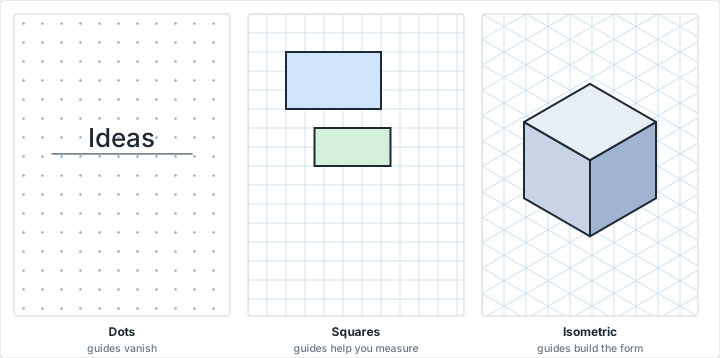
Different activities work best with different grid types. Here is a quick reference for matching your project to the right grid style and spacing. For a deeper dive, see our guide to choosing grid size.
Project-to-Grid Reference
- Bullet journaling: Dot grid, 5mm spacing. Subtle structure, clean look, community standard.
- Garden planning: Standard square grid, 1/4-inch spacing. Set 1 square = 1 foot for accurate scale drawings.
- Room layout: Standard square grid, 1/4-inch spacing. Same scale approach as garden planning.
- Design sketching: Standard square grid, 5mm or 1/4-inch. Provides proportion guides without being obtrusive.
- Math and graphing: Standard square grid, 5mm or 1/4-inch. Clear axis alignment for plotting functions and data.
- RPG dungeon maps: Standard square grid, 1/4-inch. One square = five feet is the tabletop standard.
- RPG overworld maps: Hexagonal grid. Natural terrain boundaries, uniform adjacency in all directions.
- Cross-stitch patterns: Standard square grid, fine spacing (1/8-inch or 3mm). One square = one stitch.
- Knitting colorwork: Standard square grid, 5mm. Design the motif, adjust proportions from a test swatch.
- Calligraphy practice: Standard square grid, 1/2-inch or 1 cm. Larger squares for brush lettering, smaller for pointed pen.
- Pixel art: Standard square grid, fine spacing. Small grids for sprites, larger grids for detailed scenes.
Print What You Need, When You Need It
One advantage of using a graph paper generator over pre-printed notebooks is that you can change the grid type and spacing for every project. Print dot grid for journaling on Monday, hex grid for your RPG session on Saturday, and fine square grid for a cross-stitch pattern on Sunday. No single notebook can do that.
Common Mistakes When Going Analog
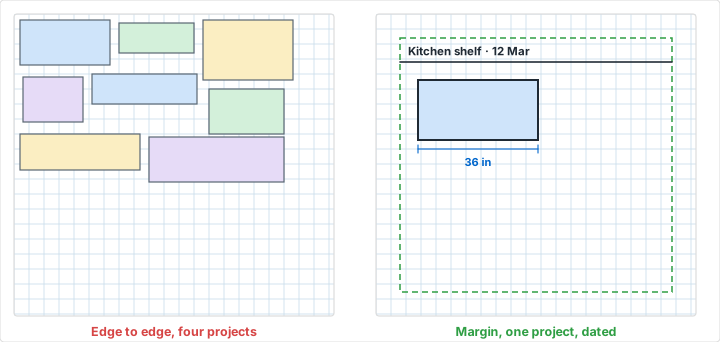
Mistake: Buying Expensive Supplies Before You Start
Problem: You spend $80 on notebooks, pens, and accessories before you have tried a single project. The investment creates pressure to "do it right," which leads to paralysis.
Solution: Print a free sheet of graph paper. Use a pencil you already own. Try the project first. Buy better supplies only after you know what you actually need based on experience, not Instagram recommendations.
Mistake: Trying to Replace Every Digital Tool at Once
Problem: You attempt to move your calendar, to-do list, notes, and project plans to paper in one weekend. By Monday you are overwhelmed and abandon the entire effort.
Solution: Pick one thing. Move your weekly planning to paper and keep everything else digital. Once that habit is solid -- give it two to three weeks -- consider moving a second thing. Small, sustainable changes stick. Full overhauls do not.
Mistake: Choosing the Wrong Grid for the Project
Problem: You print standard lined grid for bullet journaling and the lines dominate the page, or you use large grid spacing for a project that needs fine detail.
Solution: Use the project-to-grid reference table above. Match the grid type and spacing to your specific activity. With a graph paper generator, you can print a test sheet to check the fit before committing to a full project.
Mistake: Perfectionism on the First Page
Problem: You spend an hour making the first page of your bullet journal look perfect, then never finish page two because the bar is too high.
Solution: The first page is practice. So is the second. Use pencil, expect to erase, and keep moving. A finished imperfect project is more useful than a perfect first page with nothing behind it.
Getting Started
You do not need to overhaul your entire workflow. Pick one project from the list above -- the one that sounds most interesting or most useful to you right now -- and try it this week. Here is a concrete starting point:
- Choose your project. Garden layout, weekly planner spread, RPG map, pixel art character -- it does not matter which. Just pick one.
- Print the right grid. Use the graph paper generator to create a sheet with the grid type and spacing that matches your project (use the reference list above).
- Grab a pencil. Not a pen. Pencil first. You will erase and adjust. That is part of the process.
- Work for 20 minutes without checking your phone. Set a timer if you need to. The focus is the point.
- Evaluate. After 20 minutes, you will know whether this particular project is worth continuing. Most people find that they want to keep going.
The 20-Minute Rule
Twenty minutes is long enough to make meaningful progress on any grid-based project but short enough that it does not feel like a commitment. If you enjoy those 20 minutes, extend the session. If you do not, you have lost nothing. The sheet of graph paper cost you a fraction of a cent to print.
Starter Project Ideas by Time Available
- 15 minutes: Design a 16x16 pixel art character. Print fine grid, count out the canvas, pick 3-4 colors, and fill in squares.
- 30 minutes: Plan next week on a dot grid sheet. Draw seven columns, label the days, and add your priorities and appointments.
- 1 hour: Map your garden or a single room in your house to scale. Measure the space, set a scale, and draw the layout with furniture or planting beds.
- Ongoing: Start a bullet journal. Set up an index, a monthly log, and your first weekly spread. Build the habit over days, not in a single session.
Conclusion
The analog revival is not about going backward. It is about choosing the right tool for the task. For spatial planning, creative design, and focused work, that tool is often a sheet of paper with a grid on it. No account creation. No subscription. No notifications. Just the grid, a pencil, and whatever you want to build.
Every project in this article starts the same way: with a printed grid and a single decision about what to put on it. The structure is already there. You supply the idea.
Ready to Go Off-Screen?
Print custom graph paper for any analog project. Choose your grid type, set your spacing, and start building something with your hands.
Create Graph Paper NowRelated Resources
- Designing Board Games on Graph Paper
- Composing Music on Graph Paper
- Bullet Journaling with Graph Paper
- Planning Your Garden on Graph Paper
- Room Layout Planning Guide
- Design Sketching Tutorial
- Dot Grid Paper
- Hexagonal Graph Paper
- How to Choose the Right Grid Size
- Graph Paper Use Cases
- Back-to-School Graph Paper: What Each Subject Actually Needs
- Woodworking and DIY Project Plans on Graph Paper
- Designing Quilt Blocks and Patterns on Graph Paper
- Designing and Solving Grid Puzzles on Graph Paper
- The Grid Method for Drawing
- Penmanship and Handwriting Practice on Graph Paper