Designing and Solving Grid Puzzles on Graph Paper: Nonograms, Mazes, Sudoku, and More
Some of the most satisfying puzzles ever invented are, at heart, just marks in a grid. Nonograms turn a picture into a logic problem across rows and columns. Mazes are a network of open and closed cells. Sudoku, KenKen, word search, crosswords, and battleship all live on square grids where position is everything. That makes graph paper the natural home for puzzles: the pre-printed squares give you evenly sized cells, straight walls, aligned clues, and a ruler-flat canvas that keeps a hand-drawn puzzle looking crisp and readable. Whether you want to solve puzzles away from a screen or design your own to share, a sheet of graph paper is the oldest and most flexible puzzle tool there is.
Why Graph Paper for Puzzles
Puzzle apps are convenient, but they hide the structure that makes a puzzle work. On paper you can see the whole grid at once, mark tentative guesses, cross out eliminated options, and erase a wrong turn without penalty. That freedom to annotate is exactly what strong solvers rely on, and it is where printed grids beat a touchscreen. A pencil, an eraser, and a clean grid give you room to think.
For puzzle makers, graph paper does the tedious work for free. Every cell is the same size, every wall lines up, and every clue column stays aligned, so your puzzle looks professional without a straightedge or a drawing program. Because you print the grid yourself, you can match the cell size to the puzzle, run off as many blank copies as you need, and iterate on a design until it is exactly as hard as you want. The grid enforces the consistency that a good puzzle depends on.
Nonograms and Picross (Paint-by-Numbers)
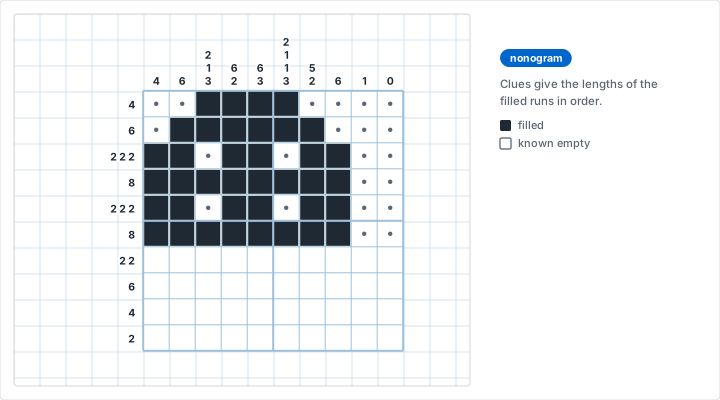
Nonograms -- also called Picross, Hanjie, or Griddlers -- are the purest graph paper puzzle. The numbers beside each row and above each column tell you the lengths of the filled runs in that line, and solving the logic reveals a hidden picture, one filled square at a time. Graph paper is ideal for solving them: use a solid fill for cells you know are on and a light dot or slash for cells you have proven are off, so you never fill a square twice or lose track of a deduction.
Designing your own nonogram is where the grid really pays off. Start by drawing a small picture directly on the squares -- a heart, a cat, a spaceship -- treating each cell as a pixel, exactly as you would in pixel art. Then read off the run lengths for every row and column to generate the clue numbers. Keep the picture simple and the silhouette clear; the best nonograms have a solution that can be reasoned out without guessing. A 10x10 or 15x15 grid is a friendly size for a first design, and larger grids let you attempt shading and detail.
Designing and Drawing Mazes
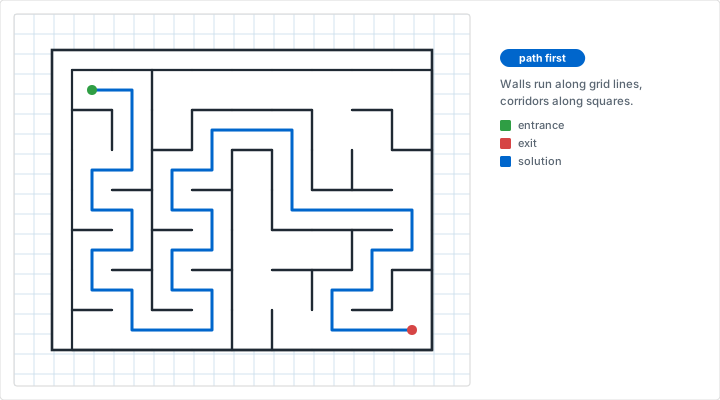
A maze is a grid of cells with walls between them, and graph paper turns maze-making into a simple, repeatable craft. The cleanest method is to draw walls along the grid lines: pick your entrance and exit on the border, then carve a single winding solution path from start to finish along the squares. Once the true path exists, add branching dead ends that split off and stop, using the grid lines as walls so every corridor is the same width and every turn is a clean right angle.
For tougher mazes, add loops and false junctions so the solver cannot simply follow one wall to the exit. You can vary the feel by changing the grid: a fine grid makes a dense, intricate maze, while a larger grid suits mazes for young children. A dot grid is especially good for maze design, because the faint dots guide your walls without the printed lines competing with the heavy corridors you draw. Adventurous designers can even move to hexagonal paper for six-way mazes, or isometric paper for mazes that look three-dimensional.
Sudoku, KenKen, and Number Grids
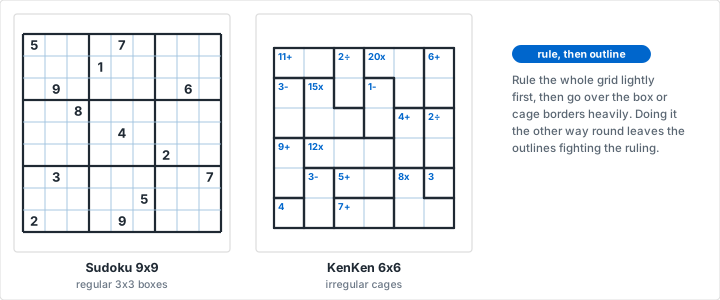
Number-placement puzzles are built on the square grid, so graph paper is a perfect solving surface. For sudoku, a nine-by-nine block of cells gives you the board; darken the lines every three squares to mark the three-by-three boxes. The real advantage of paper is pencil marks: many solvers write the candidate numbers small in the corners of each cell, and a roomy printed grid gives you space to do that cleanly, then erase candidates as you eliminate them.
The same grid handles a whole family of logic puzzles. KenKen adds heavy outlines around "cages" of cells with an arithmetic target, which is easy to draw along the grid lines. Kakura, Futoshiki, and magic squares all sit naturally on squared paper too. To design your own, start from a completed, valid grid, then remove numbers a few at a time, checking that the puzzle still has exactly one solution -- the discipline that separates a fair puzzle from a frustrating one. The grid keeps your working boards tidy through every revision.
Word Search and Crossword Grids
Word puzzles depend on one letter per cell, and that is precisely what graph paper delivers. For a word search, list your words, then write them into the grid horizontally, vertically, and diagonally, letting them cross and share letters before you fill the empty cells with random letters. Because each square holds a single character, everything stays aligned and the finished puzzle is easy to read and photocopy.
Crosswords and fill-in puzzles are a grid craft of their own. Block out the pattern of black and white squares on the paper, keeping the symmetry that traditional crosswords use, then number the cells where answers begin. Graph paper lets you test a fill by hand, spot awkward letter patterns, and rework a corner before committing to clues. The same squared layout works for acrostics, cryptograms laid out in a grid, and the "fill-in" puzzles where a word bank drops into a fixed pattern.
Battleship, Dots and Boxes, and Pencil Games
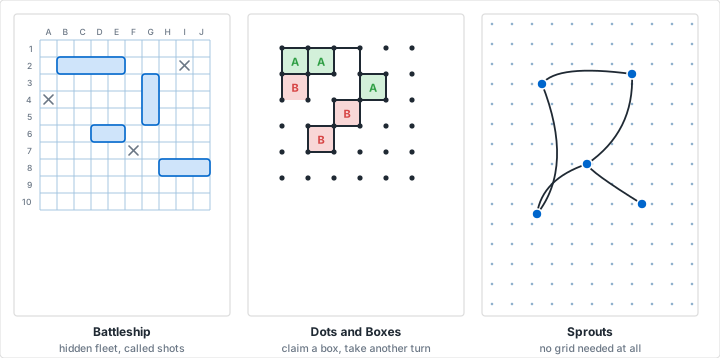
Long before puzzle apps, graph paper was the arcade. Battleship is played on two coordinate grids -- one for your fleet, one for tracking shots -- with letters down one side and numbers across the top, and a sheet of squares is all you need for both boards. Dots and Boxes uses the grid intersections as dots, with players drawing edges to claim squares. Both games are instantly ready on any graph paper, needing nothing but a pencil and an opponent.
The grid also powers a deep bench of pencil-and-paper logic puzzles you can draw yourself: Slitherlink, where you connect dots into a single loop; Nurikabe and Fillomino, which shade regions by number; Hitori; and Minesweeper-style deduction grids. Each of these is essentially a graph paper puzzle, and half the fun is constructing one for a friend. Keeping a stack of printed grids on hand means a game or a homemade puzzle is always one sheet away -- the same screen-free appeal driving the wider analog revival.
Making Puzzles for Classrooms and Kids
Grid puzzles are a favorite classroom tool because they teach without feeling like work. A word search reinforces spelling and vocabulary; a nonogram is a lesson in logic and careful reading of clues; sudoku builds patience and systematic thinking; and designing a maze is an exercise in planning and cause and effect. Because graph paper enforces even spacing, a puzzle a student makes by hand comes out neat and shareable, which is a quiet confidence builder. For more grid-based learning activities, see our roundup of visual math projects.
Teachers and parents can scale the difficulty simply by changing the grid. Larger squares and smaller boards suit young children drawing their first mazes or coloring a five-by-five nonogram, while finer grids challenge older students with dense word searches and full sudoku. Printing your own grids means you can hand out identical blank boards to a whole class and tailor the size to the lesson.
Choosing Grid Size and Paper
The right grid depends on the puzzle. A few guidelines:
- Sudoku and KenKen: larger squares (around a half-inch or 12 mm) leave room for corner candidate marks; darken every third line for the boxes.
- Nonograms and picross: a medium grid keeps the clue numbers legible along the edges; leave several blank rows and columns outside the board for them.
- Mazes: a fine grid makes intricate mazes; a dot grid keeps your walls bold without competing lines.
- Word search and crosswords: match the square size to your handwriting so one letter sits comfortably per cell.
- Battleship and pencil games: a standard quarter-inch grid with labeled edges is all you need for coordinate play.
Because you are generating the paper yourself, you can print exactly the board a puzzle needs and make unlimited copies. Use the grid-size guide if you are unsure where to start, and a custom grid with numbered edges makes coordinate puzzles effortless to set up.
Tips for Cleaner Puzzle Grids
- Work in pencil. Marking, erasing, and revising is the whole point of solving and designing on paper.
- Adopt a consistent notation: solid fill for "on," a light dot or slash for "off," small corner marks for candidates.
- Number the rows and columns along the edges so you can reference any cell by coordinate.
- When designing, always verify a single unique solution before you share a puzzle.
- Keep a blank master grid and photocopy it, so every puzzle starts from the same clean board.
- Photograph a finished design before you test-solve on it, so you never lose the original.
Ready to Make Your Own Puzzles?
Generate custom graph paper for nonograms, mazes, sudoku, and every kind of grid puzzle. Choose your grid spacing, paper size, and style, then print as many blank boards as you need.
Generate Custom Graph PaperRelated Resources
- How to Choose the Right Grid Size
- Dot Grid Paper -- clean guides for maze design
- Hexagonal Graph Paper -- for six-way mazes and hex puzzles
- Creating Pixel Art on Graph Paper -- the pixel logic behind nonograms
- Visual Math Activities on Graph Paper -- more grid-based learning
- Coordinate Graphing Mystery Pictures: another picture hidden behind a puzzle, this one behind ordered pairs
- Graph Paper and the Analog Revival
- Professional Printing Tips
- Designing Board Games on Graph Paper
- Drawing Dungeon Maps on Graph Paper
- Designing Video Game Levels and Maps on Graph Paper