Celebrate Math Month: Visual Math Activities on Graph Paper
Every April, Mathematics and Statistics Awareness Month invites students, educators, and curious minds to see math not as a collection of formulas but as a way of understanding the world. The event is jointly sponsored by the American Mathematical Society, the American Statistical Association, the Mathematical Association of America, and the Society for Industrial and Applied Mathematics. Its purpose is straightforward: make mathematics visible, accessible, and engaging for everyone. Graph paper turns out to be one of the best tools for doing exactly that -- turning abstract numbers into something you can see, touch, and build with your hands.
Why Graph Paper Is the Natural Medium for Math Month
Mathematics is fundamentally visual. Coordinate systems, geometric proofs, statistical distributions, and number patterns all become clearer when you can see them drawn out on a grid. Graph paper provides the structure that makes this possible without requiring software, accounts, or screen time. A printed sheet, a pencil, and a straightforward activity can reveal mathematical relationships that equations alone leave abstract.
The activities in this article are designed for Math Month but work any time of year. They span elementary through high school levels, with extensions that challenge adults. Each one uses graph paper as the primary tool and produces a visual result that demonstrates a mathematical concept. No calculators required for most of them -- the point is to work by hand and see the math emerge from the grid.
For Educators
Each activity below includes a recommended grid type and spacing. You can print class sets for free using the graph paper generator -- just set the grid parameters and print as many copies as you need. No accounts, no subscriptions, no per-student fees.
Activity 1: Coordinate Art
What It Teaches
Ordered pairs, coordinate plane navigation, plotting accuracy, and the connection between numerical coordinates and visual shapes.
How It Works
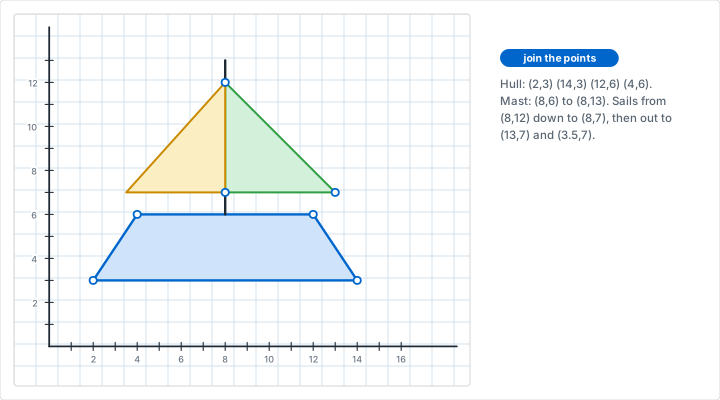
Students receive a list of coordinate pairs. They plot each point on graph paper, then connect the dots in order to reveal a hidden picture -- an animal, a geometric design, a letter, or any shape the instructor chooses.
- Set up axes: Draw x and y axes through the center of the paper. Label the axes from -15 to 15 (or whatever range fits your design).
- Plot the points: Work through the coordinate list one point at a time. Place a small dot at each (x, y) location.
- Connect: Draw straight lines between consecutive points. Some designs use multiple segments (lift the pencil between groups).
- Reveal: The completed drawing shows a recognizable image built entirely from math.
Extensions
- Create your own: Students design their own coordinate art by drawing a picture first, then reading off the coordinates.
- Transformations: Apply a reflection (negate all x-values), translation (add a constant to all coordinates), or rotation to the original design and plot the result.
- Four-quadrant work: Use designs that span all four quadrants to practice negative coordinates.
Grid recommendation: Standard square grid, 1/4-inch or 5mm spacing. See our math graphing tutorial for axis setup techniques.
Activity 2: Fibonacci Spiral
What It Teaches
The Fibonacci sequence, the golden ratio, how number patterns connect to geometry, and the presence of mathematical structure in nature.
How It Works
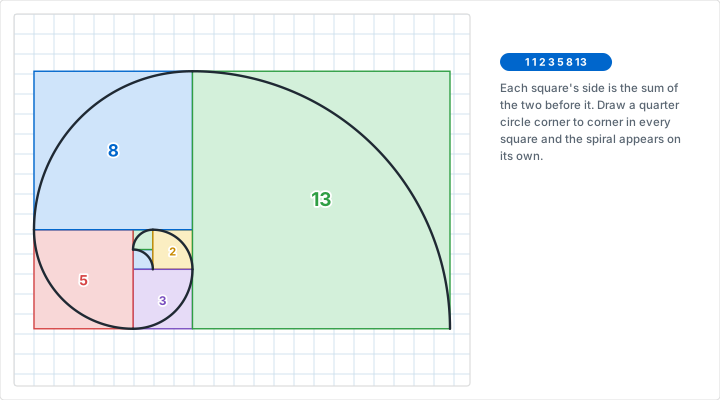
The Fibonacci sequence (1, 1, 2, 3, 5, 8, 13, 21, ...) generates a spiral when you draw squares with side lengths matching each number, then connect their corners with quarter-circle arcs.
- Start small: Draw a 1x1 square near the center of the paper.
- Add the next square: Draw another 1x1 square adjacent to the first.
- Continue the pattern: Each new square has a side length equal to the sum of the previous two. Place it along the longest side of the current rectangle. 2x2, then 3x3, then 5x5, then 8x8, then 13x13.
- Draw the spiral: In each square, draw a quarter-circle arc from one corner to the opposite corner. The arcs connect to form a continuous spiral.
Extensions
- Measure the ratio: Divide each Fibonacci number by the one before it (2/1, 3/2, 5/3, 8/5, 13/8...). Watch the ratio converge toward 1.618 -- the golden ratio.
- Find it in nature: Compare the spiral to photographs of nautilus shells, sunflower seed heads, pinecone scales, and hurricane satellite images.
- Color by number: Assign a different color to each Fibonacci square to create a visually striking piece that doubles as a math poster.
Grid recommendation: Standard square grid, 1/4-inch spacing. You will need a large sheet -- Tabloid (11x17) gives room through the 13x13 square.
Activity 3: Tessellations
What It Teaches
Geometry of regular and semi-regular tilings, angle sums, symmetry, and the mathematical rules that govern which shapes can tile a plane without gaps or overlaps.
How It Works
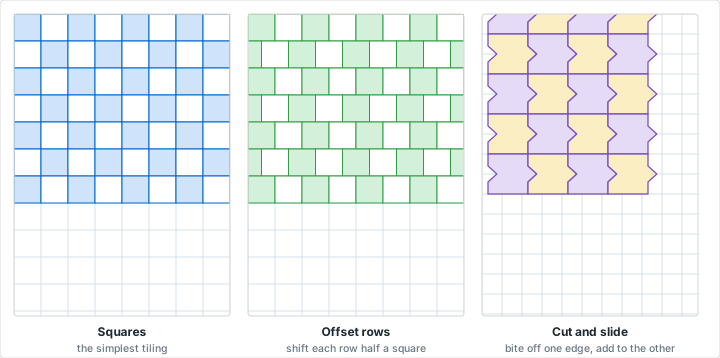
A tessellation is a pattern of shapes that covers a flat surface completely with no gaps and no overlaps. Graph paper provides the underlying grid that makes accurate tessellations possible by hand.
- Start with squares: The simplest tessellation -- the graph paper grid itself is a square tessellation. Outline a 4x4 region and color alternating squares to see the pattern.
- Try triangles: Draw diagonal lines through each square (corner to corner, same direction) to create a triangle tessellation. Color alternating triangles.
- Build hexagons: Use hexagonal graph paper and color groups of hexagons to explore the only regular polygon tessellation besides squares and triangles.
- Create Escher-style tessellations: Start with a square tile. Cut a shape from one side and tape it to the opposite side. Trace the modified tile repeatedly across the grid to create an interlocking figurative design.
The Math Behind It
Only three regular polygons tessellate on their own: equilateral triangles (6 meet at each vertex, 6 x 60 = 360), squares (4 x 90 = 360), and regular hexagons (3 x 120 = 360). The interior angles must sum to exactly 360 at every vertex. Graph paper lets students verify this by counting and measuring directly on the grid.
Extensions
- Semi-regular tessellations: Combine two or more regular polygon types (e.g., octagons and squares). There are exactly eight semi-regular tessellations -- challenge students to find them all.
- Penrose tilings: Explore non-periodic tilings using two rhombus shapes. These never repeat but still cover the plane completely.
Grid recommendation: Standard square grid for square and triangle tessellations. Hexagonal grid for hexagon work. Isometric grid for triangle-based patterns.
Activity 4: Symmetry and Transformations
What It Teaches
Reflections, rotations, translations, and dilations -- the four rigid and similarity transformations that form the basis of geometric reasoning.
How It Works
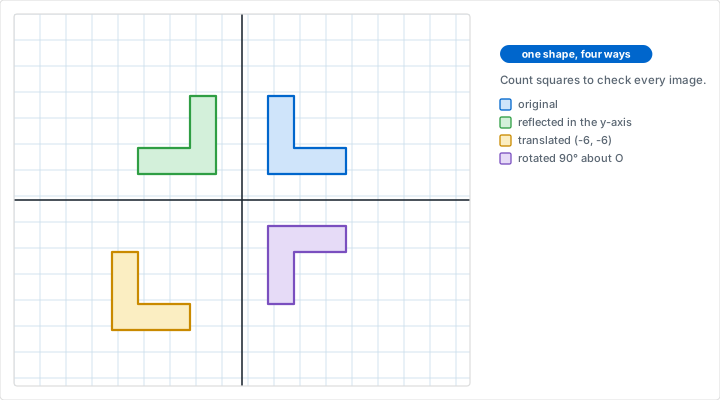
Draw a simple shape on one side of the graph paper (a house, an arrow, an irregular polygon). Then apply transformations to produce copies of the shape in new positions.
Reflection (Flip)
- Draw a vertical or horizontal line of reflection on the grid.
- For each point on the original shape, count the number of squares to the line of reflection.
- Count the same number of squares on the other side and mark the reflected point.
- Connect the reflected points to complete the mirror image.
Rotation (Turn)
- Mark a center of rotation on the grid.
- For a 90-degree rotation: each point (x, y) relative to the center becomes (-y, x).
- Plot the rotated points and connect them.
- Try 180-degree and 270-degree rotations for the same shape.
Translation (Slide)
- Choose a direction and distance (e.g., 5 squares right and 3 squares up).
- Move every point on the original shape by the same amount.
- Connect the translated points -- the shape is identical but in a new position.
Dilation (Scale)
- Choose a center of dilation and a scale factor (e.g., 2x).
- Multiply each point's distance from the center by the scale factor.
- The result is a larger (or smaller) version of the original shape, maintaining all angles and proportions.
Extensions
- Composition: Apply two transformations in sequence (e.g., reflect then rotate). Does the order matter? Students discover that transformation composition is not always commutative.
- Symmetry hunt: Identify all lines of symmetry and rotational symmetries in letters of the alphabet, drawn on the grid.
Grid recommendation: Standard square grid, 1/4-inch or 5mm spacing. Larger grids (1/2-inch) work well for younger students.
Activity 5: Hand-Drawn Data Visualization
What It Teaches
Data collection, statistical thinking, chart construction, scale selection, and the ability to read and interpret visual representations of data -- the statistics side of Mathematics and Statistics Awareness Month.
How It Works
Students collect real data and build charts by hand on graph paper. The manual process forces deliberate decisions about scale, axis labels, and visual encoding that drag-and-drop chart tools handle invisibly.
Bar Charts
- Collect categorical data (favorite subjects, shoe sizes in the class, hours of sleep per night).
- Draw axes: categories on the x-axis, frequency on the y-axis.
- Choose a scale: each square equals one count, or two, or five -- depending on the data range.
- Draw bars with heights matching each category's count. Use the grid lines to keep bars equal width and evenly spaced.
Scatter Plots
- Collect paired numerical data (height vs. arm span, hours studied vs. test score, temperature vs. ice cream sales).
- Set up axes with appropriate scales for each variable.
- Plot each data pair as a point on the grid.
- Look for patterns: positive correlation, negative correlation, clusters, or outliers.
- Draw a line of best fit by eye -- lay a ruler so roughly equal numbers of points fall above and below the line.
Histograms
- Collect continuous numerical data (test scores, daily temperatures, commute times).
- Group data into equal-width bins (e.g., 60-69, 70-79, 80-89, 90-100).
- Draw bars with no gaps between them (histograms differ from bar charts in this way).
- Discuss the shape: is the distribution symmetric, skewed left, skewed right, bimodal?
Why Hand-Drawn Charts Matter
Spreadsheet software generates charts in seconds, but students who have never built a chart by hand often cannot read one critically. They accept whatever the software produces without questioning whether the scale is misleading, the axis is truncated, or the chart type is appropriate for the data. Building charts by hand on graph paper teaches the decisions behind the visualization -- decisions that matter when you encounter charts in news articles, reports, and presentations.
Extensions
- Misleading charts: Deliberately create two versions of the same data -- one with a truncated y-axis that exaggerates differences, one with a full axis that shows them in proportion. Discuss how chart design choices affect perception.
- Box plots: Calculate the five-number summary (minimum, Q1, median, Q3, maximum) and draw a box-and-whisker plot on graph paper.
- Stem-and-leaf plots: Use the grid to keep stems and leaves aligned -- graph paper is ideal for this because each digit fits in one square.
Grid recommendation: Standard square grid, 1/4-inch or 5mm spacing. Engineering graph paper (with heavier lines at intervals) works especially well for charts because the major gridlines serve as natural scale markers.
Activity 6: Area and Perimeter Explorations
What It Teaches
Area and perimeter measurement, the relationship between the two (shapes with the same area can have very different perimeters), and Pick's theorem for polygons on a grid.
How It Works
The Fixed-Perimeter Challenge
- Give students a fixed perimeter (e.g., 24 units).
- Challenge them to draw as many different rectangles as possible on graph paper that have that exact perimeter. (1x11, 2x10, 3x9, 4x8, 5x7, 6x6)
- Calculate the area of each rectangle.
- Discover: the square (6x6 = 36) has the maximum area. As the rectangle gets longer and thinner, the area decreases despite the perimeter staying the same.
The Fixed-Area Challenge
- Give students a fixed area (e.g., 24 square units).
- Draw all possible rectangles with integer dimensions and that area. (1x24, 2x12, 3x8, 4x6)
- Calculate the perimeter of each.
- Discover: the most square-like shape (4x6, perimeter 20) has the minimum perimeter. The 1x24 rectangle has perimeter 50.
Pick's Theorem
For any polygon drawn on graph paper with vertices at grid intersections, the area can be calculated using: A = I + B/2 - 1, where I is the number of interior grid points and B is the number of boundary grid points. Students draw irregular polygons, count the grid points, apply the formula, and verify by counting squares.
Extensions
- Non-rectangular shapes: Draw L-shapes, T-shapes, and irregular polygons. Calculate area by decomposing into rectangles and triangles.
- Estimation: Draw a circle on graph paper. Count full squares inside it, then partial squares. Compare the estimate to the formula (pi * r^2).
Grid recommendation: Standard square grid, 1/4-inch or 1 cm spacing.
Activity 7: Slope in the Real World
What It Teaches
Rate of change, slope as a physical concept (not just rise/run on a worksheet), and the ability to model real situations with linear relationships.
How It Works
Instead of graphing abstract equations, students graph real data that demonstrates slope as a rate of change.
- Distance over time: Walk across the room at a steady pace while a partner marks your position every 2 seconds. Plot distance vs. time on graph paper. The slope is your walking speed.
- Plant growth: Measure a plant's height daily for two weeks. Plot height vs. day. The slope is the growth rate. Is it constant, or does it change?
- Water filling a container: Pour water into a container at a steady rate. Measure the water level every 30 seconds. The slope depends on the container's shape -- a cylinder gives a constant slope, a cone gives a decreasing slope.
- Savings over time: Track allowance or earnings week by week. Plot total savings vs. weeks. The slope is the savings rate.
Extensions
- Compare slopes: Two students walk at different speeds. Graph both on the same axes. The steeper line represents the faster walker -- slope is speed.
- Zero and undefined slopes: What does a horizontal line on a distance-time graph mean? (Stopped moving.) What would a vertical line mean? (Teleportation -- impossible in the real world.)
- Nonlinear rates: Graph a ball dropped from a height -- the distance-time curve is parabolic, not linear. Discuss why the "slope" changes (acceleration).
Grid recommendation: Standard square grid, 1/4-inch or 5mm spacing. See our math graphing tutorial for axis setup and scale selection techniques.
Activity 8: Polar Coordinate Art
What It Teaches
Polar coordinates (r, theta), the difference between Cartesian and polar systems, and how mathematical curves can produce beautiful visual patterns.
How It Works
Polar graph paper uses concentric circles (distance from center) and radial lines (angle from a reference direction) instead of the x-y grid. Certain equations produce striking curves on polar paper.
Rose Curves
The equation r = a * cos(n * theta) produces a flower-like pattern. The number of petals depends on n: if n is odd, there are n petals; if n is even, there are 2n petals.
- Print polar graph paper from the generator.
- Choose a simple rose curve like r = 4 * cos(3 * theta) (3 petals).
- Calculate r for theta values at 15-degree intervals from 0 to 360 degrees.
- Plot each (r, theta) point on the polar grid.
- Connect the points with a smooth curve to reveal the rose.
Spirals
The Archimedean spiral r = a + b * theta produces an evenly spaced spiral. Plot it by calculating r at regular angle intervals and watching the spiral grow outward.
Extensions
- Cardioids: r = a(1 + cos(theta)) produces a heart-shaped curve.
- Lemniscates: r^2 = a^2 * cos(2 * theta) produces a figure-eight.
- Combine and color: Plot multiple polar curves on the same sheet, each in a different color, for a mathematical art piece.
Grid recommendation: Polar graph paper from the generator. For an introduction to polar coordinates, see our polar graph paper guide.
Activity 9: Number Patterns and Sequences
What It Teaches
Pattern recognition, sequence behavior, the visual difference between linear growth, quadratic growth, and exponential growth.
How It Works
Visualizing Growth Rates
Plot three sequences on the same graph paper to see how different types of growth compare:
- Linear: 2, 4, 6, 8, 10, 12... (add 2 each time). Plot as (1,2), (2,4), (3,6), etc.
- Quadratic: 1, 4, 9, 16, 25, 36... (perfect squares). Plot as (1,1), (2,4), (3,9), etc.
- Exponential: 1, 2, 4, 8, 16, 32... (double each time). Plot as (1,1), (2,2), (3,4), (4,8), etc.
For the first few terms, all three sequences look similar. By term 6 or 7, the exponential curve pulls dramatically away from the others. This visual comparison is more intuitive than any verbal explanation of "exponential growth."
The Sieve of Eratosthenes
- Write the numbers 1 through 100 on graph paper, one number per square, in a 10x10 grid.
- Cross out 1 (it is neither prime nor composite).
- Circle 2. Cross out every multiple of 2 (4, 6, 8, 10...).
- Circle 3. Cross out every multiple of 3 that is not already crossed out.
- Continue with 5, 7, and so on. Every remaining number is prime.
- The visual pattern of primes on the grid reveals interesting structures -- diagonal patterns, gaps, and clusters.
Extensions
- Pascal's triangle: Write Pascal's triangle on graph paper (one number per square, centered). Color the odd numbers one color and the even numbers another. The result is Sierpinski's triangle -- a fractal hidden inside a number pattern.
- Collatz conjecture: Pick any starting number. If even, divide by 2. If odd, multiply by 3 and add 1. Repeat. Plot the sequence on graph paper. Does it always reach 1? (Nobody knows for certain -- an unsolved problem in mathematics.)
Grid recommendation: Standard square grid, 1/4-inch or 5mm spacing for plotting. For the Sieve, use larger grid (1 cm or 1/2-inch) so numbers fit inside the squares.
Activity 10: Geometric Constructions
What It Teaches
Classical geometry, compass-and-straightedge constructions, and the properties of geometric shapes that make these constructions work.
How It Works
Graph paper makes classical constructions easier because the grid provides reference points and right angles. Students use a compass and the grid lines to construct shapes that would be much harder on blank paper.
- Perpendicular bisector: Draw a line segment. Use a compass to find two points equidistant from both endpoints. Connect them -- the resulting line is perfectly perpendicular and bisects the original segment. The grid lets you verify the result by counting squares.
- Equilateral triangle: Draw a base on a horizontal gridline. Set the compass to the length of the base. Draw arcs from both endpoints. Where the arcs intersect is the third vertex.
- Regular hexagon: Draw a circle. Without changing the compass width, step around the circle marking off arcs. Six equally spaced points form a regular hexagon. Compare the result to hexagonal graph paper.
- Square from a circle: Draw a circle. Draw a diameter. Construct a perpendicular diameter. Connect the four points where the diameters meet the circle.
Extensions
- Impossible constructions: Discuss why some constructions are impossible with compass and straightedge alone (trisecting an arbitrary angle, doubling a cube, squaring a circle). These impossibility proofs are major results in the history of mathematics.
- Origami constructions: Some constructions impossible with compass and straightedge become possible with paper folding. Explore the mathematical power of origami.
Grid recommendation: Standard square grid, 1/4-inch or 5mm spacing. A compass is required for these activities.
Organizing a Math Month Event
These activities work individually, but they are even more effective as part of a coordinated Math Month celebration. Here are practical ways to organize them.
For Classrooms
- Activity of the week: Feature one activity each week of April. Print the appropriate graph paper for each week's activity.
- Math art gallery: Display completed coordinate art, Fibonacci spirals, tessellations, and polar curve drawings in the hallway. Each piece includes a placard explaining the math behind it.
- Data collection projects: Assign each student a real-world question to investigate using hand-drawn charts. Present findings in the final week.
For Libraries and Community Centers
- Drop-in stations: Set up tables with pre-printed graph paper and activity instruction cards. Visitors choose an activity and work at their own pace.
- Family math night: Run 2-3 activities simultaneously at different difficulty levels. Coordinate art for younger children, tessellations for middle schoolers, polar curves for teens and adults.
For Homeschool Groups
- Co-op sessions: Each family prepares one activity and teaches it to the group. Rotate through stations.
- Month-long challenge: Complete all ten activities over the course of April. Assemble the results into a math portfolio.
Print What You Need
Every activity in this article uses a different grid type or spacing. The graph paper generator lets you print the exact grid for each activity -- standard square, hexagonal, isometric, polar, engineering -- without buying separate pads for each type. Set the parameters, print, and go.
Which Grid Type for Which Activity
Quick reference for matching each activity to the right grid from the generator:
- Coordinate art: Standard square grid, 1/4-inch or 5mm
- Fibonacci spiral: Standard square grid, 1/4-inch (large paper recommended)
- Tessellations: Standard square, hexagonal, or isometric
- Symmetry and transformations: Standard square grid, 1/4-inch or 5mm
- Data visualization: Standard square or engineering grid
- Area and perimeter: Standard square grid, 1/4-inch or 1 cm
- Slope in the real world: Standard square grid, 1/4-inch or 5mm
- Polar coordinate art: Polar graph paper
- Number patterns: Standard square grid, 1/2-inch or 1 cm for number grids
- Geometric constructions: Standard square grid, 1/4-inch or 5mm
For a deeper guide to grid selection, see How to Choose the Right Grid Size.
Conclusion
Mathematics and Statistics Awareness Month exists because math is not just a school subject -- it is a way of seeing structure, pattern, and relationship in the world around you. The activities in this article use graph paper to make that structure visible and tangible. A Fibonacci spiral drawn by hand is not the same as seeing one on a screen. A bar chart built square by square forces you to understand every decision behind the visualization. A tessellation colored on grid paper teaches geometric rules through direct experience.
Graph paper is the simplest possible bridge between abstract mathematics and physical reality. A printed grid, a pencil, and a clear activity are all it takes to turn April -- or any month -- into an opportunity to see math differently.
Ready to Celebrate Math Month?
Print custom graph paper for every activity -- standard, hexagonal, isometric, polar, and engineering grids, all free.
Create Graph Paper NowRelated Resources
- Mathematics Graphing Tutorial
- Polar Graph Paper Guide
- Logarithmic Graph Paper Guide
- Hexagonal Graph Paper Guide
- Isometric Graph Paper Guide
- Engineering Graph Paper Guide
- How to Choose the Right Grid Size
- Graph Paper Use Cases
- Graph Paper and the Analog Revival
- Graphing Science Lab Data on Graph Paper