Designing Quilt Blocks and Patterns on Graph Paper
Quilting is geometry you can sleep under. Nearly every traditional pieced quilt block is built on a grid -- a four-patch, a nine-patch, a sixteen-patch -- and that grid translates directly onto graph paper. Long before quilt design apps existed, quilters worked out their blocks, color placements, and full quilt-top layouts with a pencil, a ruler, and a sheet of graph paper. The method still holds up. Graph paper lets you see the whole block at once, count seams before you cut a single piece of fabric, and calculate yardage with simple arithmetic. Whether you are drafting a classic Ohio Star or planning a king-size sampler, the grid is where good quilts begin.
Why Graph Paper Is the Classic Quilt Design Tool
Quilt design software is powerful, but graph paper has advantages that matter for most quilters working out a block or a quilt top:
- Blocks are grids: Pieced quilt blocks divide into equal units. Graph paper squares map onto those units one to one, so the drawing tool matches the structure of the block.
- See the whole quilt at once: You can sketch a full quilt-top layout on a single sheet and judge the balance, repetition, and secondary patterns without scrolling.
- Plan before you cut: Fabric is expensive and cutting is permanent. Working on paper catches mistakes while they cost nothing but a pencil eraser.
- Built-in measurement: Each square can represent a fixed measurement (one inch, half an inch), turning your drawing into a scaled diagram you can read dimensions off directly.
- No cost, no learning curve: Print a sheet from our generator and start drafting in seconds.
- Portable and durable: A graph paper notebook goes to the fabric store, the guild meeting, or the sofa. No battery, no app.
Software wins for complex applique, photo-realistic designs, and automatic fabric calculation across many sizes. But for drafting a traditional block, testing a color layout, and laying out a quilt top, graph paper is faster and more intuitive. This is closely related to charting fiber arts patterns -- if you also do cross-stitch or colorwork knitting, see our guide to designing fiber arts patterns on graph paper. Quilting differs in one crucial way: you are cutting and sewing fabric with seam allowances, not filling stitches, so the math and the cutting steps are unique to quilting.
The Grid-Based Nature of Pieced Blocks
Most traditional pieced blocks are classified by their underlying grid. Understanding the grid category tells you immediately how to draft the block on graph paper.
- Four-patch (2x2 grid): The block divides into four equal units. Classics include the simple Four-Patch and the Pinwheel.
- Nine-patch (3x3 grid): The most common traditional category. Nine equal units form the basis of the Ohio Star, Shoofly, Churn Dash, and Friendship Star.
- Sixteen-patch (4x4 grid): Sixteen units allow finer detail. The Double Four-Patch and many sampler blocks use this layout.
- Five-patch (5x5 grid) and seven-patch (7x7 grid): Less common but important. The Bear's Paw is a classic seven-patch block.
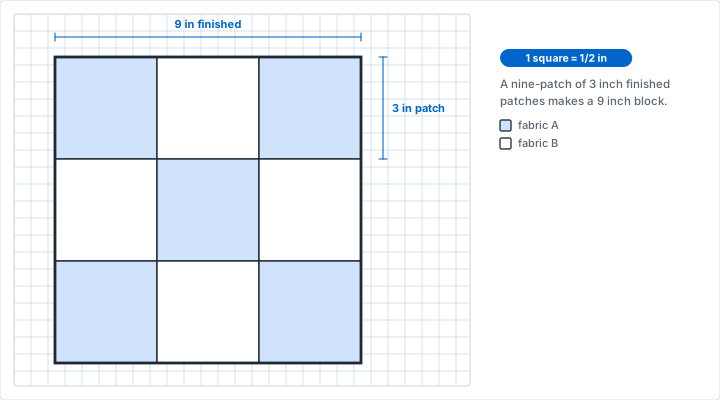
The number of grid divisions determines what fits cleanly into the block. A nine-patch block divided into a 3x3 grid means each unit is one-third of the block. If your finished block is 9 inches, each unit is 3 inches finished. The beauty of graph paper is that you choose a square count that matches the grid: a nine-patch drafts perfectly on a grid where each block unit spans a whole number of paper squares.
Designing a Block on a Grid
Start by deciding the grid category of your block, then assign a number of graph paper squares to each unit. A common and convenient choice is to let each block unit equal a fixed number of squares so subdivisions stay clean.
Step One: Draw the Block Boundary
Outline the full block on the grid. For a nine-patch where each of the three units across spans 3 squares, the block boundary is 9 squares by 9 squares. Choosing a grid size that gives you legible, workable squares matters here -- our grid size guide walks through the tradeoffs. A 1/4-inch grid is a comfortable default for block drafting on letter-size paper.
Step Two: Divide Into Units
Draw the grid lines that separate the major units. For a nine-patch, draw lines after every 3 squares both horizontally and vertically. You now have nine equal cells, each ready to hold a patch, a half-square triangle, or a further subdivision.
Step Three: Fill the Units
Draw the shapes inside each unit. Plain squares stay as they are. Units that contain triangles get a diagonal line. Units that contain a smaller four-patch get subdivided again. Work from the structural pieces outward to the details, exactly as you would frame a house before adding trim.
Draft One Repeat First
Draft a single clean block before you ever sketch the full quilt. Get the proportions and piecing right at the block level. A mistake repeated across forty blocks is forty times harder to fix than a mistake caught in the first draft.
Half-Square Triangles and Diagonal Seams
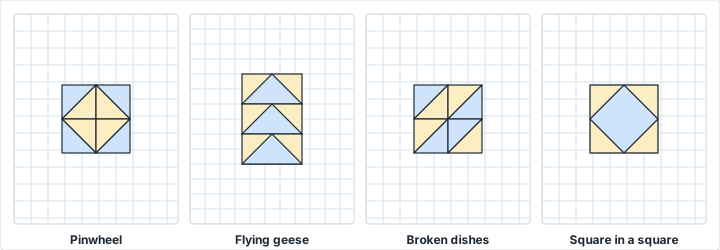
The half-square triangle (HST) is the workhorse of pieced quilting. It is a square unit split corner to corner into two triangles of different fabrics. On graph paper, an HST is simply a grid square with a diagonal line from one corner to the opposite corner. That diagonal represents the seam where two triangles of fabric meet.
Diagonal seams are where graph paper earns its keep, because the diagonal of a square is not a whole number. The diagonal of a 1-inch square is about 1.414 inches (the square root of 2). This matters when you cut fabric: an HST unit is not cut as a finished square and sliced. Instead, you cut a slightly oversized square, cut it once on the diagonal, and sew the two triangles back together along that bias edge. The seam allowance eats into the diagonal, so the cut square must be larger than the finished unit.
Half-square triangle cutting rule: To make two HST units of a given finished size, cut two squares (one of each fabric) that are the finished size plus 7/8 inch. For a 3-inch finished HST, cut 3 7/8-inch squares. Place them right sides together, sew 1/4 inch from each side of one diagonal, then cut on that diagonal to yield two HST units. The extra 7/8 inch covers the two 1/4-inch seam allowances plus the diagonal geometry.
On your graph paper chart, mark each HST unit with its diagonal and shade the two triangles to show which fabric goes where. Many classic blocks -- the Ohio Star, the Pinwheel, Flying Geese arrangements -- are built almost entirely from HST units oriented in different directions. Drawing the diagonals on the grid lets you see the secondary patterns (stars, chevrons, pinwheels) that emerge when the triangles point the right way.
Scaling a Block to Finished Size and Seam Allowances
Two sizes matter for every quilt piece: the finished size (the dimension after the piece is sewn into the quilt, with seams hidden) and the cut size (the dimension you actually cut, including seam allowance). Confusing the two is the single most common quilting mistake, and graph paper helps you keep them separate.
Let One Square Equal One Unit of Measurement
Assign a real-world measurement to each graph paper square. A natural choice is one square equals one inch finished. Then a nine-patch block drawn as a 9x9 square grid is a 9-inch finished block, and each unit is a 3-inch finished patch. The drawing becomes a scaled diagram you can read dimensions directly from.
Add the Seam Allowance
The standard quilting seam allowance is 1/4 inch on every edge. This is industry standard and what every commercial pattern assumes. To convert a finished dimension to a cut dimension for a simple square or rectangle, add 1/2 inch total (1/4 inch for each of the two opposing edges).
- Finished 3-inch square: Cut at 3 1/2 inches (3 + 1/4 + 1/4).
- Finished 6-inch square: Cut at 6 1/2 inches.
- Finished 2-inch by 4-inch rectangle: Cut at 2 1/2 by 4 1/2 inches.
Triangles need different math because the seam allowance must cover the diagonal. As noted above, half-square triangles use the finished size plus 7/8 inch. Quarter-square triangles (a square cut into four triangles on both diagonals) use the finished size plus 1 1/4 inches. Write these cut sizes directly on your graph paper chart next to each piece so the numbers travel with the design to the cutting table.
Keep Two Numbers on Every Piece
Label each shape on your chart with both its finished size and its cut size. For example, write "3 in finished / 3.5 in cut" inside each plain square. When you move to the cutting mat, you read the cut size; when you check the assembled block, you verify the finished size. Keeping both visible eliminates the most common piecing errors.
Planning a Full Quilt Top Layout and Setting
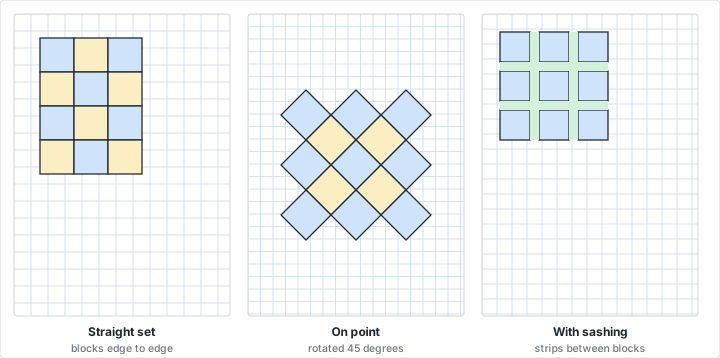
Once a block is drafted, zoom out and plan the whole quilt top. This is where the full-page view of graph paper is invaluable. Use a coarse grid where each square (or each small group of squares) represents one finished block, so the entire quilt fits on one sheet.
Straight Setting
In a straight setting, blocks are arranged in horizontal rows and vertical columns, edges aligned to the sides of the quilt. This is the most common and most beginner-friendly layout. On graph paper, draw a grid of equal squares: a quilt that is 5 blocks across and 7 blocks down is a 5x7 grid of cells. Add sashing (strips between blocks) by leaving a consistent gap or drawing thin rectangles between cells.
On-Point Setting
In an on-point setting, blocks are rotated 45 degrees so they sit as diamonds, with rows running diagonally. On-point settings are more dynamic but require setting triangles to fill the zigzag edges and corner triangles to square off the corners. Graph paper handles this well: draw your block grid, then rotate the layout 45 degrees by drawing the blocks as diamonds on the diagonal of the grid. The half-empty squares around the perimeter show exactly where setting and corner triangles go.
On-point dimension note: When a block is set on point, its diagonal becomes its width and height in the quilt. A 9-inch finished block set on point measures about 12.7 inches across the quilt (9 multiplied by 1.414). Account for this when planning quilt dimensions -- on-point layouts cover more area per block than straight settings, so a quilt of a target size needs fewer blocks.
Borders and Sashing
Add sashing and borders to your layout sketch before finalizing dimensions. Sashing separates blocks and frames each one; borders frame the whole quilt. On graph paper, draw these as bands of squares around your block grid. A 2-inch finished sashing strip and a 6-inch finished border each add measurable width to the quilt, and reading those widths off the grid lets you total the finished quilt size before cutting anything.
Color and Value Mapping
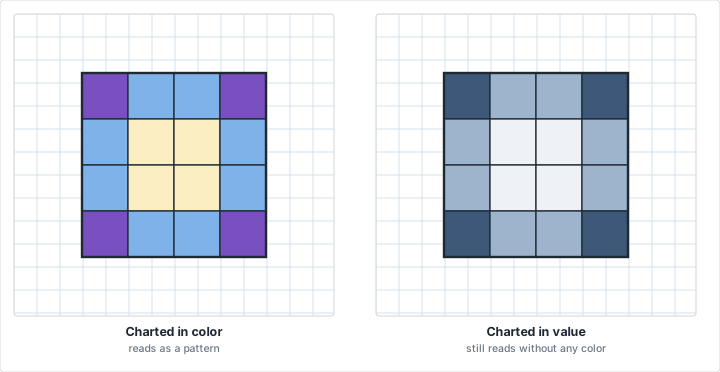
A quilt's impact comes as much from value (the lightness or darkness of each fabric) as from hue. A block can read as a crisp star or a muddy blur depending entirely on which patches are light, medium, and dark. Graph paper lets you test value placement before you commit fabric.
Map Value With Colored Pencils
Shade each patch on your chart to represent its value. Use light, medium, and dark pencil pressure -- or three distinct pencils -- to map the value structure. Squint at the finished chart. If the design still reads clearly when blurred, the value contrast is working. If the star disappears, you need more contrast between the star points and the background.
Test Multiple Colorways
Print several copies of your block outline and color each one differently. Try a high-contrast version, a low-contrast version, and a scrappy version. Comparing them side by side reveals which palette delivers the secondary patterns you want when blocks repeat across the quilt top.
Photograph Your Chart in Grayscale
Take a photo of your colored chart and convert it to grayscale on your phone. Stripping out the color shows the pure value structure. A design that looks great in color but flat in grayscale will look flat across the room as a finished quilt, because the eye reads value before hue at a distance.
Calculating Fabric and Cutting From the Chart
Your finished chart is also your cutting list. Because each piece is labeled with its cut size, you can count pieces by fabric and convert to yardage with simple arithmetic.
Count Pieces by Fabric
Go through your chart and tally how many pieces of each fabric you need at each cut size. For example: "Dark blue, 3 1/2-inch squares: 16. Dark blue, 3 7/8-inch HST squares: 8." Multiply by the number of blocks in the quilt. A nine-patch block repeated 35 times multiplies every per-block count by 35.
Convert to Yardage
Quilting fabric is typically 42 to 44 inches wide off the bolt; 40 inches of usable width after removing selvages is a safe planning figure. To estimate yardage for a given piece:
- Find pieces per width: Divide 40 by the cut width of the piece, rounding down. A 3 1/2-inch square yields 11 pieces across a 40-inch strip (40 divided by 3.5).
- Find strips needed: Divide total pieces by pieces per strip, rounding up. For 80 squares at 11 per strip, you need 8 strips.
- Find length needed: Multiply the number of strips by the cut height of the piece. Eight strips at 3 1/2 inches tall need 28 inches of fabric.
- Add a margin: Add 10 to 15 percent for cutting errors, squaring up, and shrinkage. Round up to the nearest quarter yard (9 inches).
The engineering style of graph paper, with bold lines every few squares, is especially handy for cutting layouts because the heavier lines act as a built-in ruler. See our engineering graph paper for that style. When it comes time to print your charts and cutting diagrams cleanly, our printing tips guide covers scale-accurate output so a "1 inch equals 1 square" chart actually measures one inch on the page.
Common Mistakes
Mistake 1: Confusing Finished Size With Cut Size
Problem: Drafting a 3-inch finished patch and then cutting fabric at 3 inches. The lost 1/4-inch seam allowance on every edge shrinks every piece, and the block finishes too small or refuses to go together.
Fix: Always add the seam allowance to get the cut size. For squares and rectangles, add 1/2 inch total to each dimension. Label both numbers on your chart so the cut size is never in doubt at the mat.
Mistake 2: Ignoring Triangle Math
Problem: Treating a half-square triangle unit like a plain square and adding only 1/2 inch. Triangle units need extra fabric to cover the diagonal seam, so the units come out too small.
Fix: Add 7/8 inch to the finished size for half-square triangles and 1 1/4 inches for quarter-square triangles. Write the correct cut size on every triangle unit when you draft the block.
Mistake 3: Forgetting Setting Triangles on On-Point Quilts
Problem: Planning an on-point layout but only counting full blocks. The zigzag edges and corners are left unaccounted for, and the quilt cannot be squared off.
Fix: Draw the on-point layout on graph paper and you will see the half-empty squares along every edge. Those are your setting triangles, and the four corners are corner triangles. Count and cut them as part of the plan.
Mistake 4: Skipping the Value Check
Problem: Choosing fabrics by color alone. The finished quilt looks muddy because the star points and the background are the same value, even though they are different colors.
Fix: Shade your chart by value, then squint at it or convert a photo to grayscale. Ensure clear light, medium, and dark separation where the design needs contrast before you buy or cut fabric.
Tips for Better Quilt Designs
Work in Pencil First
Draft every block and layout in pencil. Quilt design is iterative -- you will redraw seam lines, swap values, and resize units several times. Pencil erases cleanly from graph paper; commit to ink only once the block is final.
Make a Test Block
Before cutting fabric for an entire quilt, sew one complete test block from your chart. The test block confirms your cut sizes are right, your seam allowance is accurate, and the finished block measures what the chart says. Adjust the chart if the test block comes out wrong, then cut the rest with confidence.
Use Bold Lines as a Built-In Ruler
Mark a heavier line every inch (or every grid division that equals one inch) on your chart. This turns the page into a measuring tool and makes it easy to verify finished dimensions at a glance. The bold lines also help you spot if a unit has drifted off-grid as you draft.
Keep a Block Library
If you design regularly, keep a notebook of drafted blocks with their grid category, finished size, and cutting list. A reusable library means you can pull a proven block into a new quilt layout without redrafting it from scratch.
Conclusion
Quilting rewards careful planning, and graph paper is the planning tool that has served quilters for generations. The grid mirrors the structure of pieced blocks, scales cleanly to finished size, and turns into a cutting list with a little arithmetic. Master a few fundamentals -- the grid category of your block, the difference between finished and cut size, the 1/4-inch seam allowance, and the extra fabric that triangles demand -- and you can take any block from idea to fabric with confidence. Print a fresh sheet, draft a nine-patch, and you will have a buildable quilt block before your coffee gets cold. For more on what graph paper is and how the grid works, see our overview of what graph paper is.
Ready to Design Your First Quilt Block?
Generate custom graph paper sized for quilt drafting. Choose your grid spacing, paper size, and line weight, then print as many copies as you need for blocks, layouts, and cutting charts.
Generate Custom Graph PaperRelated Resources
- How to Choose the Right Grid Size
- Engineering Graph Paper -- bold lines act as a built-in ruler for cutting charts
- Designing Cross-Stitch and Knitting Patterns on Graph Paper
- Professional Printing Tips -- for scale-accurate charts
- Design Sketching on Graph Paper
- Graph Paper Use Cases Across Industries
- Graph Paper and the Analog Revival