Back-to-School Graph Paper: What Each Subject Actually Needs
Somewhere on the supply list is a line that just says "graph paper," and it is doing a lot of work. It might mean the coarse quad-ruled pad in every drugstore, the finer ruling a chemistry teacher expects, the engineering pad the drafting instructor wants, or a metric sheet for a science course that works in centimeters. They are not interchangeable, and the wrong one turns up in week two when a student is trying to fit a whole quadratic onto squares that are too big for it. This guide translates the supply list into an actual ruling, walks through what each subject needs and why, and shows you how to print a term's worth in a single sitting so nobody is hunting for a pad the night before a lab report is due.
What the Supply List Actually Means
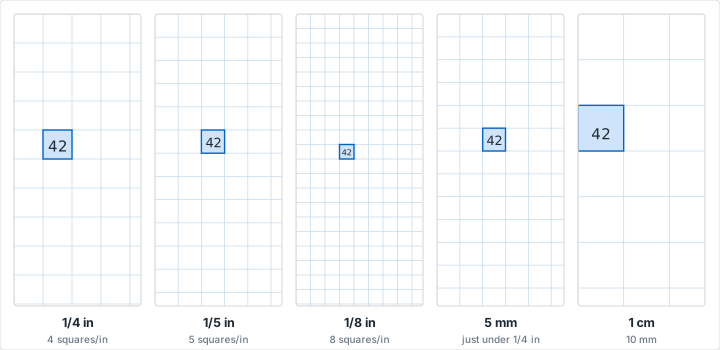
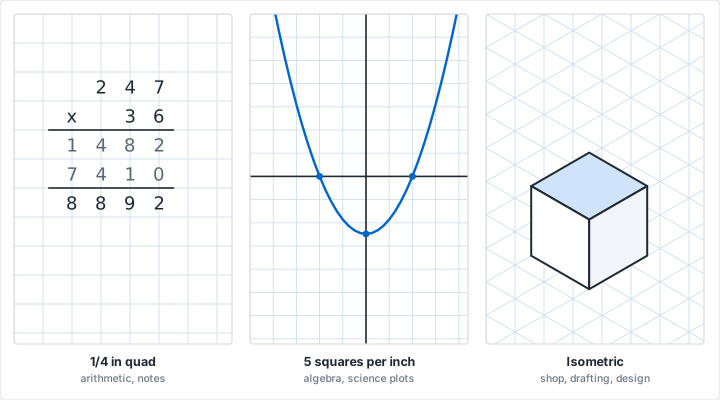
Graph paper is described by how many squares fit into an inch, or in metric countries by how many millimeters each square measures. Everything else -- "quad," "engineering," "grid" -- is a name for one of a small handful of rulings. Once you can read the label, the aisle stops being confusing.
| What the list says | What it means | Square size | Typically used for |
|---|---|---|---|
| Quad ruled, 4x4 | 4 squares per inch | 1/4 inch | The general-purpose default from about grade 3 up |
| 5 squares per inch, 5x5 | 5 squares per inch | 1/5 inch | Graphing where you need more squares per axis |
| Engineering pad | Grid printed on the back, faint through the sheet | Usually 5x5 with heavier inch lines | Engineering, physics, technical courses |
| 8x8 or 10x10 | 8 or 10 squares per inch | 1/8 or 1/10 inch | Detailed plotting, drafting, upper-level science |
| Metric, 5 mm | Five millimeter squares | 5 mm | Science courses working in SI units; standard outside the US |
| Centimeter grid | Ten millimeter squares | 1 cm | Elementary maths, area and perimeter work |
| Dot grid | Dots at the intersections, no lines | Any spacing | Notes and sketching where lines would clutter |
Two of those labels cause most of the confusion. "Quad ruled" simply means squared paper, and in the US it almost always means four squares to the inch -- but the phrase is used loosely enough that some pads sold as quad are 5x5. Check the fine print on the cover rather than the word on the front. And "engineering paper" is not a grid size at all: it describes a pad whose grid is printed on the reverse side so it shows through faintly and does not photocopy. If a teacher asks for engineering paper specifically, they usually want the faint grid and the heavy inch lines, not a particular density.
Ask What the Teacher Means
If the list just says "graph paper" with no ruling, 1/4 inch quad is the safe answer for anything below high school maths, and 5 squares per inch is the safe answer for high school science. A one-line email in August costs nothing and saves buying twice. Some teachers also require a three-hole punch or a specific paper size, which is far easier to satisfy before term starts than after.
Grid Size by Grade
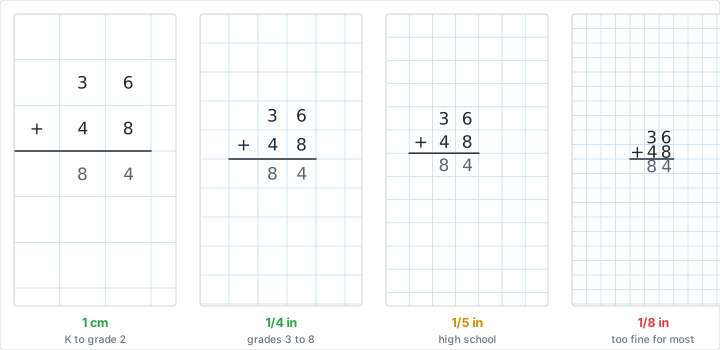
The single rule behind every recommendation below: a square has to be big enough to hold whatever the student writes in it. Younger writers form larger letters and digits, so they need larger squares, and the grid shrinks as their handwriting does. Squares that are too small are worse than no grid at all, because the student writes across four of them and the alignment the grid was supposed to provide disappears.
- Kindergarten to grade 2: 1/2 inch or 1 cm. Big squares for early number formation, one digit per square, and simple counting and area work. A 2 squares-per-inch sheet is not too coarse at this age.
- Grades 3 to 5: 1/4 inch or 1 cm. Column-aligned long multiplication and division is the main use, and it is genuinely transformative for students whose arithmetic errors are really alignment errors.
- Grades 6 to 8: 1/4 inch for general work, 5 squares per inch when coordinate graphing starts. This is where the grid changes job, from keeping columns straight to representing a coordinate plane.
- High school: 5 squares per inch for maths and science, 1/4 inch for notes and sketching, engineering pads for physics and technical courses. Anything finer is a specialist choice rather than a default.
- College: Whatever the department uses. Engineering programs standardize on engineering pads, science labs often want 1 mm or 5 mm metric, and everything else runs on quad.
A useful way to check before printing a hundred sheets: write a two-digit number in one square of a test sheet. If it fills the square comfortably without touching the lines, the ruling is right. If it sprawls over two squares, go coarser. If it floats in the middle of a lot of white space, go finer. Our guide to choosing a grid size works through the same decision for non-school projects.
Print Both and Let Them Choose
Grid preference is more personal than the grade bands suggest. Print a few sheets at two adjacent sizes -- 1/4 inch and 5 squares per inch, say -- and let the student work a page of problems on each. Most people have a clear preference within ten minutes, and it is cheaper to find out in August than in November.
Subject by Subject
Beyond the grade bands, individual courses have their own requirements. These are the ones that come up year after year.
Algebra and Pre-Algebra
Coordinate graphing is the reason graph paper appears on maths supply lists at all, and the requirement is specific: you need enough squares along each axis to plot a sensible range without every point landing between grid lines. A standard letter sheet at 5 squares per inch gives roughly 40 by 50 squares of usable area, which comfortably holds an axis running from -20 to 20 with the origin in the middle. At 1/4 inch you get about 32 by 42, which is workable but tighter.
For solving rather than graphing, the grid does something quieter but just as useful: it keeps equals signs aligned down the page, one step per line. A surprising share of lost marks in algebra are transcription errors between one line and the next, and a column of aligned equals signs makes them visible.
Geometry and Trigonometry
Geometry uses the grid as a measuring tool. Constructions, transformations, reflections, rotations and dilations are all easier to draw and far easier to check when every vertex sits on a lattice point. Coordinate geometry -- distance, midpoint, slope -- is effectively an algebra topic drawn on the same paper.
Trigonometry adds a second requirement. Graphing sine and cosine wants a wide, short sheet so a full period fits without the curve being squashed, which is one of the few cases where turning the paper landscape genuinely helps. Polar coordinates, when they arrive in precalculus, need polar graph paper rather than squares, and it is rarely stocked in shops. Printing it is usually the only practical option.
Chemistry and Physics
Lab courses are where graph paper stops being optional. Most lab reports require hand-plotted data with labeled axes, a stated scale, and a best-fit line drawn by eye -- and many instructors still mark hand-plotting specifically, because it forces the student to think about scale and units in a way that a spreadsheet does not.
Practically, this means 5 squares per inch or finer, and a sheet with a wide clear margin for the axis labels. Chemistry adds titration curves and Beer's law plots; physics adds motion graphs, force diagrams and, in later courses, log and semi-log plots for anything exponential. Our guide to graphing lab data covers axis choice and error bars in detail, and logarithmic paper explains when to switch away from linear.
Organic chemistry is the exception to all of this, because it is drawing rather than plotting. An orgo course wants hexagonal paper, where one cell of the rule is one six-membered ring, and it wants it from the first week rather than the first lab report. Our guide to drawing structures on hexagonal paper covers bond length, ring orientation and the parts of the course the rule does not help with.
Check the Calculator Policy First
Maths and science courses often specify an exact calculator model, and the rules differ between classroom use and standardized tests. Confirm the required model with the school before buying, and check the current calculator policy for any exam the student will sit -- the permitted list changes, and a calculator that is fine in class is not automatically fine in the exam hall.
Biology and Environmental Science
Biology needs less graph paper than chemistry, but what it needs is specific: population growth curves, enzyme rate plots, Punnett squares, and quadrat sampling grids for ecology fieldwork. Punnett squares in particular are just a small grid drawn by hand, and doing them on squared paper stops the 4x4 dihybrid cross from wandering off the edge of the page.
Field notebooks are a separate question. If the course involves outdoor sampling, a bound quad-ruled notebook survives a rucksack better than loose sheets in a folder, and the numbered pages matter if the notebook is being marked as a record.
Art and Design Classes
Art classes use grids for transferring and scaling images -- the grid method is still taught because it works -- and for perspective construction, where a grid on the ground plane makes vanishing points tractable. Design and tech courses use isometric paper for three-dimensional sketching without any drawing instruments.
One caution: for finished work, students usually want the grid to disappear. Either draw on plain paper over a printed grid on a light box, or use dot grid, which gives the alignment without lines that show up in a photograph of the finished piece.
Shop, Drafting, and CAD Classes
Technical drawing courses are the most demanding users of graph paper in a school, and the most particular about it. Orthographic projection -- top, front and side views laid out in the standard arrangement -- wants a fine grid and a lot of sheet, so 8 or 10 squares per inch on the largest paper the printer takes. Isometric paper is a separate requirement for pictorial views, and it is worth printing a stack at the start of term because it is almost never available locally.
Even courses that are entirely CAD-based tend to start on paper, because sketching a part before modeling it is faster than fighting the software into showing you what you meant. Our guide to drawing plans to scale covers the same ground for shop projects.
Note-Taking in Any Subject
Outside the sciences, graph paper earns its place in note-taking for anyone who draws while they think. Diagrams, timelines, mind maps, tables sketched on the fly, and the margins of a page of prose all benefit from a faint grid, and students with handwriting or spatial difficulties often find squared paper markedly easier than ruled. Our post on handwriting practice covers using the grid to control letter size and baseline, which is the same mechanism working in the background of ordinary notes.
Buy a Pad or Print Your Own
Both, usually. They solve different problems, and the mistake is treating it as an either-or.
Buy a pad or notebook when the paper needs to survive being carried around. A bound quad-ruled composition book does not fall out of a bag, cannot be handed in out of order, and is what most teachers picture when they write "graph paper notebook" on a list. For a daily-use maths or science class, this is the right default.
Print your own when you need something a shop does not stock -- isometric, polar, hexagonal, semi-log, a specific metric spacing, a grid sized to a project -- or when you need a lot of one thing quickly. This covers most of the awkward cases in the list above, and it costs nothing but paper.
| Situation | Better answer | Why |
|---|---|---|
| Daily maths class | Bound quad-ruled notebook | Stays together and stays in order |
| Weekly lab reports | Printed sheets, three-hole punched | Goes straight into the lab binder |
| Isometric, polar, or log paper | Printed | Rarely stocked, and needed in small quantities |
| A metric ruling in the US | Printed | Genuine 5 mm paper is hard to find locally |
| Ran out at 9pm | Printed | The shop is shut and the assignment is not |
| A whole class needs the same sheet | Printed once, photocopied | One master sheet, any quantity |
Printing a Term's Worth in One Sitting
Printing graph paper is easy to get slightly wrong in a way that only shows up when a student measures something. Ten minutes of setup in August prevents it.
Print at 100%, Always
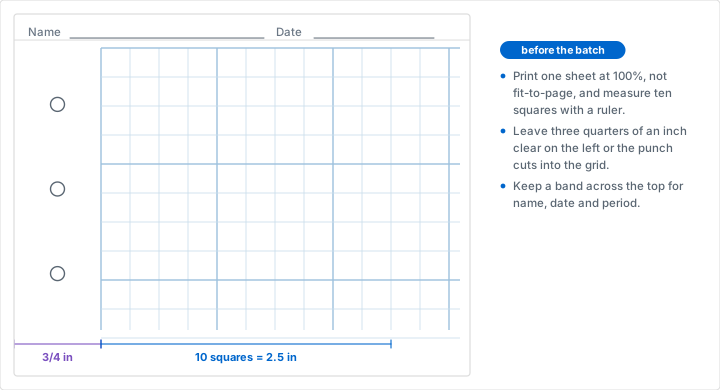
The single most important setting. "Fit to page" and "shrink oversized pages" both scale the sheet down by a few percent to fit the printer's margins, which means your 1/4 inch squares come out at something like 0.24 inches. Nobody notices until a geometry problem asks the student to measure a length off the grid, and then every answer is quietly wrong. Set the scale to 100% or "actual size," print one sheet, and check it with a ruler before printing the rest. Our printing guide covers the driver settings for the common cases.
Leave Room for the Holes
If the sheets are going into a binder, the left margin needs about three quarters of an inch of clear paper for the punch, or the holes will cut through the grid. Set the margin before you print rather than punching hopefully afterwards. The same applies to any header the teacher requires -- name, date, period -- which wants a clear band across the top rather than a name written over squares.
Print the Awkward Ones Now
Isometric, polar, hexagonal and log paper are all needed a few times a term and never available on the evening they are needed. Print ten or twenty of each at the start of term, punch them, and put them at the back of the binder. This is the single highest-return thing on this page.
A Fifteen-Minute August Session
Print 40 sheets of the student's default ruling, 20 of the secondary ruling their science class wants, and 10 each of any specialist paper on the syllabus. Check the first sheet of each with a ruler. Punch the lot in one go, and split it between the binder and a folder kept at home. That is the whole year's paper problem solved before term starts, and it takes about as long as one trip to the shop.
The Supply Checklist
What actually gets used, as opposed to what gets bought and stays in the packet.
- The right ruling, in quantity. One default grid for everyday work, plus whatever the science or technical courses specify.
- A bound quad-ruled notebook for any class where loose paper goes missing.
- Pencils, not pens, for graphing. Plotted points move once the student realizes the scale is wrong, and they should be able to move.
- An eraser that does not smear. A plastic or vinyl block eraser lifts graphite cleanly off a printed grid; the eraser on the end of a pencil mostly redistributes it.
- A ruler with a straight, unchipped edge. Doubling as a straight edge for axes and best-fit lines.
- Compass and protractor for any geometry course, checked to make sure the compass actually holds its setting.
- The specified calculator, confirmed with the school rather than guessed.
- A punch, or pre-punched paper, if anything is going into a binder.
Mistakes That Show Up Every August
Mistake: Buying the Grid Size on the Shelf
Problem: The pad in the shop is whatever the shop stocks, which in the US is usually 4 squares per inch. If the course needs 5 or finer, the student spends the term working around paper that does not suit the task, and coordinate graphs come out cramped.
Solution: Read the ruling on the cover, not the word "graph" on the front. If the required ruling is not stocked, print it -- this is exactly the case printing solves.
Mistake: Printing with "Fit to Page" Left On
Problem: The grid prints a few percent small. Every measurement taken off the sheet is wrong by the same factor, and because it is consistent it looks like nothing is wrong at all.
Solution: Print at 100% or "actual size," then measure a known distance on the first sheet -- ten squares at 1/4 inch should be exactly 2.5 inches. Check once, then print the batch.
Mistake: Squares Too Small for the Writer
Problem: A fine grid looks precise and professional, so it gets chosen for a young student whose digits are three squares tall. The alignment benefit vanishes and the page looks messy, which is discouraging.
Solution: Match the square to the handwriting, not to the subject. One digit should sit inside one square with room to spare. Go coarser without embarrassment; the paper is there to serve the writing.
Mistake: Leaving the Specialist Paper Until It Is Needed
Problem: Polar paper is required for a Tuesday assignment, nobody stocks it, and the printer is out of paper on Monday night. The student draws circles by hand and the marks reflect it.
Solution: Read the syllabus in August for anything that is not plain squares, and print a stack of each then. It takes minutes and removes an entire category of last-minute problem.
Mistake: Loose Sheets With No Home
Problem: Printed paper is free, so it accumulates loose in a bag, gets creased, and cannot be found when a graph is due. Loose sheets also arrive at the teacher out of order and unlabeled.
Solution: Punch everything as it comes off the printer and give it a section in the binder. If loose paper is a persistent problem for that student, use a bound notebook for daily work and reserve printed sheets for assignments that get handed in.
Conclusion
Most graph paper problems in a school year trace back to one of two things: a ruling that does not match the writing, or a sheet that printed at 97%. Both are decided in the first week and neither is difficult to get right. Read the ruling rather than the word on the cover, match the square to the student's handwriting rather than to the subject, and check the first printed sheet with a ruler.
Then print the awkward paper -- isometric, polar, log, metric -- before anyone needs it. That stack at the back of the binder is worth more than anything else you will buy in August, and it costs a few sheets of paper and fifteen minutes.
Print This Year's Paper Now
Any ruling, any paper size, metric or imperial, at exactly 100% scale. Free, with no account and nothing to install.
Create Graph Paper NowRelated Resources
- How to Choose the Right Grid Size -- matching the square to the work
- Professional Printing Tips -- printing at true 100% scale
- Paper Sizes Explained -- letter, A4, and what your printer will actually do
- Mathematics Graphing Tutorial -- setting up axes and scales
- Graphing Science Lab Data -- plots that satisfy a lab report
- Handwriting Practice on Graph Paper -- letter size, baseline and spacing
- Isometric Graph Paper -- for design and technical drawing courses
- Sketching Circuits on Graph Paper -- the sheet an electronics course actually needs
- Logarithmic Graph Paper -- for exponential data in upper-level science
- How to Make a Seating Chart -- desk arrangements drawn to scale before you move any
- Graph Paper and the Analog Revival