Drawing Organic Chemistry Structures on Hexagonal Graph Paper
Organic chemistry is the one science course still examined almost entirely by hand. Nobody gets ChemDraw in the exam hall, and a mechanism that is unreadable is a mechanism that is unmarked, so the ability to put a clean benzene ring on paper quickly is worth real marks. Hexagonal graph paper makes that close to automatic: one hexagon of the rule is one six-membered ring, drawn at a consistent size, with the 120-degree bond angles already built into the paper. This article covers how to set the paper up, how rings, chains and fused systems land on it, and -- just as important -- the large parts of an organic course where the hex rule does nothing for you at all.
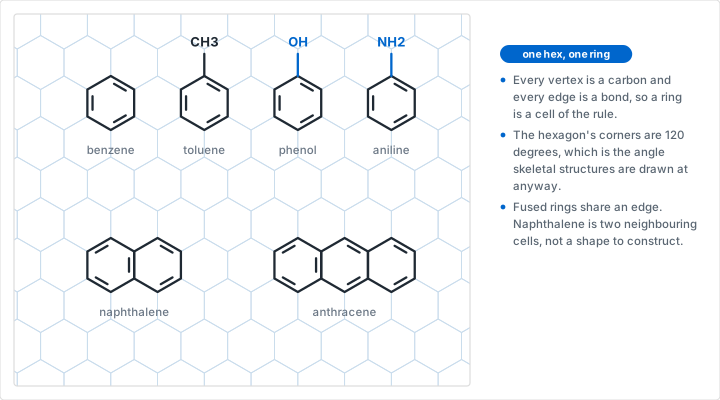
Why Skeletal Structures Suit a Hex Grid
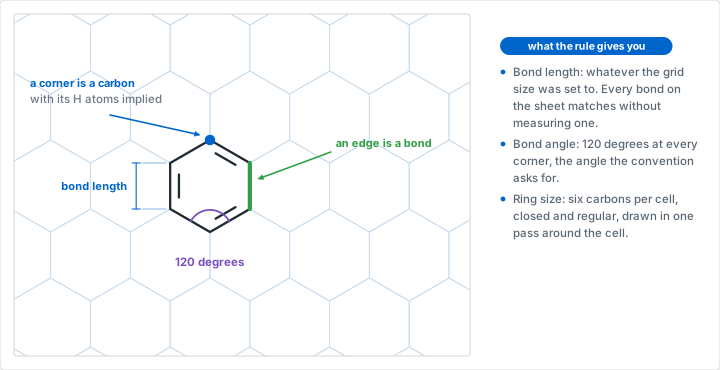
Organic structures are drawn in skeletal form, also called line-angle notation, and the whole convention is an exercise in leaving things out. Every corner and every free line end is a carbon atom, and it is never written. Hydrogens attached to those carbons are not written either -- you infer them from the fact that carbon forms four bonds. What does get written is anything that is not a carbon: the O in an alcohol, the N in an amine, the halogen on a haloalkane, and any hydrogen attached to one of those heteroatoms, because that hydrogen is where the chemistry usually happens.
What is left is a drawing made entirely of equal-length lines meeting at consistent angles. The convention asks for 120 degrees between them, partly because trigonal planar carbon genuinely is 120 degrees, and partly because even tetrahedral sp3 chains are drawn as a 120-degree zig-zag for legibility rather than at the true 109.5. A regular hexagon has 120-degree interior angles and six equal sides. The notation and the paper are describing the same shape.
That gives you three things without any effort, and they are exactly the three things that make hand-drawn structures look competent: every bond on the page is the same length, every angle is correct, and every six-membered ring closes cleanly at the size the last one did. Freehand, all three drift over the course of a page, and a ring that does not quite close or a bond that is half again as long as its neighbors reads as carelessness even when the chemistry is right.
The Paper Does Not Do the Chemistry
Worth saying plainly: a neat structure is not a correct one. The rule fixes geometry, not valence, and it will let you draw a pentavalent carbon as happily as a correct one. Treat it as handwriting practice for chemistry -- it removes a category of presentation error so the marker is reading your reasoning rather than deciphering your lines.
Setting Up the Sheet
Orientation: A Vertex at the Top
Hexagons tile in two orientations, and only one of them is useful here. You want the pointy-top arrangement: a vertex at the top and bottom of each cell, and vertical bonds down the left and right sides. That is the orientation every textbook draws benzene in, and the reason matters. Each ring vertex has three lattice directions leading away from it; the ring itself uses two, so exactly one is left over, and that is where a substituent goes. On the top carbon, the leftover direction points straight up the page -- which is where you would have drawn the methyl group of toluene anyway.
The generator on this site produces pointy-top hexagons, so hexagonal graph paper from it is already in the right orientation. If you have a sheet with flat tops and horizontal bonds instead, turn it ninety degrees; the two orientations are the same tiling seen from different sides, and rotating the page converts one into the other.
Grid Size Is Bond Length
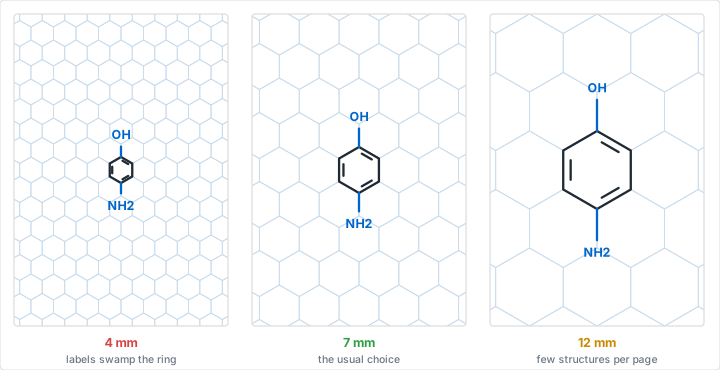
For a regular hexagon, the distance from the center to a corner equals the length of a side, so the grid size setting is the bond length of every structure you draw. This is the one number to get right, and it is a trade-off rather than a correct answer. Substituent labels do not shrink when the rule does: OH, NH2 and OCH3 are written at whatever size your handwriting produces, so on a fine rule they end up as large as the ring they hang off, and the structure is swamped by its own labeling.
- 7 mm, or 1/4 inch, is the general answer. Substituents clear the ring, a full mechanism fits across one sheet, and the structures are close to textbook size.
- 10 to 12 mm for heavily substituted work, or when you are labeling carbons with numbers, marking stereocenters, or annotating in a second color. Fewer structures per page, but nothing is cramped.
- 4 to 5 mm only for large fused systems -- steroids, polycyclic aromatics -- where you need a lot of rings on one sheet and there is little to label.
The same logic drives every grid decision on this site, and our guide to choosing a grid size works through it for other kinds of work. The test is identical: write the label you actually write, at the size you actually write it, and see whether it fits.
Line Color and Printing
Print the rule light. A hex grid is dense -- far more line per square inch than a squared sheet -- and at full-strength black it competes with your structures instead of guiding them. A light gray or pale blue rule stays visible enough to draw along and drops away when you look at the finished structure, which is the same reason engineering pads print their grid faintly. If you are photographing or scanning work for a submission, a pale blue rule tends to disappear almost entirely under a scanner's contrast settings.
Print at 100% scale rather than fit-to-page. This matters less here than on a squared sheet, since you are not measuring anything off a structure, but a scaled sheet is no longer the bond length you chose, and if you print a second batch later the two will not match. Our printing guide covers the driver settings that quietly rescale a page.
Rings, Chains and Fused Systems
Benzene, and the Circle Question
Benzene can be drawn two ways: the Kekule structure with three alternating double bonds, or a plain hexagon with a circle inscribed to represent the delocalized system. Both are accepted, and the circle is arguably the more honest picture of the real molecule, where all six bonds are identical.
Draw the Kekule form anyway, at least while you are learning mechanisms. The moment you need to push arrows -- electrophilic aromatic substitution, the formation and collapse of an arenium ion -- you have to say which bond the electrons came from, and a circle cannot say that. Students who habitually draw the circle tend to freeze at exactly the step where a specific pi bond has to attack something. The circle is a summary; the mechanism needs the detail.
Fused Rings Are Just Neighboring Cells
This is where the paper earns its place. Two rings sharing an edge is a fused bicyclic: naphthalene, or decalin if it is saturated. On hex paper, that is two adjacent cells, and the shared bond is a line you have already drawn. Anthracene is three cells in a row; phenanthrene is three cells in an angular arrangement. None of them requires you to construct anything, and the geometry cannot drift, because the second ring is not a copy of the first -- it is the cell next door.
Freehand, fused systems are where structures visibly fall apart. The second ring comes out slightly larger than the first, the shared bond ends up at a different angle from its parallel partner, and by the fourth ring the drawing is leaning. On the rule this failure mode does not exist. If a course covers polycyclic aromatics, steroids or alkaloids in any depth, this alone is worth the printing.
Substituents, Heteroatoms and Chains
A substituent takes the one lattice direction the ring leaves free at its vertex, so it lands on the rule without being placed. Write its label just beyond the end of that bond. Heteroatoms inside a ring are different: nitrogen in pyridine replaces a carbon rather than hanging off it, so the N is written at the vertex position itself, with the two ring bonds stopping just short of the letter rather than running into it. Leaving that small gap is what makes the difference between a label that reads clearly and one that looks like it was struck through.
Open chains work better on hex paper than people expect. The edges of a hex tiling form continuous zig-zag paths running across the sheet, so an alkyl chain drawn along those edges gets equal bond lengths and correct alternating angles for free -- hexane as six edges of the rule, with the seventh position ready for whatever is on the end. The one thing to watch is that two carbons bearing different groups can be an awkward fit, because a quaternary or gem-disubstituted carbon needs two bonds leaving one vertex and the lattice only offers one free direction. That one goes off-grid, and it is fine that it does.
Number the Ring Once, at the Top
Because every ring on a hex sheet has a vertex at twelve o'clock, you can adopt a habit of numbering from that vertex clockwise on every structure you draw. IUPAC locants still have to follow the lowest-locant rules rather than your habit, but starting from a fixed position makes it far quicker to check that two structures on the same page are substituted at the same carbon -- which is most of what you are doing when you compare a starting material with a product.
Where the Hex Rule Stops Helping
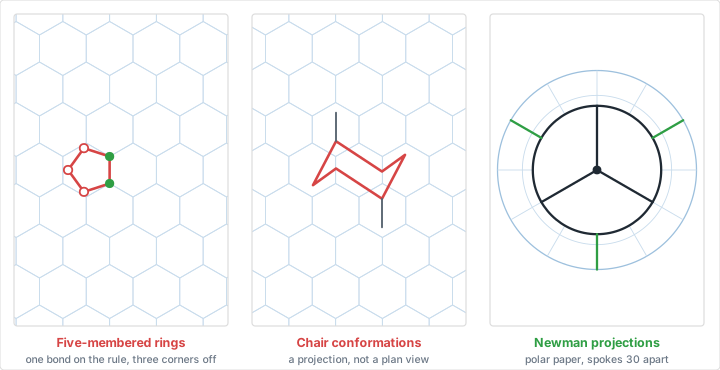
A hexagonal rule does exactly one thing: six-membered rings and 120-degree chains. A large fraction of an organic course is neither, and it is worth knowing in advance which pages to draw on something else rather than fighting the paper.
Rings that are not six-membered. A five-membered ring can share one bond with the rule and no more, because lattice edges meet at 120 degrees and a pentagon corner is 108 -- so the third corner is already off, and with it cyclopentane, furan, pyrrole, thiophene, imidazole and the whole run of five-membered heteroaromatics. Indole is a six-ring fused to a five-ring, so half of it fits and half does not. Three-, four-, seven- and eight-membered rings are off the rule entirely. The steroid nucleus is a particularly annoying case: three six-membered rings that land perfectly, and a five-membered D ring that does not.
Conformations. A cyclohexane chair is not a hexagon seen from above; it is a projection drawn as three pairs of parallel bonds, and it corresponds to nothing on the rule. Boat, twist-boat and the ring-flip diagrams that go with them are the same. Axial bonds are drawn vertically, alternating up and down around the ring, and equatorial bonds roughly parallel to the ring bond two positions away -- none of which the paper helps with. Draw conformational analysis on plain or lightly squared paper.
Projections. Newman projections want a circle, not a hexagon, and they are one of the few places where polar graph paper is genuinely the right sheet: the front atom's three bonds and the back atom's three both sit at 120-degree spacing, so on a twelve-spoke polar rule every bond lands on a spoke and a staggered conformation is exactly two spokes offset from an eclipsed one. Fischer projections are a cross of horizontal and vertical bonds and belong on ordinary squared paper.
Stereochemistry. Bold wedges and hashed wedges point out of and into the page, which is a direction the lattice does not have. They are drawn off-grid by nature. This is not a problem -- a wedge hanging off a ring vertex looks entirely normal -- but do not try to align them to anything.
| What you are drawing | Best sheet | Why |
|---|---|---|
| Benzene, cyclohexane, pyridine | Hexagonal | One ring per cell, no construction |
| Fused and polycyclic aromatics | Hexagonal | Neighboring cells, geometry cannot drift |
| Alkyl chains and zig-zags | Hexagonal | Chain runs along the lattice edges |
| Five-membered rings and heteroaromatics | Plain or dot grid | No five-fold geometry on a hex rule |
| Chair and boat conformations | Plain or squared | A projection, not a plan view |
| Newman projections | Polar | Bonds land on spokes 30 degrees apart |
| Fischer projections | Squared | Horizontal and vertical bonds only |
| Mixed pages, mostly six-rings | Dot grid | Alignment without a rule that fights the exceptions |
For a course where you want one sheet rather than four, a dot grid is the honest compromise. It gives you alignment and consistent spacing everywhere without asserting a geometry, so a cyclopentane looks no worse than a benzene. You lose the automatic ring, which is a real loss, but you stop fighting the paper on every page that is not aromatic.
Mechanisms, Resonance and Retrosynthesis
The strongest argument for the rule is not any single structure -- it is what happens when you draw the same skeleton four times in a row.
Resonance structures are the clearest case. You are drawing one molecule repeatedly, changing only where a pair of electrons sits, and the entire point is that the reader can see what moved. If the four hexagons come out at four slightly different sizes and angles, that signal is buried in noise. On the rule they are identical by construction, so the only visible difference between one structure and the next is the difference you meant. The same holds for a mechanism, where the substrate persists across several steps while groups come and go.
Some practical layout habits that the rule makes easy:
- One step per row, left to right. Put the reaction arrow between structures at a consistent height, reagents above it and conditions below.
- Leave a full cell of clear paper between structures. Curved arrows need room to be curved; cramped arrows get ambiguous about which bond they start from, and an arrow whose origin is unclear does not earn the mark.
- Keep charges clear of the rule lines. A plus or minus sign written on top of a grid line is easy to misread. Set formal charges just outside the ring, next to the atom carrying them.
- Distinguish your arrowheads. A full head is two electrons, a single-barbed fishhook is one. In radical mechanisms the difference is the whole answer, and it is the first thing lost in a rushed drawing.
- Retrosynthesis runs right to left with an open double-lined arrow. Target at the right edge of the sheet, work backwards, and let each disconnection have its own row.
A Page That Marks Well
Target structure at the top with its carbons numbered. Each subsequent row is one step: starting material on the left, arrow with reagents above it, product on the right, and a short note in the margin saying what kind of step it is. Every ring the same size, every bond the same length, and a clear cell of white paper wherever an arrow has to curve. None of that is chemistry, and all of it is marks.
The Rest of the Chemistry Course
Structures are only part of what a chemistry student draws, and the other parts want different paper entirely.
Kinetics is the main one. A first-order reaction gives a straight line when the logarithm of concentration is plotted against time, and semi-log paper lets you plot the concentration directly on the log axis and read the straight line without computing a column of logarithms first. Second-order runs want 1/[A] against time on ordinary squares. Either way you need a linear sheet with room for labeled axes, not a hex rule.
Titration curves, Beer-Lambert calibration lines and vapour-pressure plots are all ordinary squared-paper work, and most lab reports still want them plotted by hand with a stated scale and a best-fit line drawn by eye. Our guide to graphing lab data covers axis choice, units and error bars for exactly those plots, and the mathematics graphing tutorial covers setting up axes and scales from scratch. If you are working out what to buy or print before a term starts, the back-to-school paper guide goes subject by subject, chemistry included.
Mistakes That Cost Marks
Mistake: Drawing Too Small
Problem: A fine rule looks precise, so it gets chosen for a mechanism with substituents on half the ring positions. The labels overlap the bonds, curved arrows have nowhere to go, and by the third step the page is unreadable -- to the marker as well as to you.
Solution: Set the bond length from your handwriting, not from how much you want to fit on a page. If OH written at your normal size does not sit clear of the ring, the rule is too fine. Use a second sheet instead.
Mistake: The Circle in a Mechanism
Problem: Benzene is drawn with an inscribed circle throughout, and then an electrophilic aromatic substitution needs a specific pi bond to attack. There is nothing on the page to push an arrow from, and the intermediate cannot be drawn honestly.
Solution: Use the Kekule form with alternating double bonds whenever electrons are going to move. Keep the circle for structures that are only being named or identified.
Mistake: Forcing the Exceptions Onto the Rule
Problem: Cyclopentane gets drawn as a squashed hexagon so it will fit the cells, or a chair gets built out of grid edges. Both produce structures that are wrong in a way a marker will notice, and the chair in particular stops showing axial and equatorial positions, which is the only reason to draw a chair at all.
Solution: Draw off the rule and ignore it. The grid is a guide, not a constraint -- a correct five-membered ring floating between cells is far better than a distorted one aligned to them.
Mistake: Grid Printed Too Dark
Problem: The rule is printed at full black, so a page of structures is a thicket of hexagons with the actual molecules somewhere inside it. Photographed for an online submission, the structures are barely findable.
Solution: Print the rule in a light gray or pale blue and draw in a darker pen or pencil. The contrast between rule and ink is what makes the structure read; without it the paper is working against you.
Mistake: Practicing Only on Gridded Paper
Problem: Every structure all term is drawn on hex paper, and then the exam supplies plain lined answer booklets. The rings come out uneven and oversized because the hand has never had to judge a hexagon unaided.
Solution: Use the rule to learn what a correct ring looks and feels like, then deliberately work some problem sets on blank paper. The grid is training wheels, and the point of training wheels is to come off before the race.
Conclusion
Hexagonal paper solves a narrow problem completely. Six-membered rings, fused systems and 120-degree chains -- the structural core of an organic course -- come out consistent, correctly angled and the same size every time, and repeated structures across a mechanism differ only where you meant them to. That is a real gain in a subject where presentation and comprehension are hard to separate.
It does nothing for five-membered rings, conformations or projections, and pretending otherwise produces worse drawings than plain paper would. Print a stack of hex sheets for structures and mechanisms, keep squared and plain paper for everything else, and set the bond length from the size of your own handwriting rather than from how much you would like to fit on a page.
Print Hexagonal Paper at Your Bond Length
Set the grid size to the bond length you want, pick a light rule color, and print at 100%. Free, with no account and nothing to install.
Create Hexagonal Graph PaperRelated Resources
- Hexagonal Graph Paper -- the grid itself, and its other uses
- Back-to-School Graph Paper -- what each subject needs, chemistry included
- Graphing Science Lab Data -- axes, scale and best-fit lines for lab reports
- Logarithmic Graph Paper -- semi-log plots for reaction kinetics
- Polar Graph Paper -- the right sheet for Newman projections
- Dot Grid Paper -- alignment without a geometry that fights the exceptions
- Mathematics Graphing Tutorial -- setting up axes and scales
- What Is Graph Paper? -- the rulings and where each came from