Graphing Science Lab Data on Graph Paper
A good graph turns a column of numbers into a relationship you can see. In physics, chemistry, and biology lab work, the graph is often the whole point of the experiment: it reveals whether two quantities are proportional, where a reaction levels off, or how fast a population grows. Plotting software is everywhere, but hand-plotting data on graph paper remains one of the most valuable skills a science student can build. When you place each point by hand, you slow down enough to understand what the data is actually telling you. This guide walks through choosing scales, labeling axes, plotting points, drawing a best-fit line, reading slope as a physical quantity, handling uncertainty, and knowing when to reach for logarithmic paper instead.
Why Hand-Plotting Still Matters
It is tempting to type your numbers into a spreadsheet, click a chart button, and move on. For final lab reports, that is often the right call. But for learning, hand-plotting teaches things software hides:
- You feel the scale decisions: Software auto-scales axes for you. On paper, you must decide how many units each square represents, which forces you to understand the range of your data.
- You see outliers immediately: A point that lands far from the trend jumps out when you place it by hand, prompting you to check for a measurement or recording error.
- You judge the fit yourself: Drawing a best-fit line by eye builds intuition for what a good fit looks like, rather than trusting a hidden regression formula.
- No software dependency: A printed grid and a sharp pencil work during an exam, a field trip, or a power outage. Print a sheet from our generator and you are ready.
- It is often required: Many lab courses and standardized practical exams still require neat hand-drawn graphs, and grade them on scale, labeling, and line-fitting.
The goal is not to avoid computers forever. It is to understand graphing deeply enough that you can read any graph critically, including the ones a computer makes for you. For a broader walkthrough of plotting equations and coordinates, see our math graphing tutorial.
Choosing Your Axes
Which Variable Goes Where
The convention is firm and worth memorizing: the independent variable goes on the horizontal axis (x), and the dependent variable goes on the vertical axis (y). The independent variable is the one you control or change deliberately. The dependent variable is the one you measure in response.
- In a spring experiment, force (what you apply) goes on x, and extension (what you measure) goes on y.
- In a heating experiment, time goes on x, and temperature goes on y.
- In an enzyme experiment, substrate concentration goes on x, and reaction rate goes on y.
A common shortcut: whatever you wrote in the left column of your data table usually belongs on the x-axis. Keep the spoken phrase "y versus x" in mind. A graph of "temperature versus time" means temperature on the vertical axis and time on the horizontal axis.
Setting the Scale
Scale is where most hand-drawn graphs go right or wrong. The principle is simple: spread your data across as much of the grid as possible so the trend is easy to read. A graph crammed into one corner wastes the paper and hides the relationship.
To choose a scale, find the largest value you need to plot on each axis, then divide the available squares by that value to get a "units per square" figure. Round to a convenient number. Good scales use 1, 2, 5, or 10 units per square (or those numbers times a power of ten). Awkward scales like 3 or 7 units per square make plotting and reading slow and error-prone.
Scale rule of thumb: Your plotted points should fill at least half the width and half the height of the grid. If they do not, your scale is too compressed. Choose a finer scale (fewer units per square) so the data spreads out. Our grid size guide can help you pick paper with enough squares for the range you need.
The Origin Question
Your axes do not always have to start at zero. If your temperature readings run from 78 to 96 degrees, starting the y-axis at zero would squash all your data into a thin band near the top. Instead, start that axis at 75 and let the data spread out. This is called a "suppressed zero" or "false origin," and it is perfectly valid when you are studying the trend rather than the absolute size of the values.
There is one important exception. If you intend to read the slope or extrapolate back to the axis, you usually want a true origin at (0, 0) so that the y-intercept is meaningful. For a force-versus-extension graph used to find a spring constant, start both axes at zero. When you suppress the origin, mark the axis break clearly so no one misreads the graph.
Labeling Axes With Units
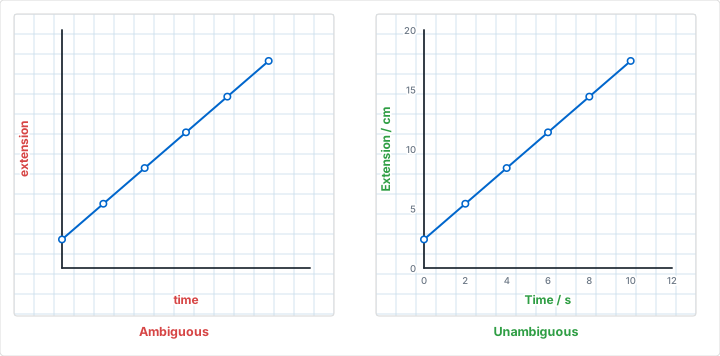
An unlabeled graph is nearly worthless in science. Every axis needs a quantity name and a unit. Write the label along the axis, centered, in the form "Quantity / unit." The slash is read as "in units of," so "Time / s" means time measured in seconds.
- Force / N for force in newtons
- Extension / mm for extension in millimeters
- Temperature / °C for temperature in degrees Celsius
- Volume / cm³ for volume in cubic centimeters
- Rate / s⁻¹ for a reaction rate per second
Number the gridlines, not the data points. Write scale numbers at regular intervals along each axis (every 5 or 10 squares is common) and let the gridlines carry the rest. Give the graph a clear title that states what it shows, such as "Extension of a Steel Spring Against Applied Force." A title of "Graph 1" tells the reader nothing.
Plotting Data Points
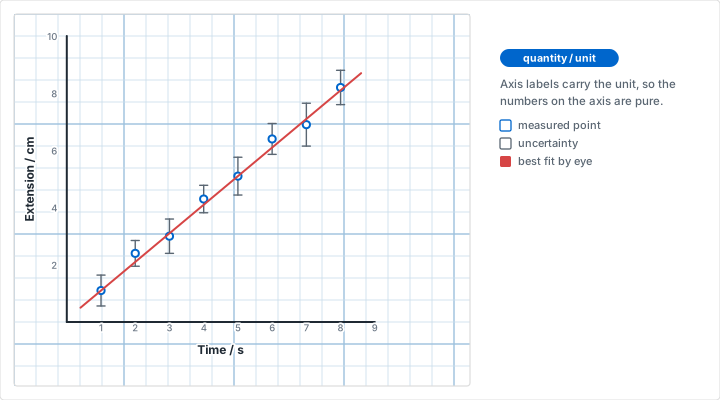
Plot each point with a small, precise mark. The two standard conventions are a fine cross (plus sign) or a dot inside a small circle. Both make the exact location visible and distinguish a true data point from a stray pencil smudge. Avoid heavy blobs; a fat dot can cover half a square and hide where the point really sits.
Work from your data table one row at a time. Find the x value along the horizontal axis, the y value along the vertical axis, and mark where they meet. After plotting every point, scan the whole set before drawing any line. A point that breaks the pattern is a signal: recheck the reading in your table, and if you confirm it, decide whether it is a genuine result or an error to investigate.
Plot in Pencil First
Always plot in sharp pencil. Points get repositioned, scales get reconsidered, and lines get redrawn. Pencil erases cleanly from graph paper; ink does not. Keep the pencil sharp so each cross stays small and accurate.
Drawing a Best-Fit Line by Hand
Once your points are plotted and you can see a trend, draw a single straight best-fit line (or a smooth curve, if the relationship is clearly curved). The most important rule of hand-graphing follows here.
Best Fit, Not Connect-the-Dots
Problem: Drawing short line segments from point to point, creating a jagged zigzag. This treats every measurement as exact and ignores experimental scatter.
Fix: Draw one smooth line that captures the overall trend. The line should pass through or near as many points as possible, with roughly equal numbers of points above and below it. Some points will sit off the line; that is normal and expected.
To draw a good best-fit line, lay a clear ruler across the points and adjust its angle until the scatter is balanced on both sides. The line does not need to pass through any particular point, and it does not need to start at the origin unless the physics demands it. Extend the line across the full range of your data. Draw it thin and confident; a single clean stroke is easier to read than several overlapping tries.
For curved relationships, sketch the smoothest curve that follows the trend without wobbling between points. Do not force a curve through every dot. The smoothness itself communicates that the underlying relationship is continuous.
Finding the Slope
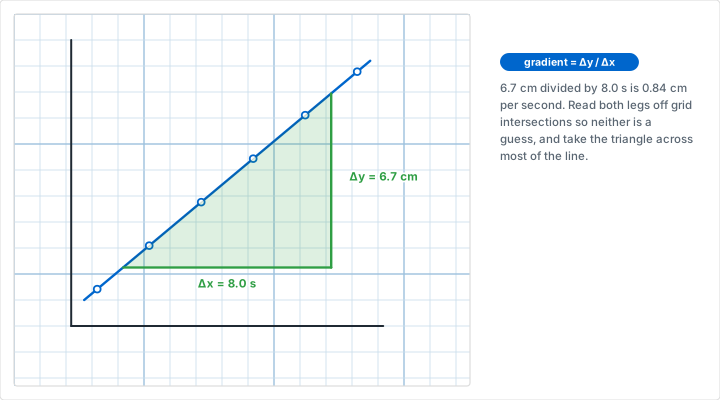
The slope of a straight-line graph is often the quantity you actually want from the experiment. To measure it, choose two points on your best-fit line (not raw data points) that are far apart, near the two ends of the line. Read their coordinates carefully.
The slope is the change in y divided by the change in x, commonly written as "rise over run":
- Slope = (y₂ − y₁) / (x₂ − x₁)
- Pick widely spaced points so small reading errors have little effect on the result.
- Draw a faint triangle (the "gradient triangle") on the graph connecting your two points, and label the rise and run. This shows your work and lets a marker verify it.
Because you used points on the line rather than scattered data, the slope reflects the trend rather than any single noisy measurement. This is exactly why a best-fit line is worth drawing carefully.
Reading the Slope as a Physical Quantity
The slope is not just a number. Its units come from dividing the y-axis units by the x-axis units, and those units tell you what the slope means.
- On a distance-versus-time graph, slope has units of meters per second, so the slope is the speed.
- On a velocity-versus-time graph, slope has units of meters per second squared, so the slope is the acceleration.
- On a force-versus-extension graph, slope has units of newtons per meter, so the slope is the spring constant.
- On a voltage-versus-current graph, slope has units of ohms, so the slope is the resistance.
This is the payoff of careful labeling. When your axes carry correct units, the slope's units fall out automatically, and you can state your result as a real measured physical constant rather than an abstract number.
Error Bars and Uncertainty
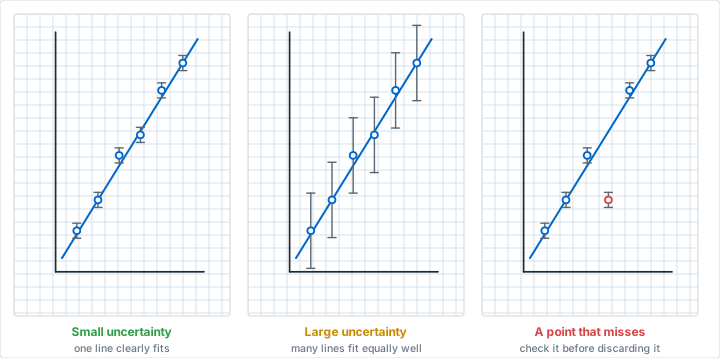
Real measurements have uncertainty, and a careful lab graph shows it. An error bar is a short line drawn through a data point that extends to show the range the true value might occupy. If you measured a temperature as 84 degrees with an uncertainty of plus or minus 1 degree, the vertical error bar runs from 83 to 85.
Error bars serve two purposes. First, they communicate how trustworthy each point is. Second, they let you judge your best-fit line honestly: a good line should pass through (or very close to) most of the error bars. If your line misses many bars entirely, either the line is wrong or the uncertainties are underestimated.
Slope Uncertainty From Error Bars
To estimate the uncertainty in your slope, draw two extra lines in addition to the best fit: the steepest line and the shallowest line that still pass through most of the error bars. The difference between their slopes gives a rough uncertainty range for your measured quantity. This simple technique turns a hand-drawn graph into a genuine uncertainty analysis.
Linear, Semi-Log, and Log-Log Paper
Standard square graph paper works when the relationship between your variables is linear, or when a simple curve is acceptable. But some relationships are far easier to read on logarithmic paper, where one or both axes use a logarithmic scale instead of an evenly spaced one.
When to Reach for Log Paper
- Exponential relationships (radioactive decay, bacterial growth, capacitor discharge) plot as a straight line on semi-log paper, where the y-axis is logarithmic and the x-axis is linear. A straight line on semi-log paper confirms exponential behavior, and its slope relates to the growth or decay constant.
- Power-law relationships (where y is proportional to x raised to some power) plot as a straight line on log-log paper, where both axes are logarithmic. The slope of that line equals the exponent of the power law.
- Data spanning many orders of magnitude (from 0.01 to 10,000, say) fits comfortably on a log axis, where a linear axis would compress the small values into invisibility.
The advantage is that a straight line is much easier to draw, read, and analyze than a curve. Converting a curved exponential or power relationship into a straight line is a standard technique in physics and chemistry labs. To plot these, print logarithmic graph paper with the right number of decades for your data range, then plot your values directly against the printed log scale without doing any logarithm arithmetic yourself.
Bar Charts and Histograms on a Grid
Not all lab data is a scatter of points waiting for a line. When you are comparing categories or showing a distribution, a bar chart or histogram on graph paper is the right tool, and the grid makes the bars easy to size accurately.
- Bar charts compare separate categories, such as reaction times across different temperatures or yields from different catalysts. Draw bars of equal width with gaps between them, and use the gridlines to set each bar's height precisely.
- Histograms show how a continuous measurement is distributed, such as the spread of leaf lengths in a sample. Bars sit directly against each other with no gaps, because the x-axis represents a continuous range divided into intervals (bins).
For both, choose a vertical scale the same way you would for a line graph: pick convenient units per square and spread the bars across the grid. Heavy gridlines at regular intervals make it easy to read a bar's value without a ruler. Our engineering graph paper, with bold lines every few squares, is well suited to this.
Neat Lab-Notebook Practice
A graph is part of a scientific record, and it should be neat enough that someone else could read and reproduce it. Good habits make grading easier and, more importantly, make your own data trustworthy weeks later.
- Give every graph a descriptive title stating exactly what is plotted against what.
- Label both axes with quantity and unit in the "Quantity / unit" form.
- Number the gridlines at regular, convenient intervals.
- Plot points as fine crosses or circled dots, never heavy blobs.
- Draw a single best-fit line or smooth curve, not a connect-the-dots zigzag.
- Show your gradient triangle when you calculate a slope.
- Include error bars when you have estimated uncertainties.
- Tape or glue the graph into your notebook securely, or rule the grid directly onto the page.
If you draw graphs often, keep a small stock of printed sheets in your lab folder. Standard square grid covers most line graphs, bar charts, and histograms. Keep a few sheets of logarithmic paper for the exponential and power-law cases. To understand the broader role graph paper plays across disciplines, see what is graph paper.
Common Mistakes
Mistake 1: Squished Scales
Problem: Choosing a scale that crowds all the data into one corner or a thin strip of the grid. The trend becomes impossible to read, and slope measurements lose precision because the points are too close together.
Fix: Find your maximum value on each axis, divide the available squares by it, and round to a convenient 1, 2, or 5 units per square. Aim to fill at least half the grid in both directions.
Mistake 2: Missing or Vague Units
Problem: Axes labeled "Time" and "Distance" with no units, or no labels at all. The graph cannot be interpreted, and the slope has no meaning because its units are unknown.
Fix: Always label axes as "Quantity / unit." Then the slope's units, and therefore its physical meaning, follow automatically when you divide y units by x units.
Mistake 3: Connect-the-Dots Instead of Best Fit
Problem: Joining each point to the next with straight segments, producing a jagged line that treats every measurement as exact and exaggerates random scatter.
Fix: Draw a single best-fit line or smooth curve that balances points above and below it. Let individual points scatter around the line; that scatter is the experimental uncertainty made visible.
Mistake 4: Reading Slope From Raw Data Points
Problem: Calculating the slope from two of your plotted measurements rather than from the best-fit line. A single noisy point then throws off the whole result.
Fix: Read your two slope points off the best-fit line itself, choosing widely spaced points near the ends. Draw a gradient triangle to show the rise and run you used.
Conclusion
Graphing lab data by hand is a skill that pays off across every science course and well beyond. Choose your axes deliberately, set a generous scale, label everything with units, plot precise points, and draw a single honest best-fit line. Read the slope with its units and you have measured a real physical quantity. Show your uncertainty with error bars, and reach for logarithmic paper when the relationship is exponential or power-law. Master these steps on paper and you will read every graph, including the ones a computer draws, with a sharper, more critical eye. For more on plotting and coordinate work, explore our math graphing tutorial and our math month resources.
Ready to Plot Your Lab Data?
Generate custom graph paper for your experiment. Choose your grid spacing, paper size, and line weight, then print as many copies as you need.
Generate Custom Graph PaperRelated Resources
- How to Choose the Right Grid Size
- Logarithmic Graph Paper -- for exponential and power-law data
- Engineering Graph Paper -- bold lines for reading values quickly
- Sketching Circuits on Graph Paper -- laying out the bench hardware the data came from
- Math Graphing Tutorial -- plotting equations and coordinates
- Math Month -- graphing and math activities
- Organic Chemistry Structures on Hexagonal Paper -- the drawing half of a chemistry course
- Back-to-School Graph Paper -- what each subject needs
- Graph Paper Use Cases Across Industries
- Professional Printing Tips