Penmanship and Handwriting Practice on Graph Paper
Neat handwriting comes down to consistency: letters that are the same height, sit on the same line, lean the same direction, and keep even space between them. That is a lot to control all at once, especially for a child still learning or a writer working to undo years of messy habits. Graph paper turns those invisible rules into visible boxes. Each square becomes a target. A letter starts here, stops there, sits on this line, and reaches up to that one. The grid does the measuring so the hand can focus on the movement. Whether you are a parent helping a kindergartner form letters, a teacher building a handwriting station, or an adult who simply wants legible notes, graph paper is one of the most effective and affordable practice tools available.
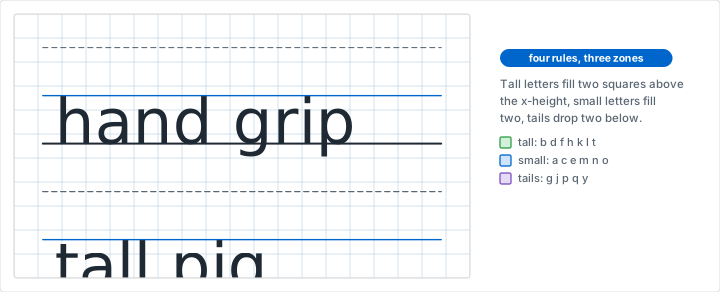
Why Graph Paper Helps Handwriting
Plain lined paper gives you a baseline and not much else. Blank paper gives you nothing. Graph paper gives you a two-dimensional reference grid, and that extra dimension is exactly what handwriting needs.
- Built-in height guides: The horizontal lines let you assign a fixed number of squares to tall letters, short letters, and letters that hang below the line.
- Built-in width guides: The vertical lines control how wide each letter is and how much space sits between letters and words.
- Consistent sizing: When every letter occupies the same number of squares, the writing instantly looks more uniform.
- Straight baselines: Words stop drifting uphill or sliding off the edge of the page because the grid keeps them level.
- A clear target for young hands: "Start in this box and stop in that box" is far easier for a child to follow than "make it medium-sized."
- Free and reprintable: Print fresh practice sheets from our generator in any grid size, as many as you need.
None of this replaces good instruction or steady practice. But the grid removes a layer of guesswork, and that lets the writer spend their attention on letter shapes and smooth motion instead of constantly judging size and placement by eye.
Understanding the Four Writing Zones
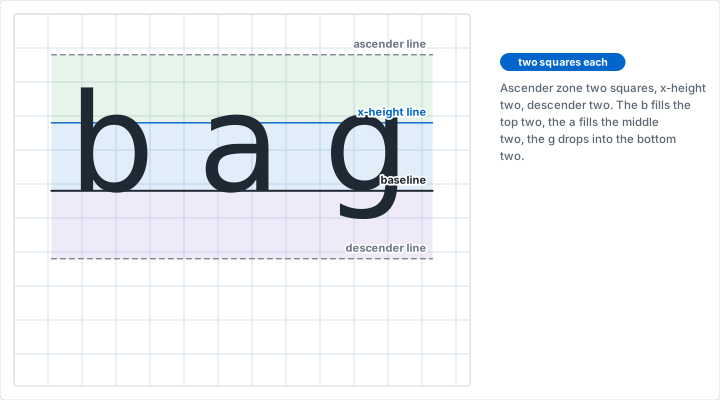
Good handwriting is organized around four reference lines that define three zones. Learning these zones is the single most useful concept for improving letter consistency, and graph paper makes each one a countable number of squares.
Baseline, X-Height, Ascenders, and Descenders
- Baseline: The line every letter sits on. Treat one horizontal grid line as your permanent baseline.
- X-height: The height of a lowercase letter with no tall or hanging parts, like a, c, e, m, and the body of the letter x. This is the core size of your writing.
- Ascender: The tall part that reaches above the x-height, found in b, d, f, h, k, l, t, and every capital letter.
- Descender: The tail that drops below the baseline, found in g, j, p, q, and y.
Assigning Squares to Each Zone
A simple and reliable scheme is to give the x-height two squares, the ascender zone two more squares above that, and the descender zone two squares below the baseline. With this layout:
- Lowercase a, c, e, o: Fill the two x-height squares only.
- Lowercase b, d, h, l, capitals: Start two squares above the x-height and come down to the baseline (four squares tall).
- Lowercase g, p, y: Fill the x-height and drop two squares below the baseline.
Mark Your Lines First
Before writing, trace over the baseline and the x-height line with a colored pencil or highlighter. Two reference lines in color stand out from the rest of the grid, so the eye locks onto where letters should sit and stop. Many teachers use one color for the baseline and a second, lighter color for the x-height.
Controlling Letter Size and Consistency
The most common handwriting complaint is uneven letter size: some letters tower over their neighbors, others shrink, and capitals are no taller than lowercase. Graph paper fixes this by making size a counting task rather than a judgment call.
Pick your square budget and stick to it across the whole page. If lowercase letters are two squares tall, they are always two squares tall, on every line, in every word. Capitals and ascenders are always four. The writer is no longer estimating; they are matching the grid. After a few pages, the proportions start to feel automatic, and that internalized sense of size is what eventually carries over to unlined paper.
Square-by-Square Letter Formation
For beginners, you can break a single letter into the squares it touches and the order the strokes follow. A lowercase letter like n, for example, starts at the top-left of its two-square box, comes straight down to the baseline, retraces up, arches over to the right, and comes back down. Describing letters as movements between grid corners gives a child concrete landmarks: "down to the line, back up, over and down." The grid becomes a shared vocabulary between teacher and learner.
Spacing Between Letters and Words
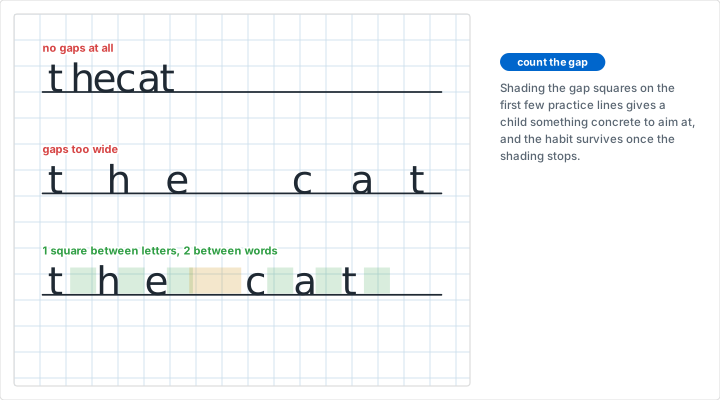
Sizing is only half of legibility. Spacing is the other half, and it is where graph paper truly shines, because horizontal space is now measured in countable squares instead of guessed by feel.
Letter Spacing
Within a word, letters should sit close but not touching. A good starting rule is to leave a consistent gap, often part of a square or a full thin square, between the end of one letter and the start of the next. The exact amount matters less than the consistency. When every gap is the same, the word reads as a single unit instead of a jumble.
Word Spacing
Between words, leave a wider, fixed gap, commonly one full square or the width of a lowercase letter. Children often run words together or leave wildly uneven gaps, and "skip one box between words" is a rule they can actually see and follow. Counting the empty square is far easier than judging the abstract "finger space" many of us were taught.
The spacing hierarchy: Smallest gaps go between letters in a word, larger fixed gaps go between words, and the largest gaps go between sentences. Graph paper lets you assign each level a specific number of squares so the rhythm of the text stays even down the whole page.
Teaching Children to Write Neatly
For young learners, graph paper is a patient, forgiving coach. It sets clear boundaries without nagging, and it gives instant visual feedback when a letter wanders out of its box.
Start Big, Then Shrink
Young children have developing fine-motor control, so begin with a large grid where each letter fills a generously sized box. Big squares forgive imprecise movements and let the child succeed early. As control improves over weeks and months, gradually move to smaller grids. This staircase from large to small mirrors the natural development of motor skills, and our grid size guide can help you pick each step.
One Skill at a Time
Resist the urge to fix everything at once. Spend one session on baseline (every letter sits on the line), the next on x-height (lowercase letters reach the same height), the next on capitals and ascenders, and a later one on spacing. The grid keeps the unpracticed skills "good enough" while the child focuses on the target skill. Layering skills one at a time prevents the frustration that comes from trying to control size, slant, and spacing all in the same breath.
Make It a Game
Turn practice into a counting challenge. "Can every letter in this word touch the baseline?" or "Can you keep exactly one empty box between every word?" Framing handwriting as a target-hitting game keeps young writers engaged far longer than rote copying. Celebrate the rows that line up neatly.
Supporting Dysgraphia and Motor-Control Challenges
Dysgraphia is a learning difference that affects the physical act of writing. People with dysgraphia often struggle with letter sizing, spacing, staying on the line, and the heavy cognitive load of coordinating all of these at once. Graph paper is frequently recommended by occupational therapists and special educators as a low-cost support because it externalizes the rules the writer would otherwise have to hold in their head.
- Sizing support: Boxes give a concrete boundary, so letters that tend to balloon or shrink have a built-in container.
- Spacing support: Counting empty squares between words replaces the difficult judgment of "how much space looks right."
- Alignment support: The grid keeps writing from drifting off the line, a common and frustrating dysgraphia challenge.
- Reduced cognitive load: When the grid handles placement, the writer has more attention left for spelling and content.
Grid size matters a great deal here. Too small and the boxes add stress; too large and the writing feels childish for an older student. Experiment to find the size that feels supportive rather than constraining, and adjust as confidence grows. The same approach helps anyone working through tremor, fatigue, or fine-motor difficulty, not only those with a formal diagnosis. Always follow the guidance of an occupational therapist or specialist when one is involved.
Practicing Numbers and Aligning Columns
Handwriting is not only letters. Numbers need the same consistency, and they carry an extra requirement: they have to line up in columns so arithmetic works. This is where graph paper crosses over from penmanship into math.
Number Formation
Practice digits using the same zone scheme as capital letters, with each number filling a consistent box. Numbers like 7 and 1 are easy to make too small; the grid keeps them the same height as their neighbors. Watch for the common reversals (3 facing the wrong way, a backward 5) and use the grid corners as starting-point landmarks, just as with letters.
Aligning Math Columns
One digit per square is the rule that makes graph paper indispensable for arithmetic. When ones line up under ones and tens under tens, carrying and borrowing become reliable. Long multiplication and long division stop collapsing into misaligned chaos. Many students who "are bad at math" are actually being defeated by misaligned columns, and a grid solves that overnight. Our math graphing tutorial goes deeper into using the grid for calculation and plotting.
One digit, one box: Have students write each digit of a number in its own square, decimal points on the grid lines, and operators in their own boxes. The vertical lines then guarantee that place values stack correctly, which is half the battle in elementary arithmetic.
Cursive Practice and Slant Guides
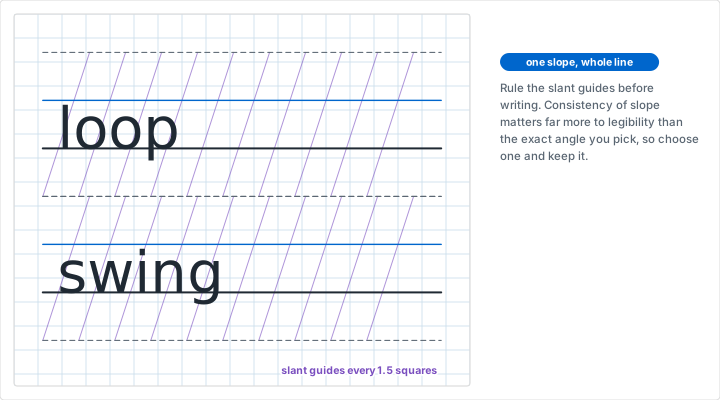
Cursive adds a new variable: slant. Letters lean forward at a consistent angle, and inconsistent slant is what makes cursive look messy even when the letters themselves are well formed. Graph paper supports cursive in two ways.
Using the Vertical Lines as Slant References
The vertical grid lines give you a fixed upright reference. You can either keep cursive perfectly upright against them, or, more commonly, draw diagonal slant guides at a consistent angle across the page using the grid intersections as anchor points. Connect the same corner of each box, for example the bottom-left to a point two squares up and one square over, and repeat the line across the sheet. These evenly spaced diagonals give every letter the same lean.
Connecting Strokes and Rhythm
Cursive lives and dies by even connecting strokes between letters. The horizontal squares help you keep those joins a consistent width, so the writing flows at a steady rhythm rather than bunching and stretching. Practice the connecting stroke itself, the small upstroke that links one letter to the next, as its own drill across a row of boxes before combining full letters. For decorative, artistic lettering rather than everyday cursive, see our companion article on calligraphy and hand lettering, which covers nib angles, flourishes, and ornamental styles.
Choosing the Right Grid Size
Grid size is the most important decision for handwriting practice, because it has to match the writer's age, hand size, and current skill. Too large wastes a page and feels babyish; too small frustrates developing motor control. Here are practical starting points.
- Large grid, 1 inch or 2cm: Best for preschoolers and kindergartners just learning letter shapes. Generous boxes forgive shaky hands.
- Medium grid, 1/2 inch or 1cm: A versatile choice for early elementary students and for anyone rebuilding handwriting habits. Big enough for control, small enough for real words.
- Standard grid, 1/4 inch or 5mm: Suits older elementary students, teens, and adults whose handwriting is reasonably developed. Two squares for x-height works well at this size.
- Fine grid, 1/8 inch or 2mm: For advanced practitioners refining small, neat handwriting, or for fitting more practice on a page. Use sparingly with younger writers.
- Dot grid: A gentler option that gives placement reference without the visual heaviness of full lines. Good for transitioning away from boxes. See dot grid paper for options.
When in doubt, start one size larger than you think you need. It is easy to step down to a smaller grid as skill grows, and early success builds the confidence that keeps a reluctant writer practicing. Read more about what graph paper is and how different grid types behave if you are choosing for the first time.
Transitioning to Lined and Blank Paper
Graph paper is a training tool, not a permanent destination. The goal is handwriting that stays neat once the grid is gone. Plan the handoff deliberately rather than abruptly.
- Step 1, full grid: Practice with both horizontal and vertical lines guiding height and width.
- Step 2, dot grid: Move to dots, which suggest the grid without enforcing it. The writer begins to internalize spacing.
- Step 3, lined paper: Drop to horizontal lines only. Height is still guided, but width and spacing now rely on the habits built earlier.
- Step 4, wide-ruled to narrow-ruled: Shrink the line spacing as control improves.
- Step 5, blank paper: Write with no guides at all. If the earlier steps went well, neat sizing and spacing carry over.
Move down a step only when the current one feels comfortable, and do not be afraid to step back up for a refresher when handwriting starts to slip. The grid is always there to recalibrate.
Common Mistakes
Mistake 1: A Grid That Is Too Small
Problem: Handing a young child fine 5mm graph paper because it looks "grown up." Small boxes overwhelm developing motor control, and the child cramps, presses too hard, and gives up.
Fix: Start large, with 1-inch or 1cm squares, and shrink the grid gradually over weeks as control improves. Match the box to the hand, not to the age on paper.
Mistake 2: Practicing Everything at Once
Problem: Trying to fix size, slant, spacing, and letter shape all in a single session. The writer cannot focus, and nothing improves.
Fix: Isolate one skill per session. Let the grid hold the others steady while the writer concentrates on a single target, then layer the skills together once each is solid.
Mistake 3: Ignoring the Zones
Problem: Writing every letter the same height, so capitals do not stand out and descenders never drop below the line. The result looks flat and is hard to read.
Fix: Assign squares to each zone, two for x-height, two above for ascenders and capitals, two below for descenders, and hold to that scheme on every line.
Mistake 4: Staying on the Grid Forever
Problem: Practicing only on graph paper, so neat handwriting depends entirely on the boxes and falls apart on lined or blank paper.
Fix: Plan the transition. Move from full grid to dot grid to lined paper to blank paper, stepping down only when the current level feels easy and natural.
Tips for Better Practice
Keep Sessions Short
Handwriting is a physical skill, and tired hands form sloppy letters. Ten focused minutes beats an hour of fatigue. End each session while the writing still looks good, so the last impression is a successful one.
Use a Model Line
Write or print one clean example line at the top of the sheet, then practice copying it down the page. The model sits in the same grid, so the writer can compare box for box and spot exactly where their letters drift.
Trace, Then Copy, Then Write
For beginners, start by tracing letters you have lightly drawn in the boxes, then copy them in the next row, then write from memory. The grid keeps placement consistent across all three stages so the muscle memory transfers cleanly.
Watch the Pencil Grip and Posture
The grid cannot fix a cramped grip or a slumped posture. A relaxed tripod grip, paper tilted slightly, and feet on the floor do as much for neat handwriting as any practice sheet. Check these basics before blaming the letters.
Conclusion
Neat handwriting is a set of consistent habits: same height, same baseline, same slant, same spacing. Graph paper makes every one of those habits visible and countable, turning vague advice like "write neater" into concrete targets a hand can actually aim for. Whether you are guiding a child through their first letters, supporting a student with dysgraphia, or sharpening your own everyday penmanship, the grid is a patient and affordable coach. Start with a comfortable square size, isolate one skill at a time, and plan a gradual handoff to lined and blank paper. Print a fresh sheet and write a single neat line today; the consistency builds faster than you expect.
Ready to Start Practicing?
Generate custom graph paper sized for your writer. Choose your grid spacing, paper size, and line weight, then print as many practice sheets as you need.
Generate Custom Graph PaperRelated Resources
- How to Choose the Right Grid Size
- Dot Grid Paper -- a gentle step toward lined and blank paper
- Calligraphy and Hand Lettering -- for decorative, artistic styles
- Math Graphing on Graph Paper -- aligning numbers and columns
- Bullet Journaling with Graph Paper
- Graph Paper Use Cases Across Industries
- Graph Paper and the Analog Revival