Using Graph Paper for Calligraphy and Hand Lettering Practice
Calligraphy has been called the mindfulness trend to watch in 2026. In an era of AI-generated text and disposable digital content, the deliberate act of forming letters by hand is gaining traction as both a creative skill and a meditative practice. Graph paper provides the structure that makes practicing calligraphy and hand lettering productive rather than frustrating -- consistent baselines, measurable letter heights, and built-in spacing guides, all without buying specialized ruled paper.
Why Graph Paper Works for Lettering
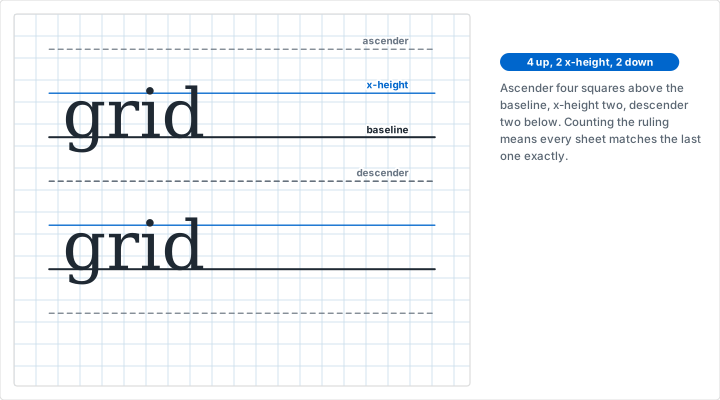
Calligraphy practice pads come pre-ruled with specific line sets: a baseline, an x-height line, ascender and descender lines. That's convenient, but it locks you into one proportion system. Graph paper gives you all of those reference lines at once -- you just choose which horizontal lines serve which purpose.
- Multiple reference lines: Every horizontal grid line is a potential baseline, x-height, ascender line, or descender line -- you define the proportions to match the script you're practicing
- Vertical guides included: The vertical grid lines help you maintain consistent letter widths, even spacing between characters, and uniform slant angles
- Cheaper than practice pads: A single sheet of graph paper replaces an entire calligraphy practice pad, and you can print as many copies as you need
- Fully customizable: Print exactly the grid size your tool and script require -- no compromising with whatever spacing the manufacturer chose
- Works for all skill levels: Children learning to write use the same grid structure that adults use for brush lettering -- just at different scales
Grid vs. Dot Grid for Calligraphy
Full grid lines are generally better than dot grid for calligraphy practice. The continuous horizontal lines give you a clear, unbroken baseline to follow. Dot grid works well for hand lettering where you're constructing letters as drawings, since the dots are less visually intrusive when you want to see the letter shapes clearly.
Understanding Letter Anatomy on the Grid
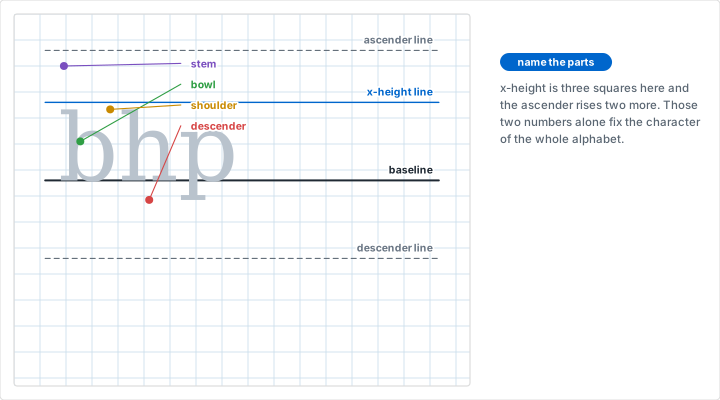
Before you start writing, you need to map calligraphy terminology to grid lines. Every script uses a system of horizontal reference lines that control letter proportions. On graph paper, each of these lines is simply a row you designate for that purpose.
- Baseline: The line letters sit on. Pick any horizontal grid line and use it consistently across the page. This is the most important reference -- every letter anchors here.
- X-height: The height of lowercase letters without ascenders or descenders -- letters like "a," "e," "o," and "x." Typically 2-3 squares above the baseline, depending on your script and grid size.
- Ascender line: The top of tall lowercase letters like "b," "d," "h," and "k." Usually 2 squares above the x-height line (4-5 squares total above the baseline).
- Descender line: The bottom of letters that drop below the baseline -- "g," "p," "y," and "q." Typically 1-2 squares below the baseline.
- Cap height: The top of uppercase letters. In most scripts, cap height equals or nearly equals the ascender line.
- Letter width: Vertical grid lines serve as width guides. Most lowercase letters in traditional scripts fit within a width roughly equal to the x-height, though this varies by letter and style.
Nib Width as a Measuring Unit
In traditional broad-edge calligraphy, letter proportions are measured in nib widths rather than fixed units. For example, Italic lowercase has an x-height of 5 nib widths. Before starting, make a "nib ladder" in the margin: stack squares of ink the width of your nib to see how many fit in your chosen x-height. Then adjust your grid line assignments so the x-height spans the correct number of nib widths.
Setting Up Your Practice Sheet
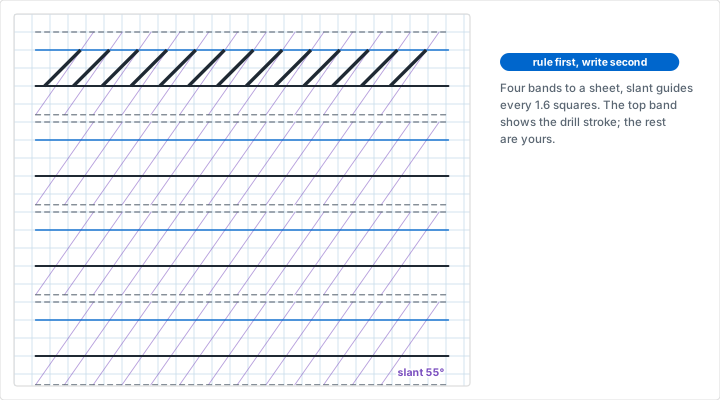
A well-prepared practice sheet eliminates guesswork and lets you focus entirely on stroke quality. Follow these steps each time you print a fresh sheet.
- Choose your grid size. Match the grid to your tool and script (see the next section for specific recommendations). As a starting point: 1/4-inch grid for standard dip pen practice, 1/2-inch grid for brush lettering, 1/8-inch grid for small technical calligraphy.
- Mark your baseline row. Use a colored pencil or fine marker to highlight one horizontal grid line as your baseline. Make it visually distinct from the rest of the grid.
- Count up for x-height. From the baseline, count up the number of squares your script requires (e.g., 3 squares up for a 3-square x-height). Mark or highlight this line in a different color.
- Count up for ascender height. Continue counting from the baseline to mark the ascender line (e.g., 5 squares total from the baseline). This line marks the top of letters like "b," "d," and "h."
- Count down for descender depth. From the baseline, count down 1-2 squares and mark the descender line. This is the lowest point for letters like "g," "p," and "y."
- Leave space between practice lines. Skip 1-2 blank rows between the descender line of one practice line and the ascender line of the next. This prevents letters from colliding between rows and gives you room for annotations.
- Use vertical lines for spacing. The vertical grid lines naturally guide letter width and the gaps between letters. You don't need to mark these separately -- just use them as visual references while writing.
Print Multiple Copies
Once you've determined the right grid size and proportions for your script, use the graph paper generator to print a stack of identical sheets. Calligraphy practice burns through paper quickly, and having a ready supply means you never hesitate to start a fresh sheet when the current one gets crowded.
Calligraphy Styles and Recommended Grid Sizes
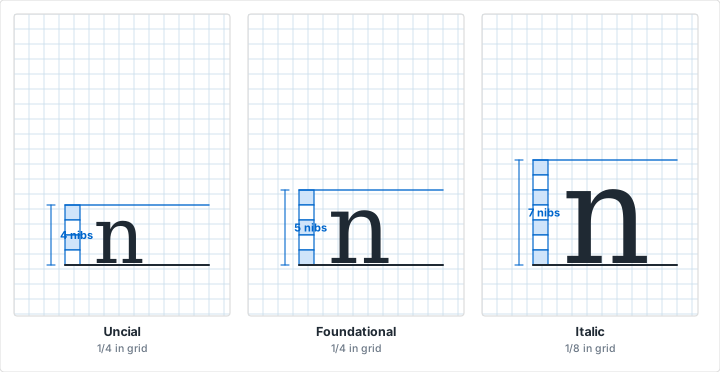
Different scripts demand different grid sizes because the tools and letter proportions vary. Here are the most common styles and the grid configurations that work best for each.
Copperplate and Spencerian
- Grid size: 1/8-inch grid
- Tool: Pointed nib dip pen (e.g., Nikko G, Hunt 101)
- X-height: 3-4 squares
- Slant: 55 degrees from the baseline. On a 1/8-inch grid, the diagonal of a 1x2 rectangle of squares gives you approximately 63 degrees -- close enough for practice. For a more precise 55-degree guide, mark dots and connect them with a straightedge.
- Key feature: Thick downstrokes, hairline upstrokes. The fine grid helps you maintain consistent letterform proportions at the small scale these scripts typically use.
Italic
- Grid size: 1/4-inch grid
- Tool: Broad-edge nib (e.g., Pilot Parallel Pen, Brause nibs)
- X-height: 5 nib widths (adjust grid lines to match)
- Slant: 5-12 degrees from vertical. The subtle forward lean is easy to gauge against vertical grid lines -- you're looking for letters that tilt just slightly off the vertical.
- Key feature: Branching arches that spring from the stem at the x-height midpoint. Grid lines help you place this branching point consistently.
Modern Brush Lettering
- Grid size: 1/2-inch grid
- Tool: Brush pen (e.g., Tombow Fudenosuke, Pentel Sign Brush)
- X-height: 2-3 squares
- Slant: Variable -- modern brush lettering is more expressive and less rigidly slanted than traditional scripts.
- Key feature: The larger grid squares accommodate the broader strokes of brush pens and give your hand room to move. Brush pens require arm movement, not just finger movement, and a cramped grid restricts that.
Gothic / Blackletter
- Grid size: 1/4-inch grid
- Tool: Broad-edge nib or flat marker
- X-height: 5 nib widths
- Slant: Vertical (no slant). Gothic letters are built from straight vertical and diagonal strokes.
- Key feature: Highly geometric letterforms constructed from measured pen widths. The grid is especially useful here because Gothic letters are essentially built on a grid -- each stroke occupies a specific number of nib widths in height and width.
Children's Handwriting Practice
- Grid size: 1/2-inch or larger
- Tool: Thick pencil or primary-size marker
- X-height: 1-2 squares (at 1/2-inch grid, letters are 1/2 to 1 inch tall)
- Key feature: Large, forgiving squares that accommodate the less precise motor control of young writers. One letter per square keeps sizing consistent.
For detailed guidance on selecting the right grid spacing for your needs, see our guide to choosing grid size.
Practice Exercises
Structured drills build muscle memory faster than freewriting. Work through these exercises in order, spending at least 10 minutes on each before moving to the next.
Exercise 1: Straight Downstrokes
Fill an entire column of squares with vertical downstrokes. Each stroke should start at the ascender line and end at the baseline (or from x-height to baseline for shorter strokes). Focus on:
- Consistent pressure: Every stroke should be the same thickness
- Parallel lines: Use the vertical grid lines as a reference -- your strokes should be parallel to them (or at your script's slant angle)
- Even spacing: Place one stroke per grid column for uniform gaps
- Smooth movement: Pull the pen toward you in one fluid motion, not a shaky crawl
Exercise 2: Curves and Ovals
Practice fitting oval shapes into a 2-wide by 3-tall area of grid squares (adjust proportions for your x-height). These ovals form the basis of letters like "o," "c," "e," and "a." Focus on making each oval the same size and shape, using the grid boundaries as your target area.
Exercise 3: Connecting Strokes
Practice the transitions between letters -- the upstrokes that link the exit of one letter to the entry of the next. In pointed pen scripts, these are hairline upstrokes. In brush lettering, they're thin connecting sweeps. Use the grid to keep connections at a consistent height (typically at or near the baseline).
Exercise 4: Full Alphabet Practice
Dedicate one practice line to each letter. Write the letter 3-5 times across the row, using the grid for consistent sizing and spacing. Group letters by structural similarity:
- Round letters: o, c, e, a, d, g, q
- Straight-stroke letters: i, l, t, h, k, b
- Diagonal letters: v, w, x, y, z
- Compound letters: m, n, u, r, s, f
Exercise 5: Word Spacing
Write short words and sentences, leaving a consistent number of grid squares between words. A good starting rule: leave a gap equal to the width of the letter "o" in your script. On the grid, that translates to a specific number of empty squares you can count and replicate.
Exercise 6: Number Practice
Numbers are often overlooked in calligraphy practice, but they're essential for addressing envelopes, creating table numbers, and writing dates -- all common calligraphy applications. Practice 0-9 in a row, using the grid to keep consistent heights and widths. Numbers in most scripts sit between the baseline and cap height.
Hand Lettering vs. Calligraphy: How the Grid Helps Each
These two disciplines are often confused, and graph paper serves each one differently.
Calligraphy
Calligraphy is writing with a specialized tool -- a dip pen, brush pen, or flat marker -- where the tool itself creates thick and thin stroke variation based on pressure or angle. The grid guides calligraphy by providing consistent baselines and x-heights so your letterforms stay uniform as you write.
Hand Lettering
Hand lettering is drawing letters. You build each character with multiple strokes, often sketching an outline first and then filling it in. Hand lettering is more illustrative and less bound to a single tool. You can use any pen, pencil, or marker -- the variation comes from your drawing, not from the tool.
The grid helps hand lettering by providing a structural framework for constructing letter shapes. You can plan the overall dimensions of each letter, sketch guidelines for consistent stroke widths, maintain uniform proportions across a word, and align baselines across an entire phrase or composition. Many hand letterers pencil their layout on graph paper first, then trace or transfer the finished design to final media.
Which to Start With
If you're new to both, start with brush pen calligraphy on a 1/2-inch grid. Brush pens are more forgiving than dip pens, the larger grid gives you room to work, and the immediate thick-thin variation is satisfying from the first stroke. Move to hand lettering once you understand letter anatomy, since lettering requires you to already know what well-formed letters look like.
For Children: Handwriting Practice on Graph Paper
Graph paper solves several common handwriting problems that children encounter. Parents and teachers can use printed graph paper sheets as an affordable, endlessly renewable alternative to handwriting workbooks.
How the Grid Helps Young Writers
- One letter per square: Assigning each letter its own grid square forces consistent sizing. Children naturally tend to make letters smaller as they write across the page -- the grid stops this drift.
- Larger grid for younger children: Use a 1/2-inch or 3/4-inch grid for children in grades K-2. The oversized squares match the less precise motor control of small hands and thick primary pencils.
- Clear baseline reference: The bottom of each square serves as the baseline. Children can see exactly where each letter should sit.
- Number formation: Grid squares are especially helpful for learning to write numbers, since most digits fit neatly within a single square. Children who reverse numbers (writing "5" backwards, for instance) benefit from the spatial reference the grid provides.
- Transition to smaller writing: As motor skills develop, move to a 1/4-inch grid. The structure stays the same -- only the scale changes.
- Left-handed accommodation: Graph paper works equally well for left-handed children, who often struggle with lined paper because their hand covers the text they've already written. The grid squares give spatial reference from all directions, not just from the left margin.
Practice Activities for Children
- Letter tracing: Write a model letter in the first square of each row. Have the child copy it across the remaining squares, using the grid for consistent sizing.
- Name practice: Children are most motivated to write their own name. Assign one square per letter and have them write it repeatedly across rows.
- Copy sentences: For older children (grades 2-4), write a sentence on one line and have them copy it on the line below, matching letter placement square by square.
Graph Paper for Learning Beyond Letters
The same grid that helps with handwriting also helps with early math. Children can use graph paper for number lines, simple addition and subtraction, and basic graphing. See our math graphing tutorial for more ideas.
Tips for Better Practice
- Warm up with basic strokes before letters. Spend 5 minutes on downstrokes, upstrokes, and ovals before writing any actual letters. Cold starts produce shaky lines.
- Work slowly. Calligraphy is about control, not speed. A slow, smooth stroke is always better than a fast, uneven one. Speed comes naturally after hundreds of repetitions.
- Print fresh sheets regularly. Don't cram practice onto a crowded sheet. Use the graph paper generator to print a new sheet whenever you need one -- clean reference lines keep your practice accurate.
- Practice one letter family at a time. Group letters by shared structural elements: all round letters in one session, all straight-stroke letters in the next. This builds pattern recognition faster than random practice.
- Use vertical grid lines to check slant consistency. After writing a line of text, hold the page at arm's length and compare your letter slants against the vertical grid lines. Inconsistent slant is the most common beginner problem, and the grid makes it immediately visible.
- Date every practice sheet. Write the date in the corner before you start. Looking back through a stack of dated sheets shows your progress in a way that feels tangible and motivating.
- Practice on both sides of the paper. If your ink doesn't bleed through, flip the sheet over and use the back. The grid is usually visible enough through the page to guide your letterforms on the reverse side.
Common Mistakes
Grid Too Small for Your Tool
Problem: You're using a large brush pen on a 1/8-inch grid, and the strokes cover multiple grid squares, making the reference lines useless.
Solution: Match the grid size to your tool. Large brush pens need 1/2-inch or larger squares. Fine-tipped dip pens work on 1/8-inch or 1/4-inch grids. If your strokes are wider than one grid square, the grid is too small.
Skipping Basic Strokes
Problem: Jumping straight to writing words or sentences without practicing individual strokes first. Letters look inconsistent because the fundamental movements aren't in your muscle memory.
Solution: Spend at least one full practice session on just downstrokes and ovals before attempting letters. It feels tedious, but it's the fastest path to consistent letterforms. Professional calligraphers return to basic stroke drills regularly.
Inconsistent Baseline
Problem: Letters drift above or below the baseline, and words have an uneven, wavy appearance.
Solution: Always mark your baseline explicitly with a colored pencil before you start writing. Don't rely on mentally tracking which grid line is the baseline -- make it visually distinct. If letters still drift, slow down and consciously anchor each letter's lowest point on the marked line.
Gripping the Pen Too Tightly
Problem: A death grip on the pen produces stiff, shaky strokes and causes hand fatigue within minutes.
Solution: Let the grid handle alignment so your hand can focus on stroke quality. The whole point of practicing on graph paper is that the structure is external -- it's on the page, not in your tense fingers. Hold the pen lightly, let it rest on the crook between your thumb and index finger, and move from your arm rather than your fingers.
Conclusion
Graph paper turns calligraphy practice from guesswork into a measurable skill-building process. The grid gives you baselines, x-heights, ascender lines, descender lines, and spacing guides all on a single sheet -- no specialized practice pads required. Whether you're learning Copperplate on a 1/8-inch grid, exploring brush lettering on a 1/2-inch grid, or helping a child form their first letters on oversized squares, the underlying approach is the same: let the grid handle structure so you can focus on the strokes.
Print a stack of sheets, pick up your pen, and start with downstrokes. The grid is waiting.
Ready to Practice Calligraphy?
Generate custom graph paper sized for your calligraphy style. Try 1/4-inch grid for broad-edge scripts or 1/2-inch grid for brush lettering.
Create Graph Paper NowRelated Resources
- How to Choose the Right Grid Size
- Dot Grid Paper Guide
- Bullet Journaling with Graph Paper
- Professional Printing Tips
- Graph Paper Use Cases
- Design Sketching Tutorial
- Pumpkin Carving Patterns on Graph Paper: lettering with bridges, so the middle of an O stays put